One-to-One
For professionals and researchers with work already under way, in Bangladesh or abroad. We build a plan around your project, your deadline, and your starting point, and classes begin when you approve it.
Mentorship and Consultancy
Real papers. Real datasets. A mentor who does statistics for a living. From your first research question to results you can defend under review, we teach you the whole study: one-to-one, in a small cohort, or in a live class.
 R
R  Python
  SPSS
SPSS  Stata
Stata  Excel
Excel  Power BI
 Mentorship
Every format is taught live by a working statistician. The difference is how closely the teaching follows your own project: completely in one-to-one, through a study of your own in the Research Cohort, and through a shared course in a batch.
For professionals and researchers with work already under way, in Bangladesh or abroad. We build a plan around your project, your deadline, and your starting point, and classes begin when you approve it.
Three to five students, one mentor, three months. You learn methodology, statistics, and software together, and each of you completes a study of your own, with a certificate anyone can verify.
A live course for fifty to a hundred students on a set subject, such as research methodology. Structured, built on real published research, and open to questions in every class.
Not sure which fits? Tell us what you want to learn and we will recommend one. Request a learning plan.
What you learn
Not a list of formulas, and not a software tour. We teach research itself: what a study asked, whether its design could answer it, and what its numbers can and cannot show.
Framing the question, choosing the design, measuring well, picking the method, and building the tables, right through to the methods section you will have to defend.
Every idea starts from a published paper or a real dataset before any formula appears, so it still makes sense long after the class ends.
SPSS, R, Stata, Python, or Excel, learned by rebuilding results you already understand, in the tool you will actually use.
Inside a real class
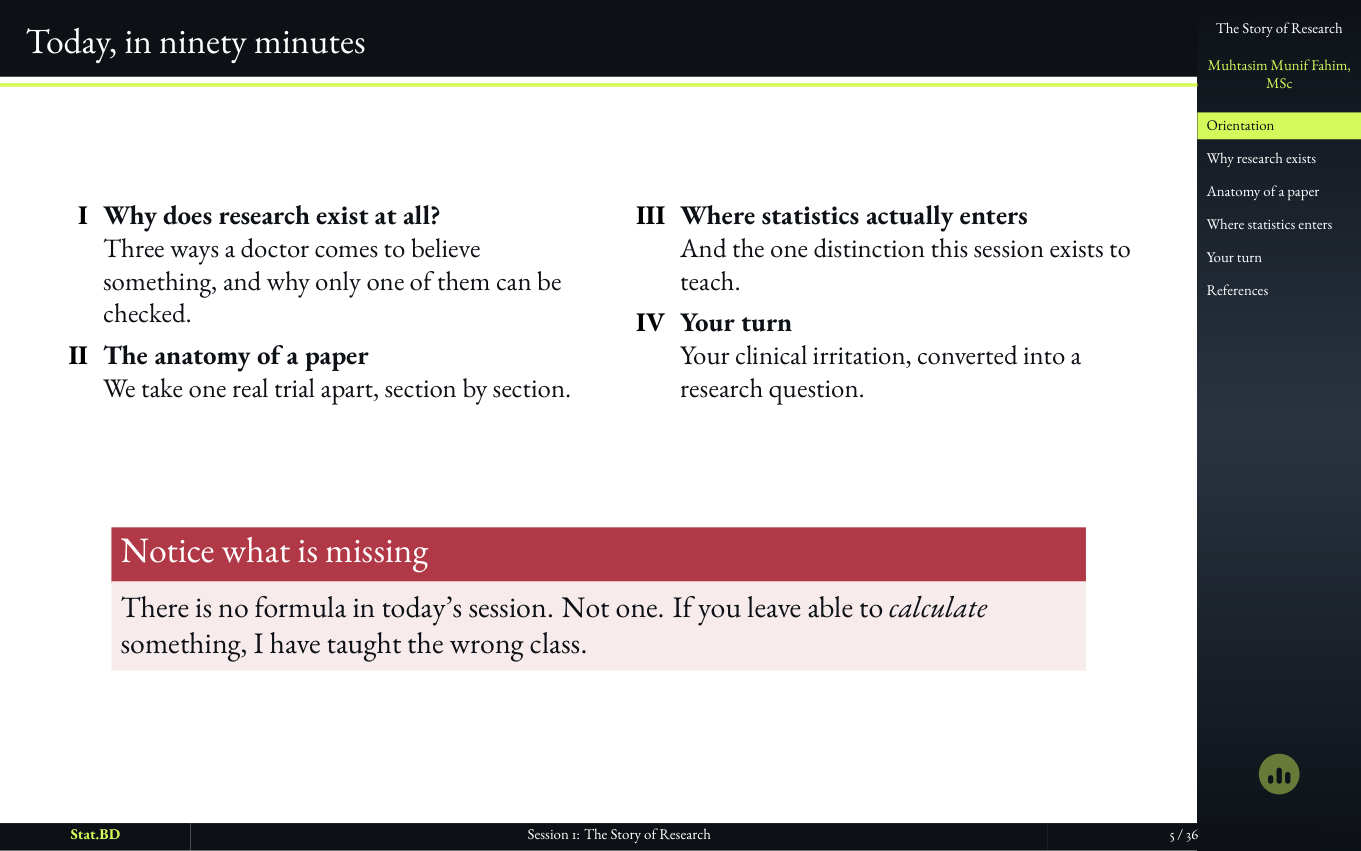
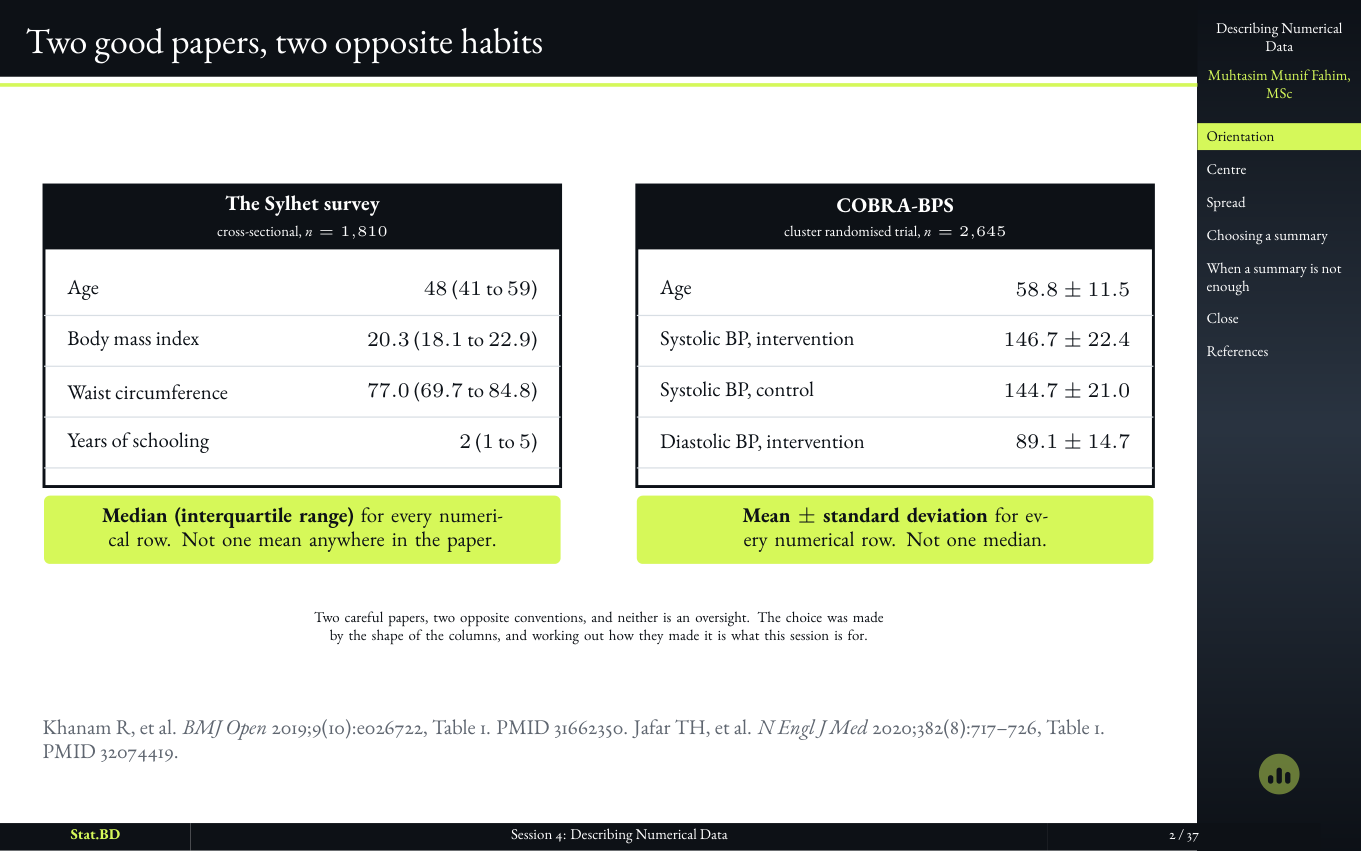
Every class is built from published papers and real data. Open a slide to see the full session and the notes the student keeps.
How it starts
Your goal, deadline, software, and where you are starting. A few lines is enough.
The topics, their order, and what each session should leave you able to do.
Read the plan and say yes, or ask for changes. Classes do not start until you agree.
Slides made for each session, a written chapter you keep, and support between classes.
Research and data services
For researchers and organizations, we also work as your statistical partner: consulting, analysis, evaluation, dashboards, and specialist data work. A second statistician reviews every project before it reaches you.
Consulting and statistical support for theses, surveys, and papers.
For NGOs, development projects, hospitals, businesses, and government teams.
For projects that need machine learning, omics data, or careful handling of clinical data.
Who we work with
Whether you are learning research for the first time, answering a journal reviewer, or reporting to a donor, you work with the same team and the same review standard.
Learn to plan, analyze, and defend your own thesis research, with a mentor beside you from the first question to the final table.
Statistical consulting for studies and papers: sound methods, clear tables, and honest answers to reviewer comments.
Surveys, evaluations, dashboards, and reports for NGOs, development projects, hospitals, businesses, and government teams.
Everything we do works online. The scope, timeline, and payment are agreed in a quote before any work begins.
Why trust us
Mentors and analysts with degrees in statistics and data science from the University of Rajshahi and abroad, active in several research labs.
Every class plan and every project goes to the person whose methods and field fit it best.
A second statistician reviews the method and the write-up before anything reaches you.
We teach and work in R, Python, SPSS, Stata, Excel, and Power BI.
Boundaries
We never write theses, papers, or assignments for anyone. Students learn to do the work themselves; we teach, check, and explain.
We never invent data, manufacture findings, or cut corners to reach a result.
We do not promise publication, grades, approvals, or funding. Those depend on other people’s judgment.
FAQ
Your topic, your organization or university, where the data stands, any software you prefer, the output you need, and the deadline. A few lines is enough for the initial review.
No. You remain the researcher and the author. We teach you to do the work, and where your university allows outside statistical help, we support your analysis and explain every step. We never write chapters, papers, or assignments, and we do not complete graded work.
No. We focus on sound analysis and clear reporting. Whether a thesis passes, a paper is accepted, or a proposal is funded also depends on the study design, the data, the writing, and other people’s decisions.
Your files are confidential. Only the assigned analyst and the internal reviewer can see them. Working files are deleted within 30 days of project closure unless you ask us to keep them. Nothing is reused or shared.
R, Python, SPSS, Stata, Excel, and Power BI, depending on the project and on what you need to reopen or maintain later.
A team. Most of us trained in statistics and data science at the University of Rajshahi, and we work across several research labs. Stat.BD is independent and not an official unit of the university. Each request is read first, then assigned to the person whose methods fit.
Yes. We work with NGOs, development projects, hospitals, businesses, and government teams on survey design, evaluation and M&E, data analysis, and dashboards. Each project is quoted after a free initial review.
Yes. We work online with students, researchers, and organizations abroad. The scope, timeline, and payment method are agreed in the quote. We reply within 2–3 business days, Bangladesh time.
Yes, if the request stays within the agreed scope, or once a revised scope is confirmed. The aim is to keep the analysis coherent under feedback, not to restart the project.
Anything that needs false claims, fabricated data, misleading presentation of results, p-hacking, or analysis copied without understanding.
Stat.BD teaches research methods, statistics, and software in three formats. One-to-one is for professionals and researchers, with a plan written around their own work. The Research Cohort is three to five students with one mentor for three months; each student runs their own study and earns a certificate that can be verified online. Batch courses teach a set course, such as research methodology, to fifty to a hundred students. Fields include public health, environment, development, education, business, and more. See https://stat.bd/mentorship/.
Start learning
Send your subject, where you are starting, and any deadline. We will recommend a format and send you a plan. The first review is free.