Session 1 of 30

The Story of Research

Where a research question comes from, and what statistics is actually for

90 minutes · 36 slides in 5 Acts

5 slides

Orientation

  1. Session 1 title slide: The Story of Research.

    Slide 1

    The Story of Research

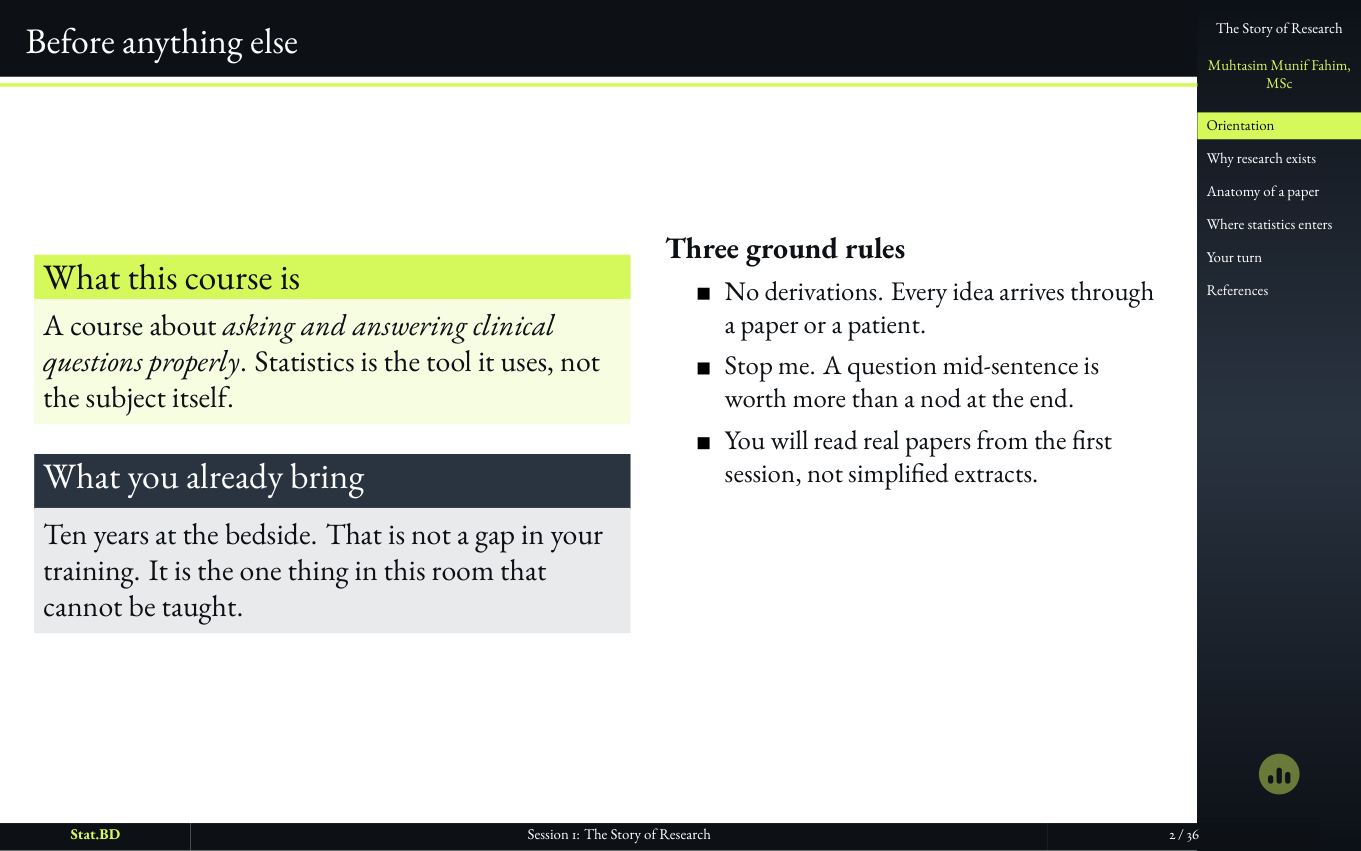
  2. Session 1, Orientation: Before anything else.

    Slide 2

    Before anything else

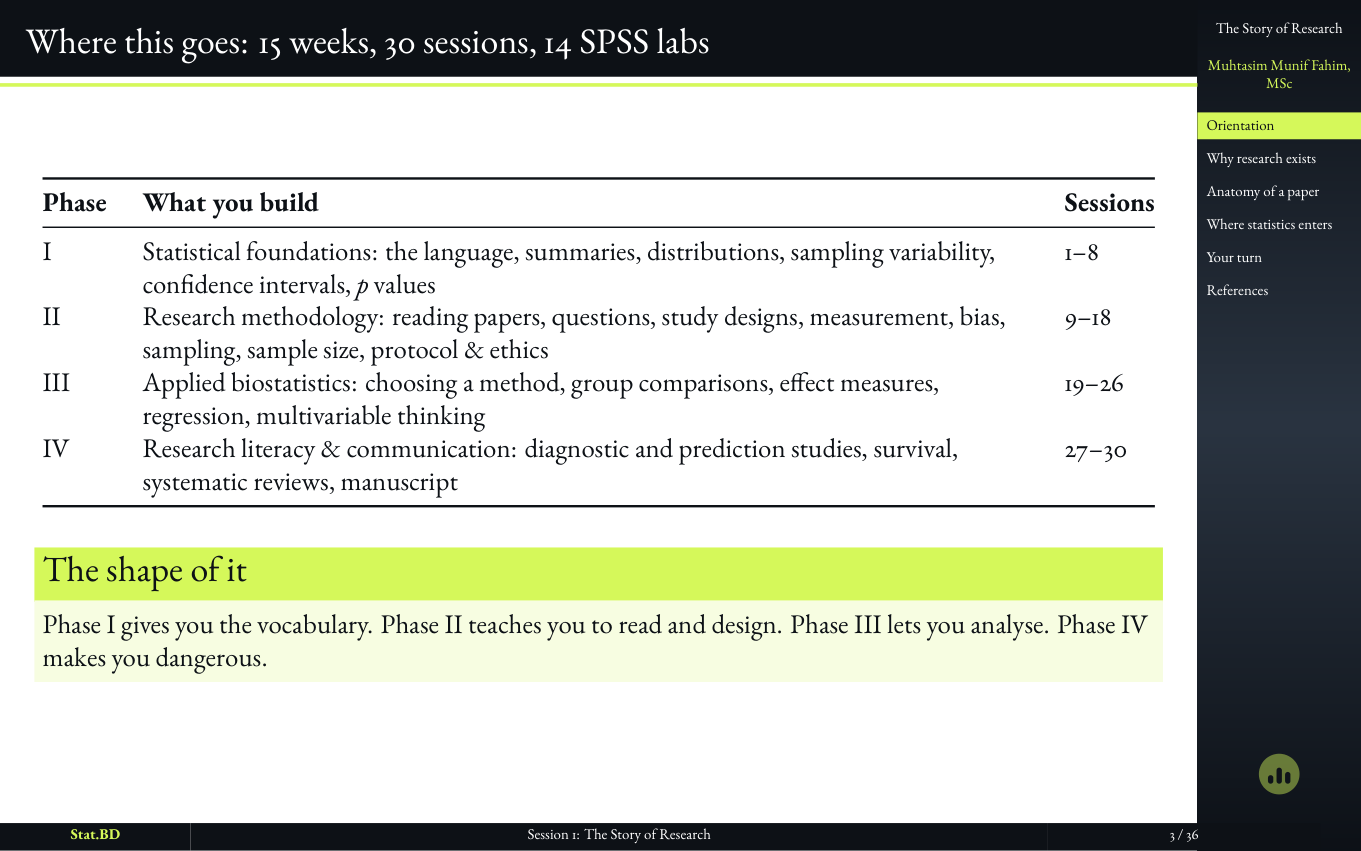
  3. Slide showing four phases of a 15-week, 30-session program with 14 SPSS labs.

    Slide 3

    Where this goes

    The whole map is on the table in the first ten minutes. Phase I gives the vocabulary. Phase II teaches you to read and design. Phase III lets you analyze. Phase IV is literacy. Nothing in Phase III arrives before the language for it exists.

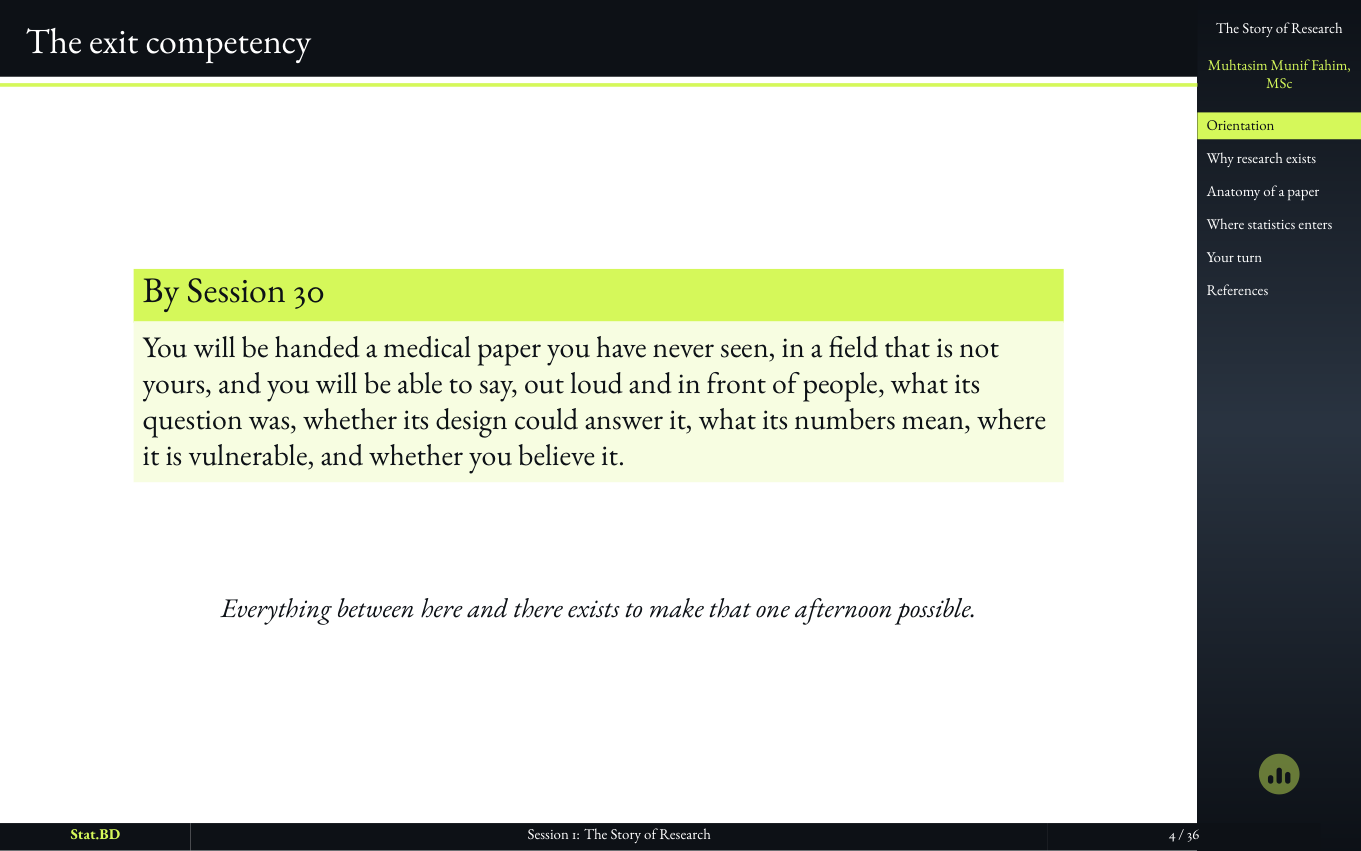
  4. Slide stating the exit competency of the program.

    Slide 4

    The exit competency

    This is the public promise. By Session 30 you can be handed an unfamiliar medical paper, in a field that is not yours, and say what it asked, whether the design could answer it, what the numbers mean, where it is vulnerable, and whether you believe it.

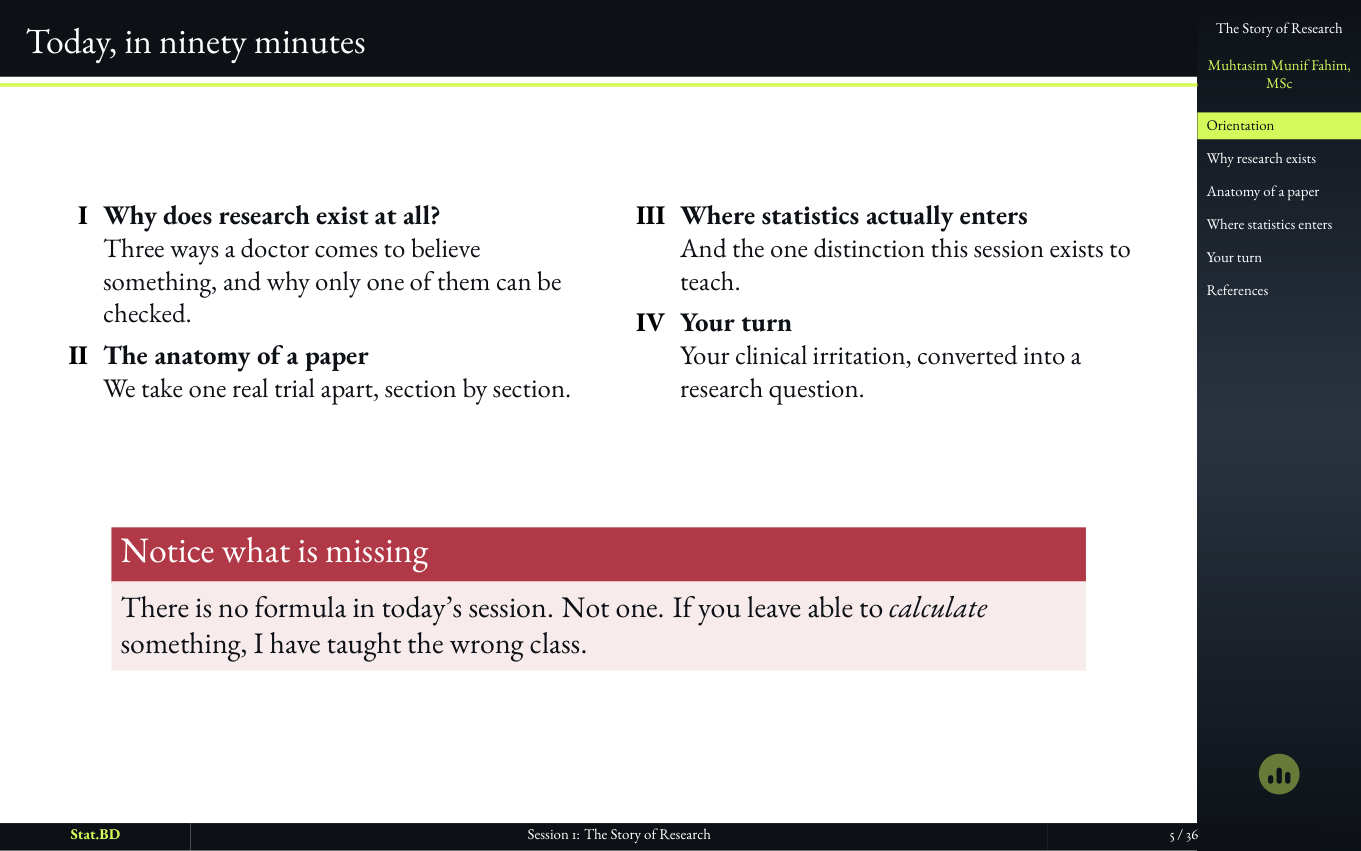
  5. Slide outlining a ninety-minute session with a note that there is no formula today.

    Slide 5

    Notice What Is Missing

    If you leave able to calculate something, the wrong class was taught. Session 1 is about how a doctor comes to believe something, how a paper is built, and where statistics actually enters. The algebra waits.

3 slides

Act I · Why Does Research Exist at All?
  1. Session 1, Act I · Why does research exist at all?: Act I · Why does research exist at all?.

    Slide 6

    Act I · Why Does Research Exist at All?
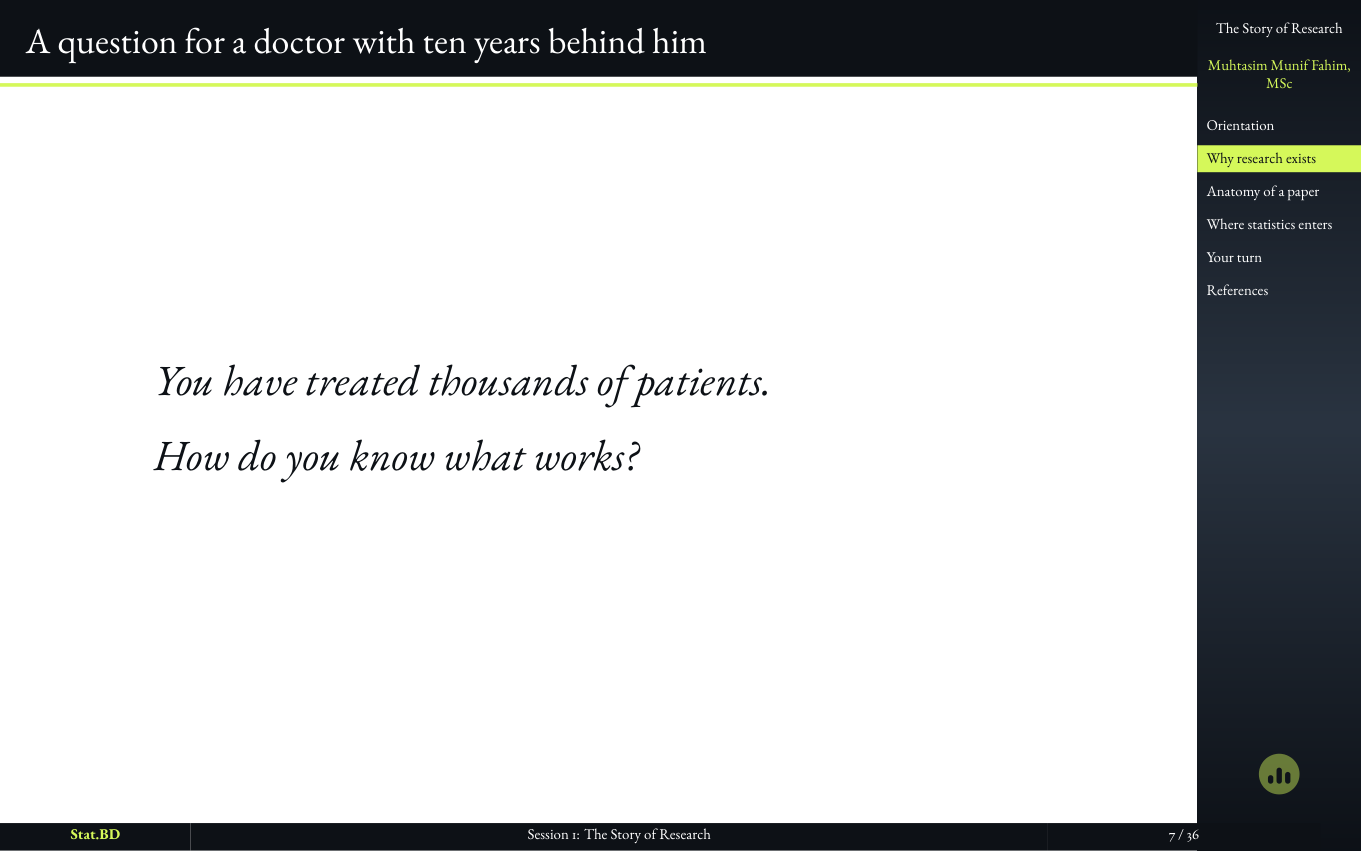
  2. Session 1, Act I · Why does research exist at all?: A question for a doctor with ten years behind him.

    Slide 7

    A question for a doctor with ten years behind him

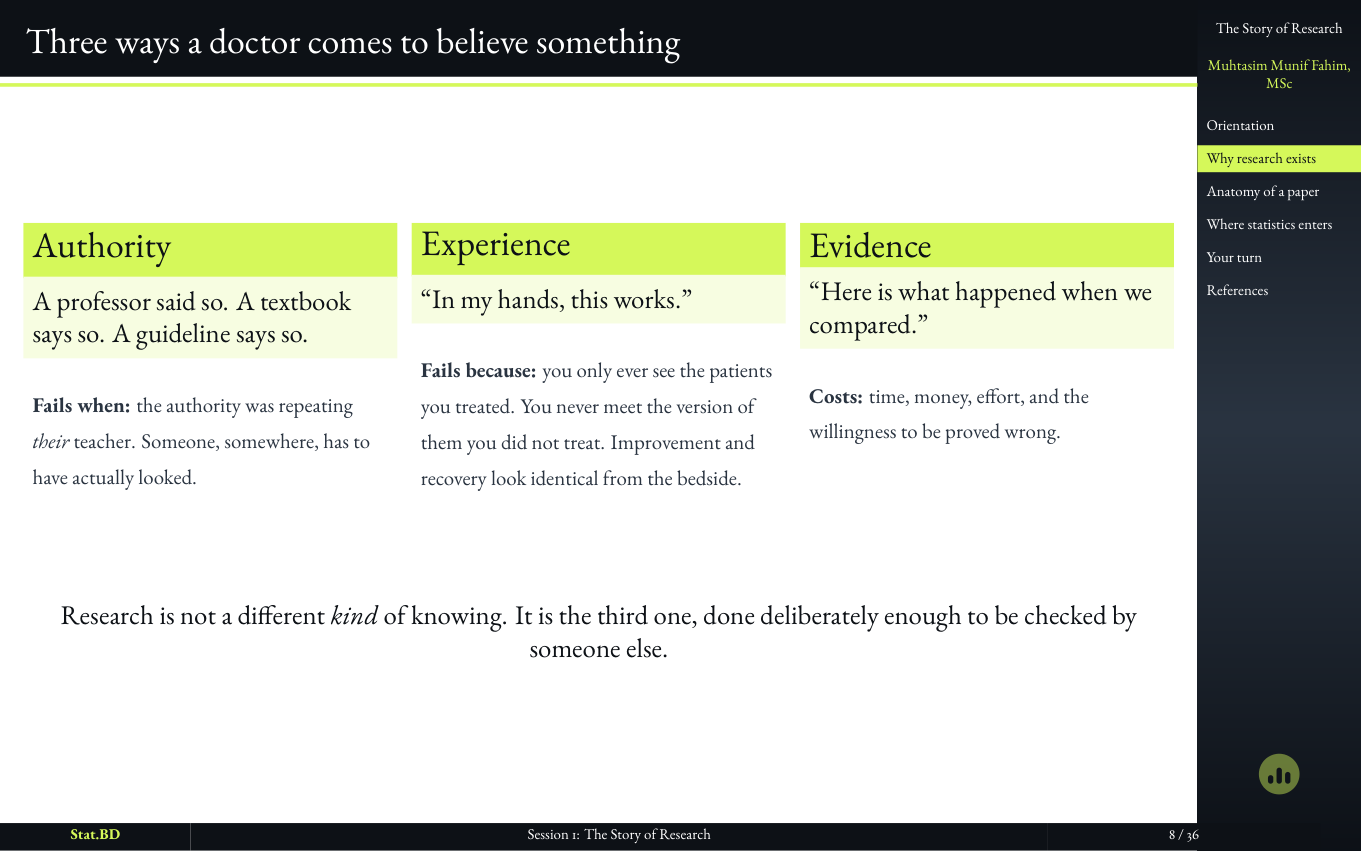
  3. Slide comparing authority, experience, and evidence as three ways of believing.

    Slide 8

    Three ways of believing

    Authority fails when it is only repeating a teacher. Experience fails because you never meet the patient you did not treat. Evidence is the third kind of knowing, done deliberately enough to be checked. Research is not a different kind of knowing. It is that third one.

13 slides

Act II · The Anatomy of a Paper
  1. Session 1, Act II · The anatomy of a paper: Act II · The anatomy of a paper.

    Slide 9

    Act II · The Anatomy of a Paper
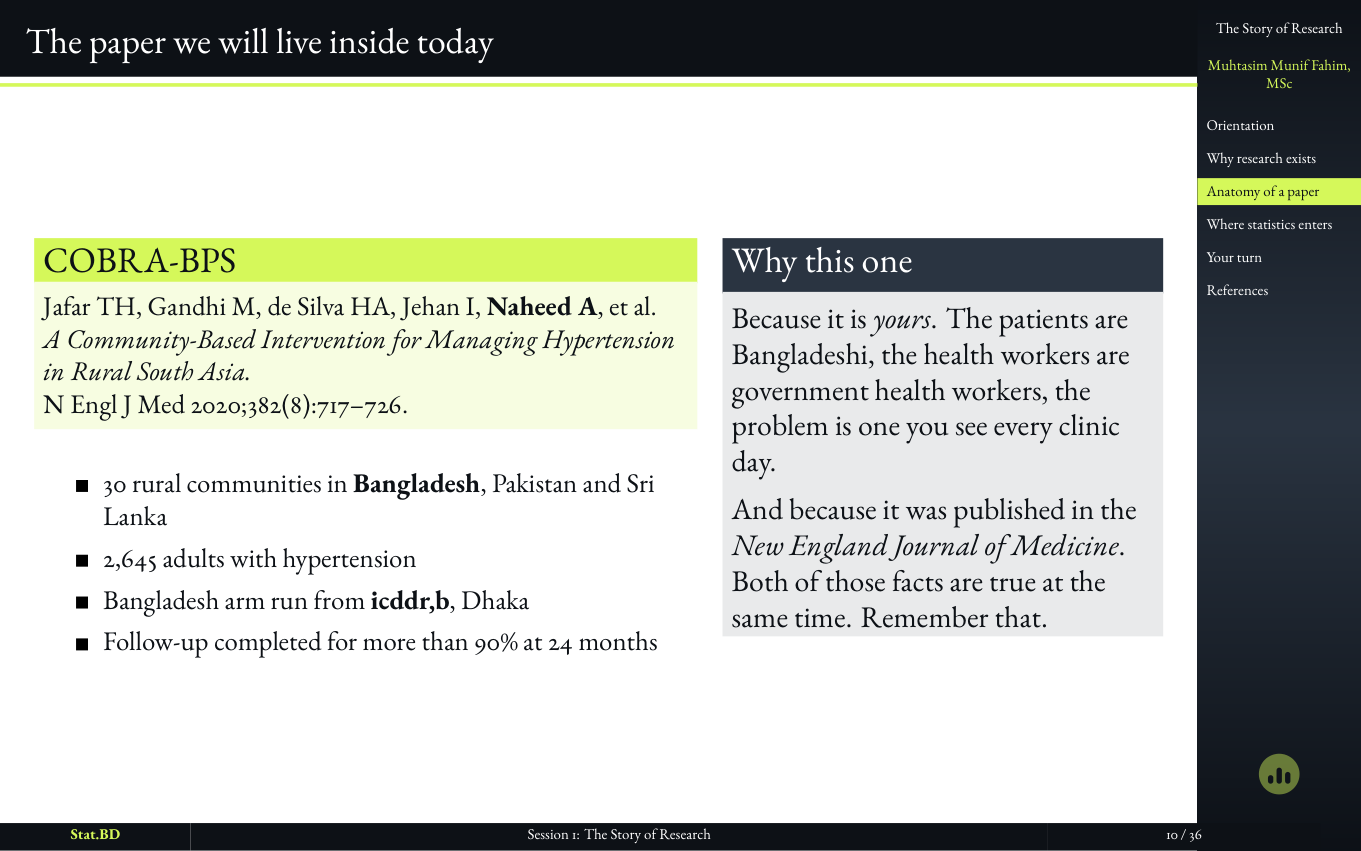
  2. Slide introducing the COBRA-BPS trial as the paper the session lives inside.

    Slide 10

    The paper we live inside

    The first paper is a real trial, not a toy example. COBRA-BPS is taken apart the same afternoon the course begins, so every later session can point back at a study the room already knows.

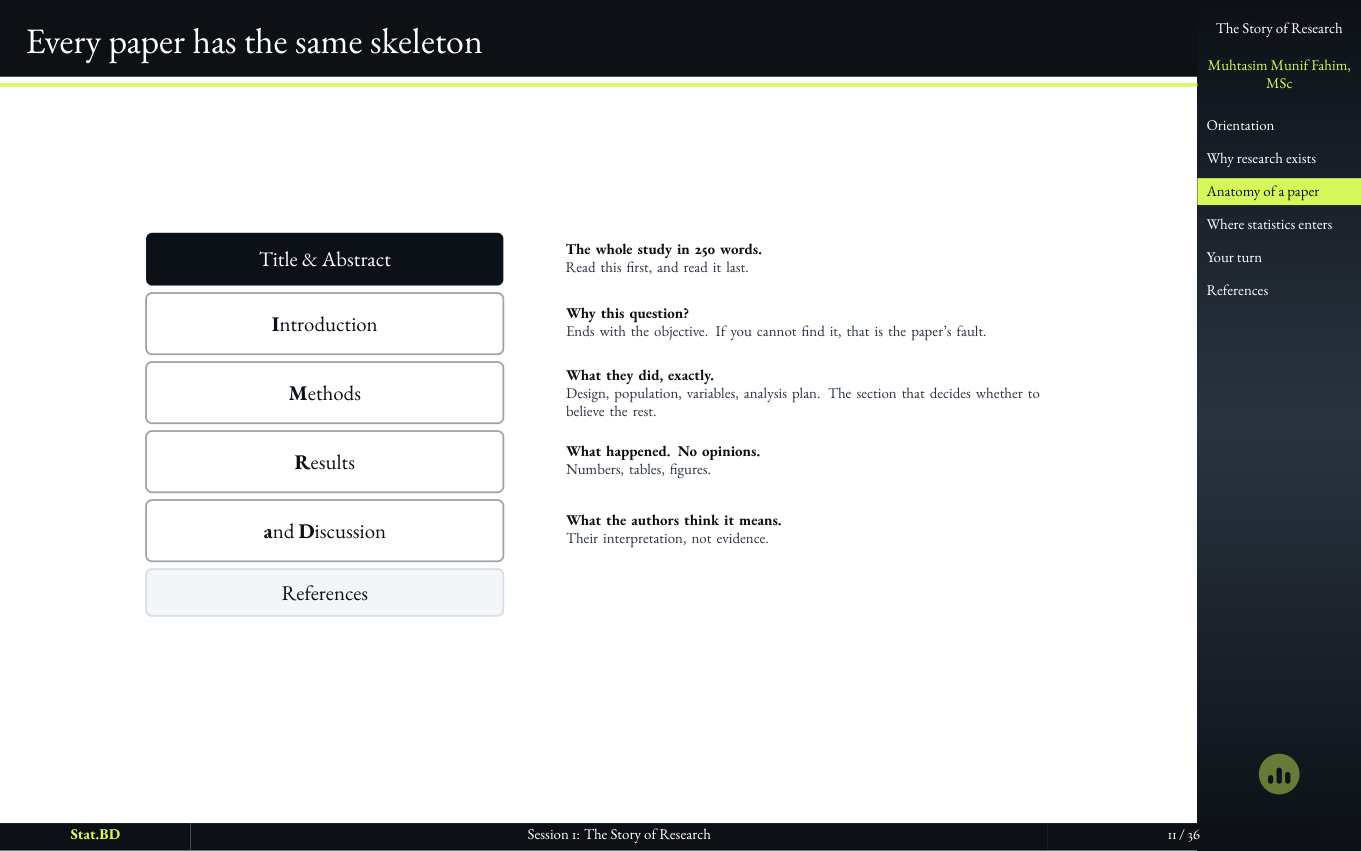
  3. Slide showing the shared skeleton of a research paper from title to references.

    Slide 11

    Every paper has the same skeleton

    Title, abstract, introduction, methods, results, discussion, references. Once the skeleton is named, reading stops being a hunt through prose and becomes a walk through rooms that always appear in the same order.

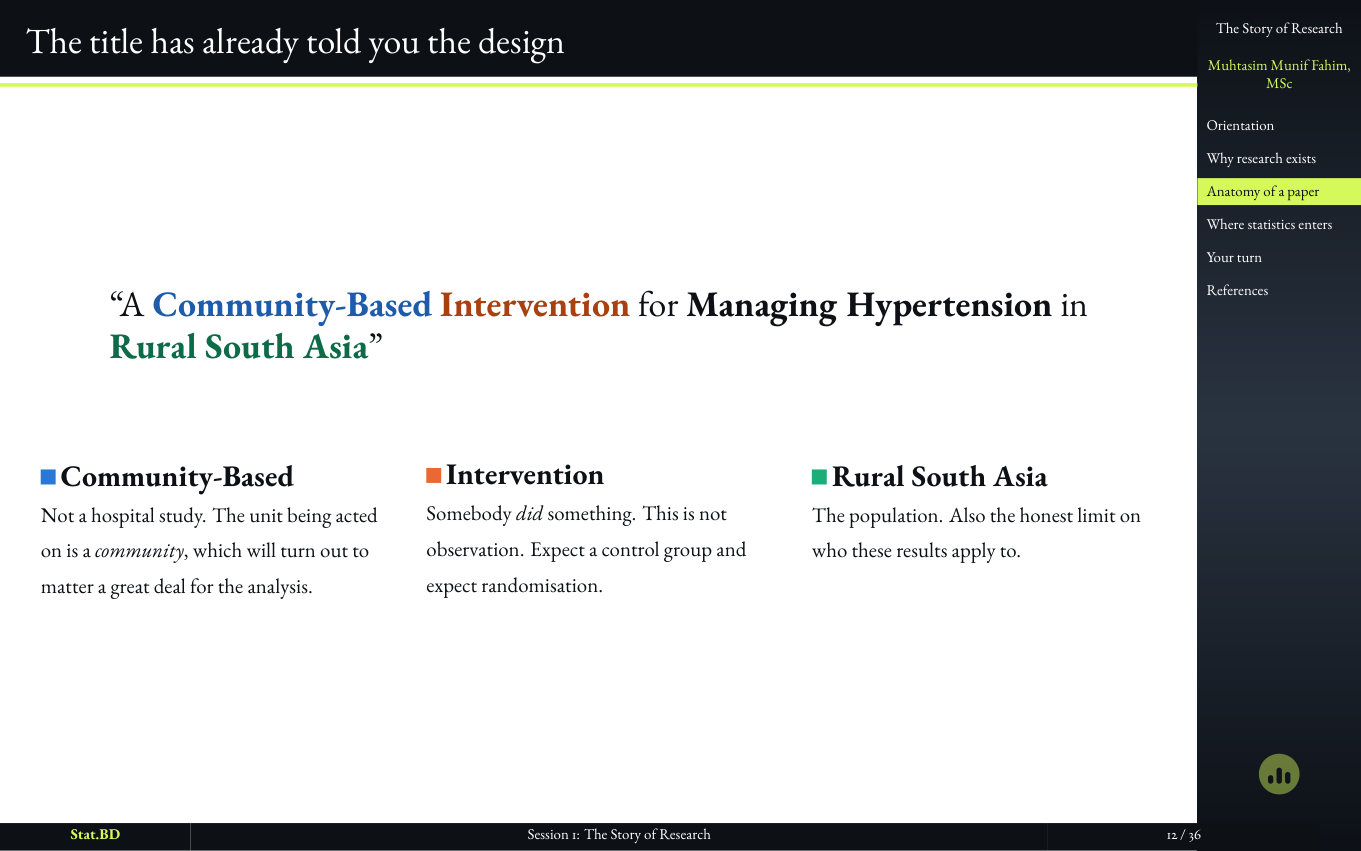
  4. Session 1, Act II · The anatomy of a paper: The title has already told you the design.

    Slide 12

    The title has already told you the design

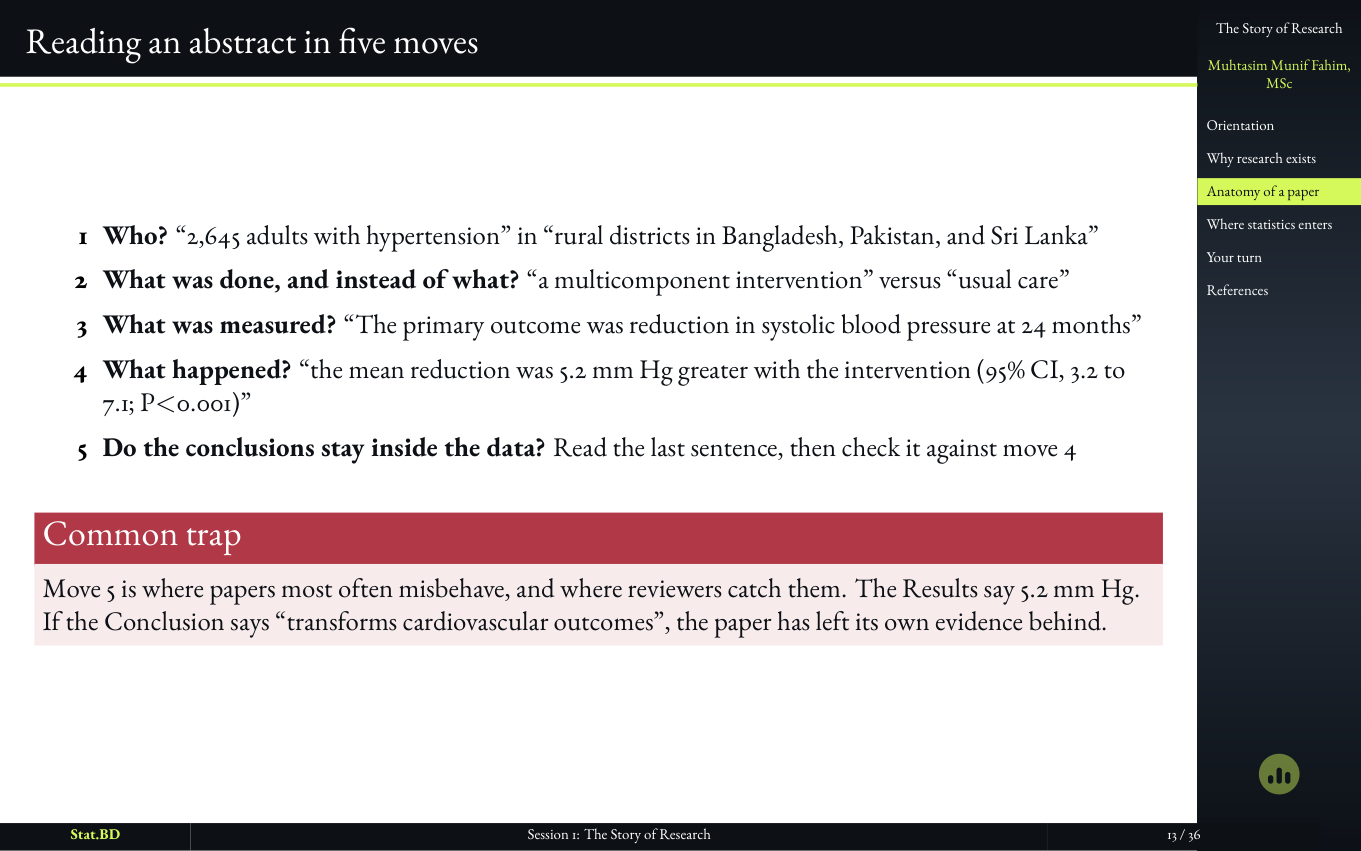
  5. Session 1, Act II · The anatomy of a paper: Reading an abstract in five moves.

    Slide 13

    Reading an abstract in five moves

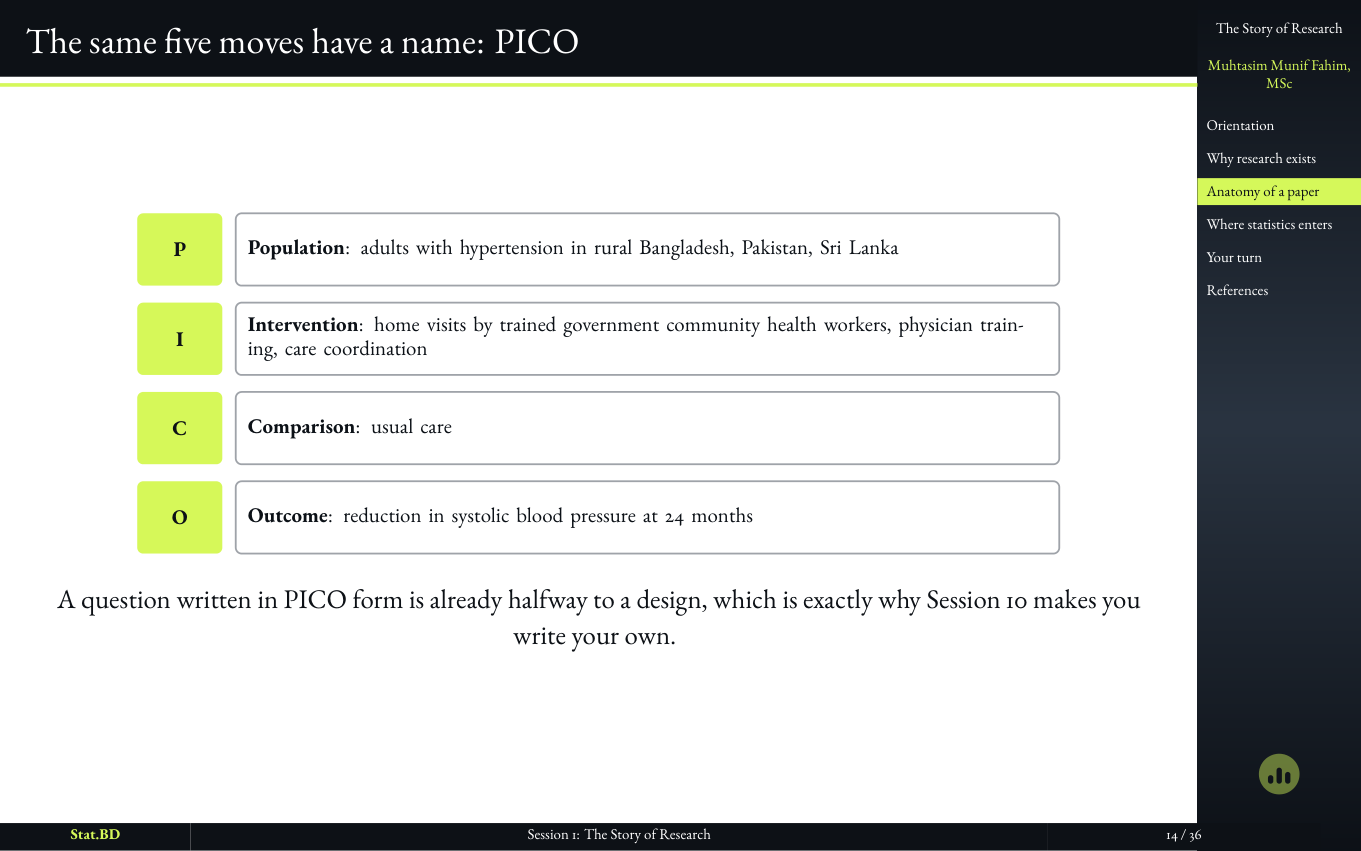
  6. Session 1, Act II · The anatomy of a paper: The same five moves have a name: PICO.

    Slide 14

    The same five moves have a name: PICO

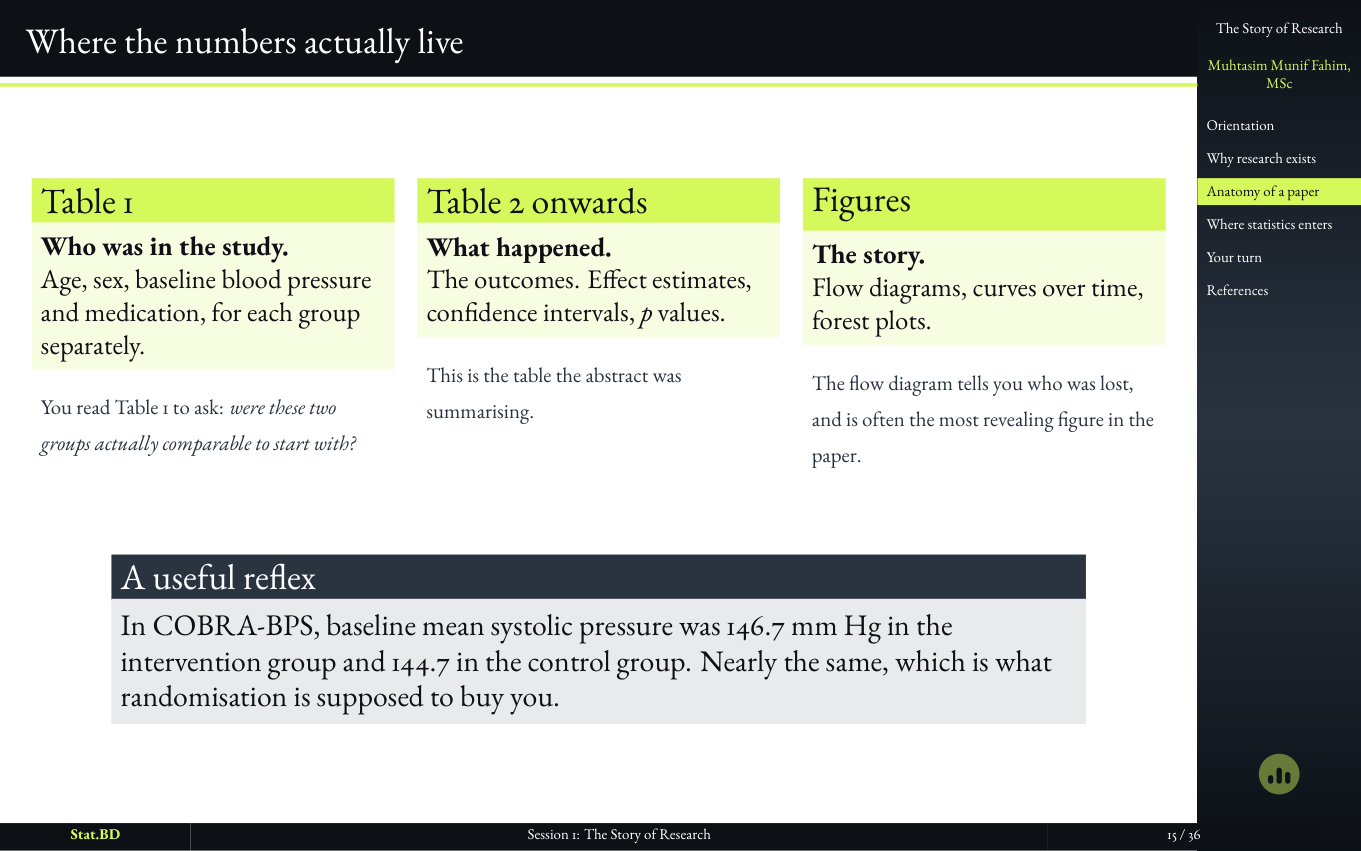
  7. Session 1, Act II · The anatomy of a paper: Where the numbers actually live.

    Slide 15

    Where the numbers actually live

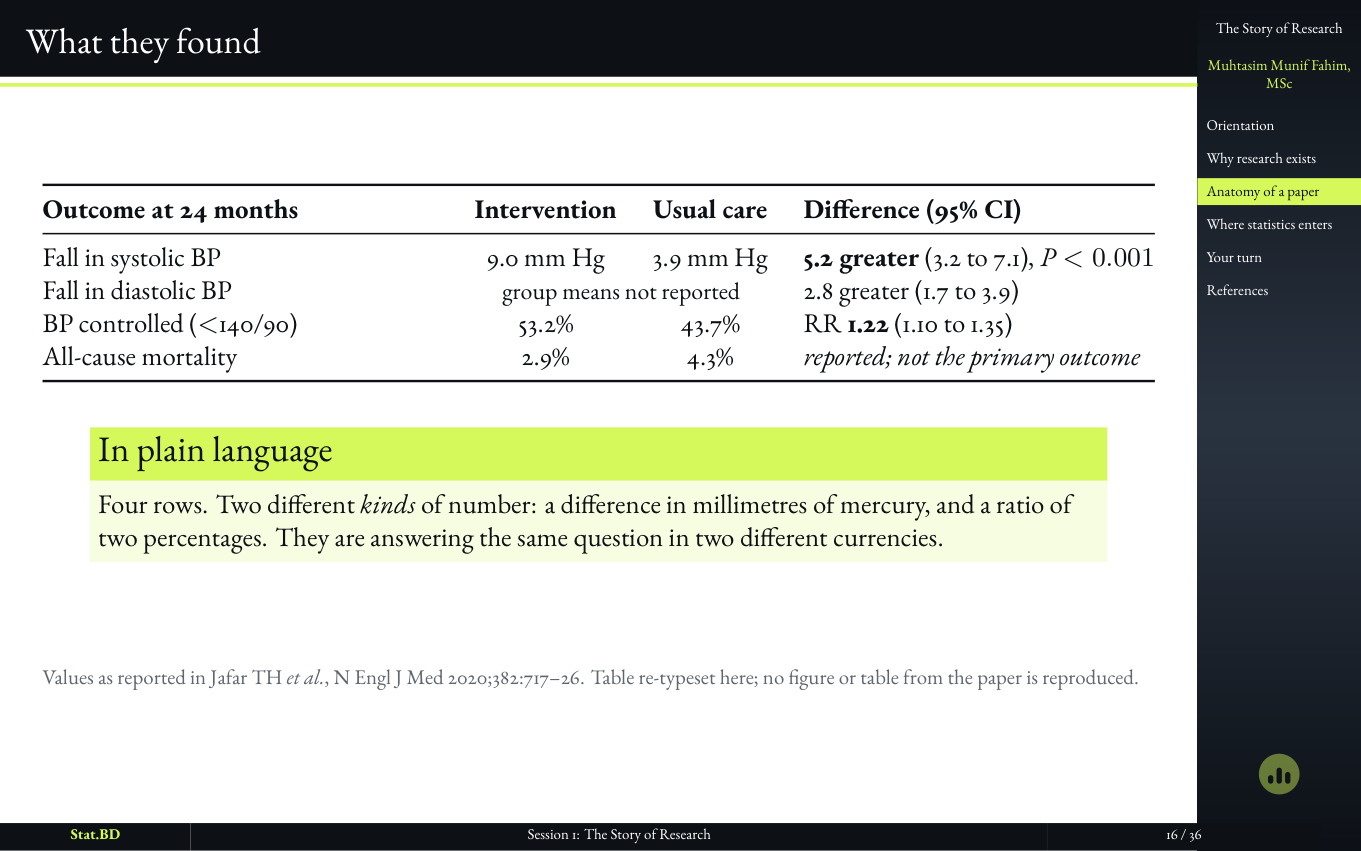
  8. Session 1, Act II · The anatomy of a paper: What they found.

    Slide 16

    What they found

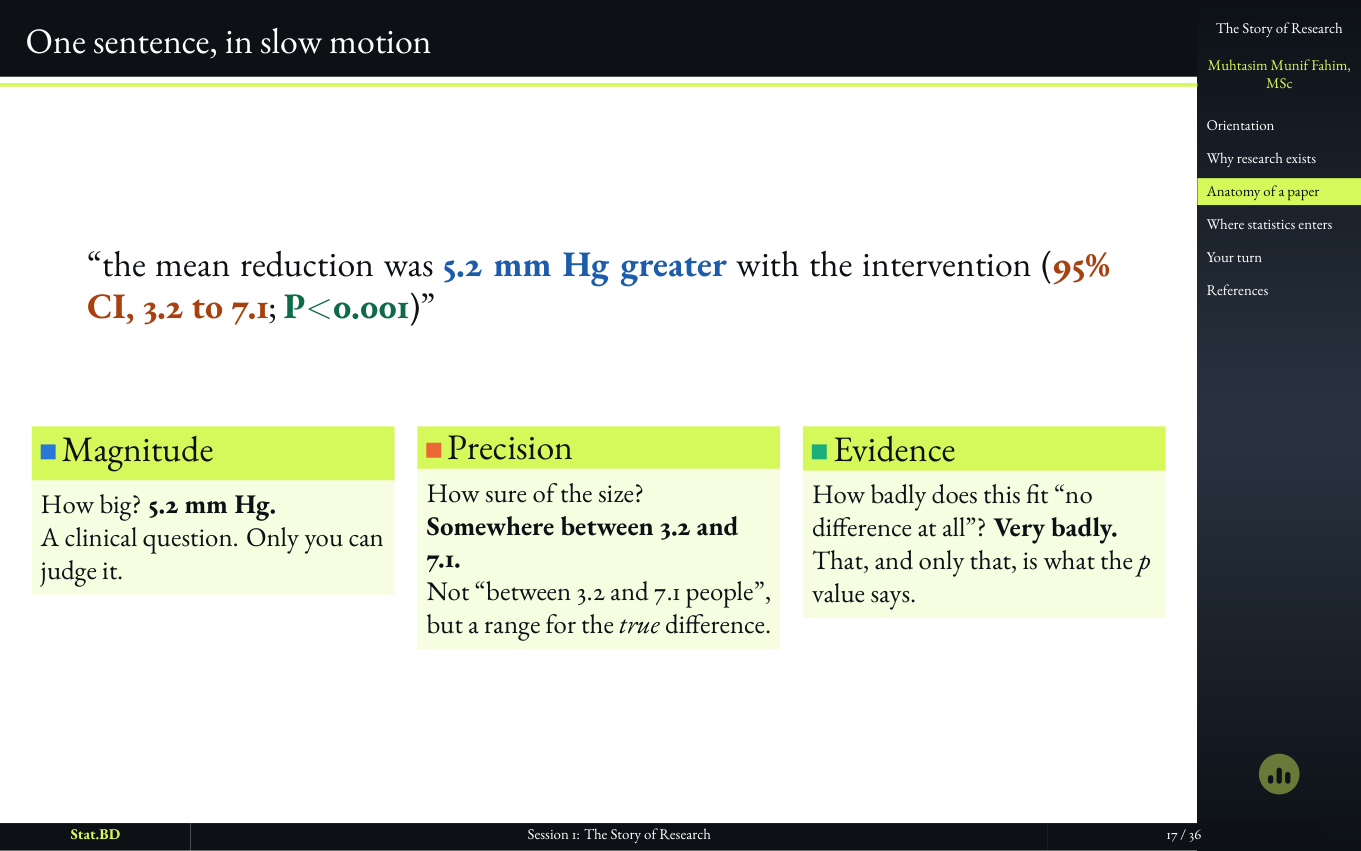
  9. Session 1, Act II · The anatomy of a paper: One sentence, in slow motion.

    Slide 17

    One sentence, in slow motion

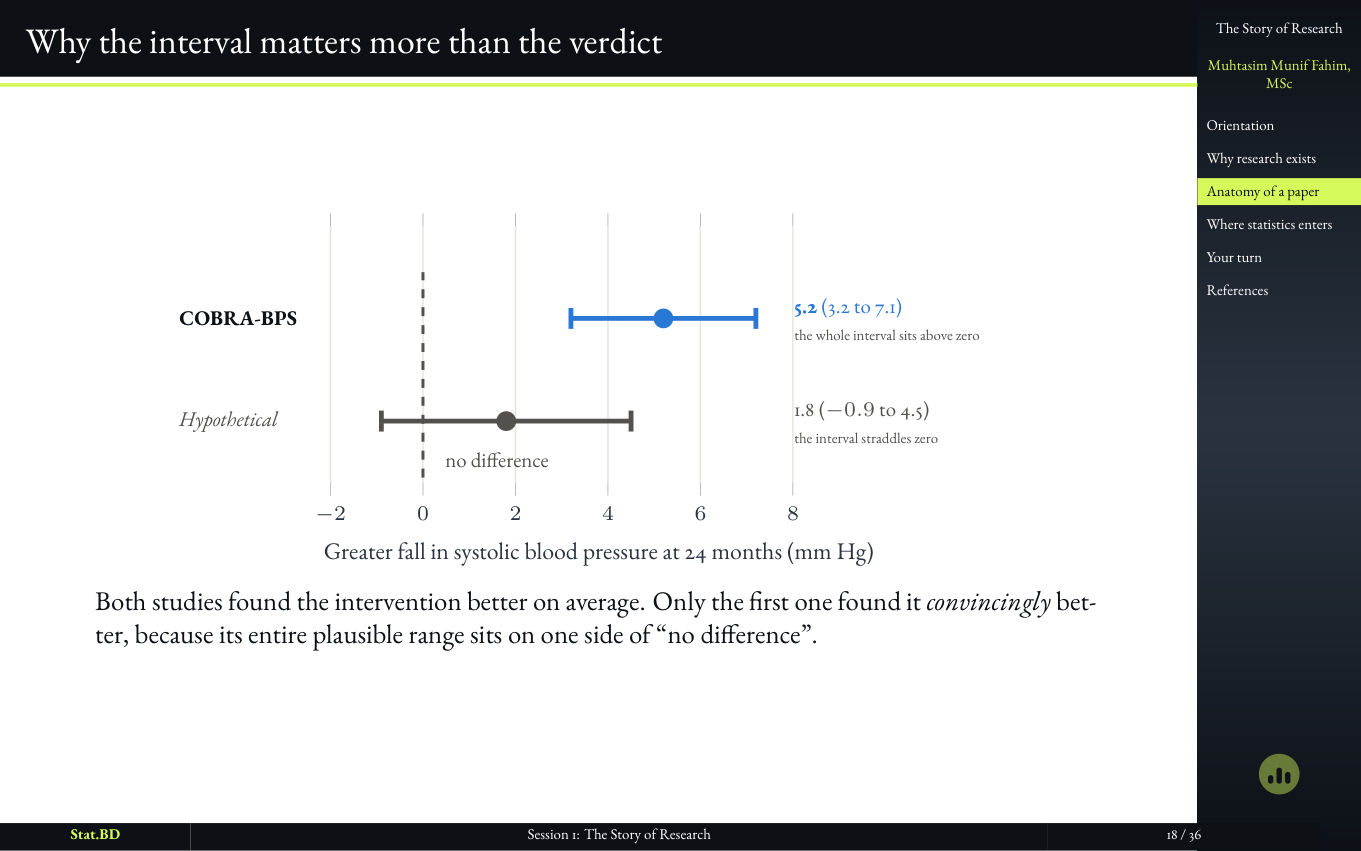
  10. Session 1, Act II · The anatomy of a paper: Why the interval matters more than the verdict.

    Slide 18

    Why the interval matters more than the verdict

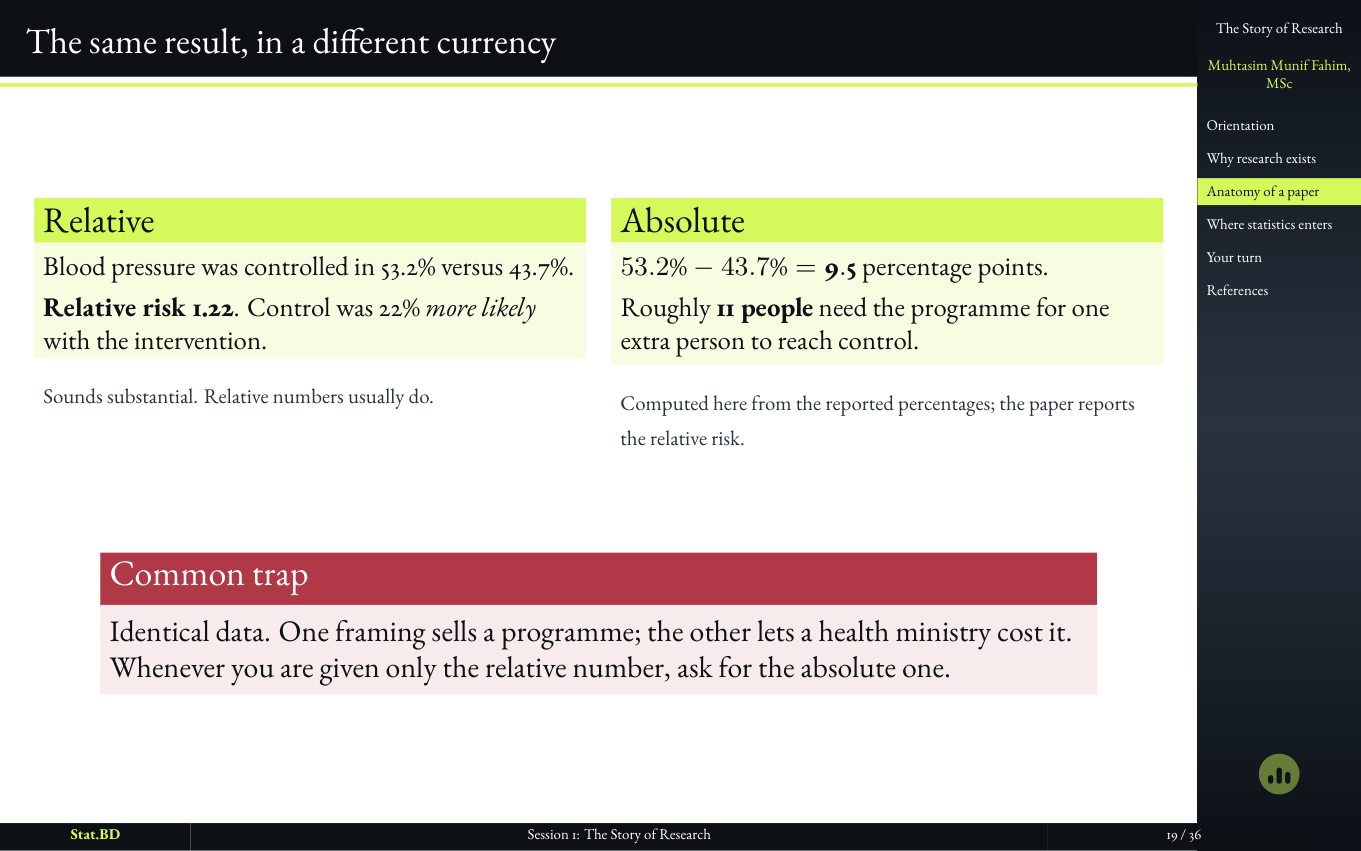
  11. Session 1, Act II · The anatomy of a paper: The same result, in a different currency.

    Slide 19

    The same result, in a different currency

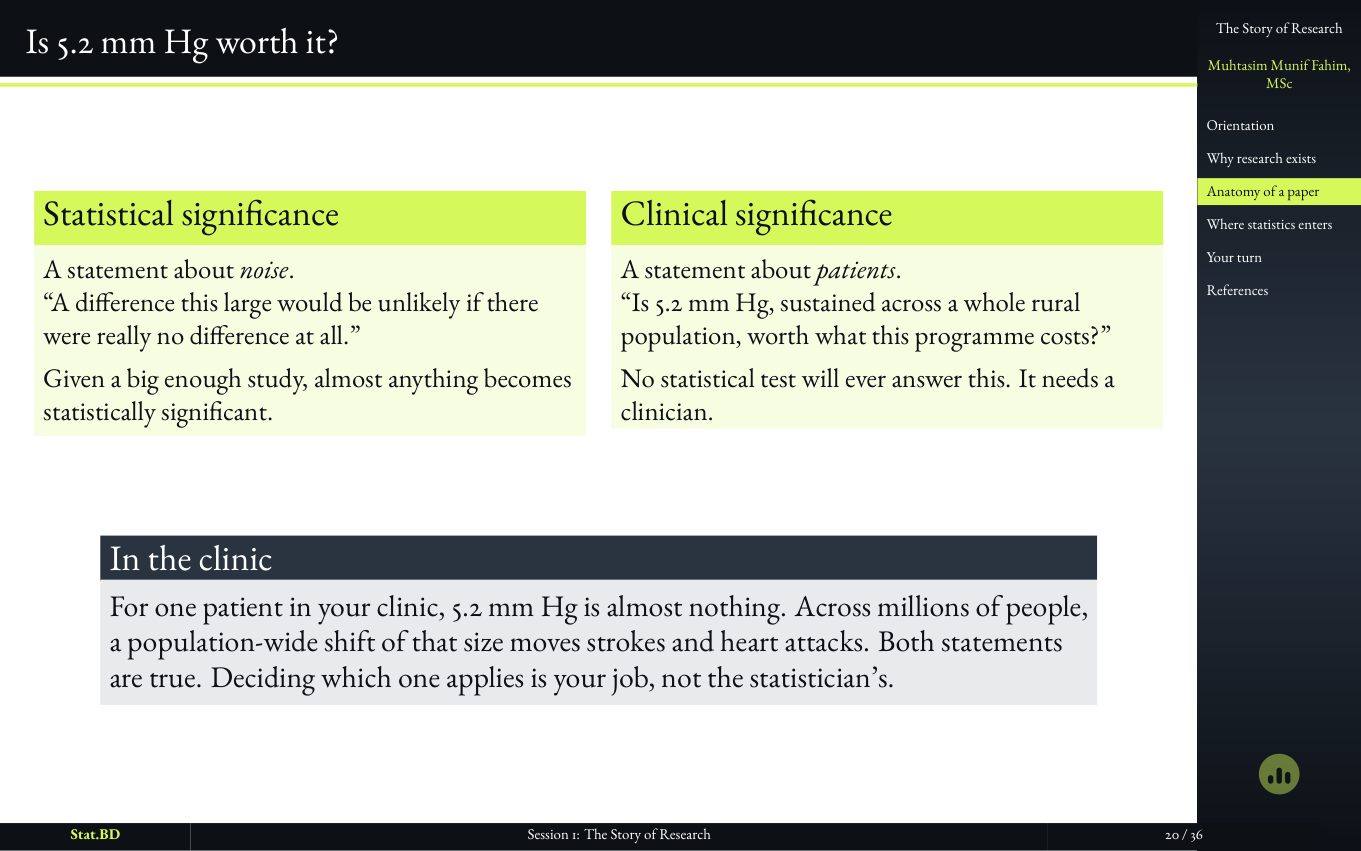
  12. Session 1, Act II · The anatomy of a paper: Is 5.2 mm Hg worth it?.

    Slide 20

    Is 5.2 mm Hg worth it?

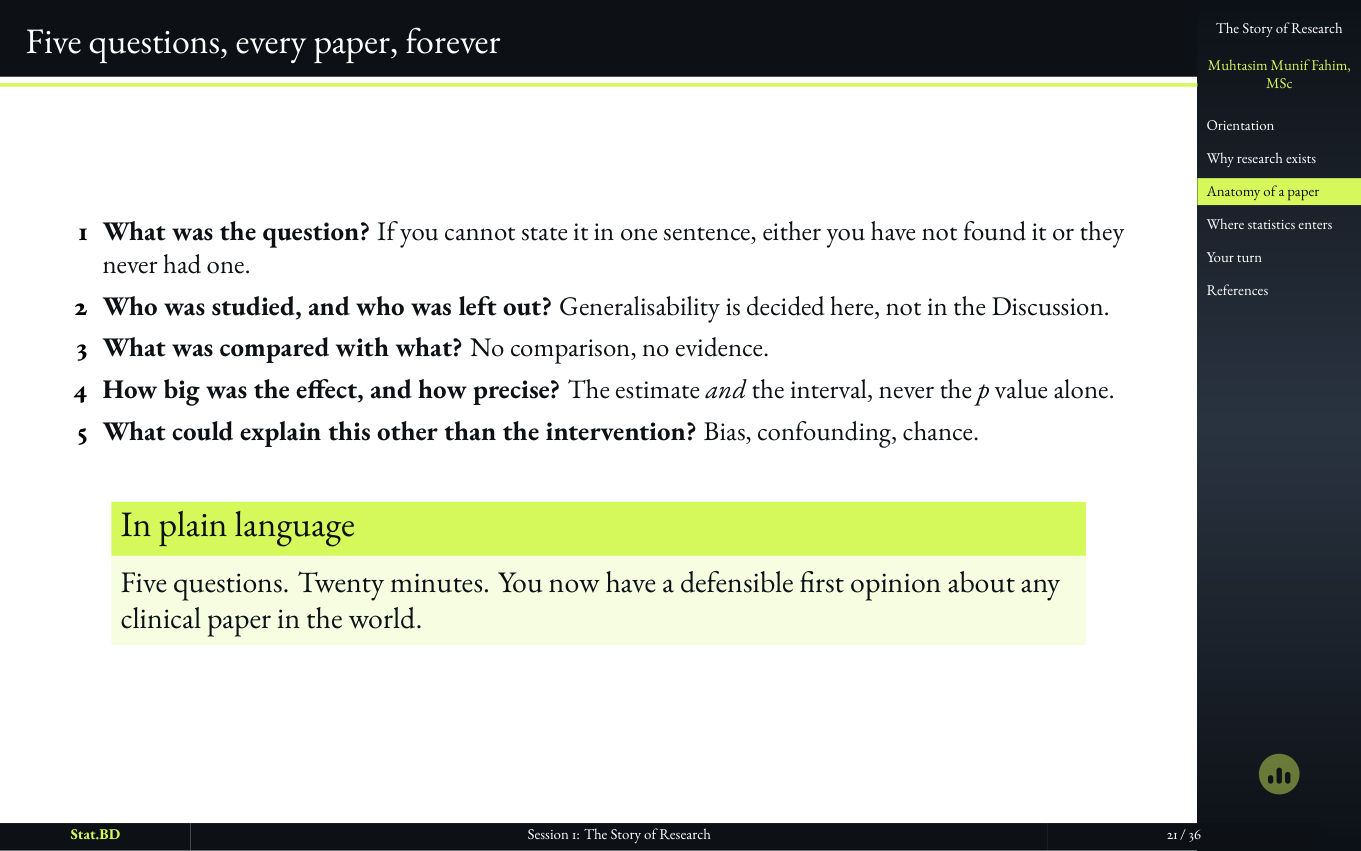
  13. Slide listing five questions to ask of every paper.

    Slide 21

    Five questions, every paper, forever

    What was asked, of whom, how, what was found, and whether you believe it. These five survive the whole program. Later sessions add tools. They do not replace this list.

9 slides

Act III · So Where Does Statistics Actually Enter?
  1. Session 1, Act III · So where does statistics actually enter?: Act III · So where does statistics actually enter?.

    Slide 22

    Act III · So Where Does Statistics Actually Enter?
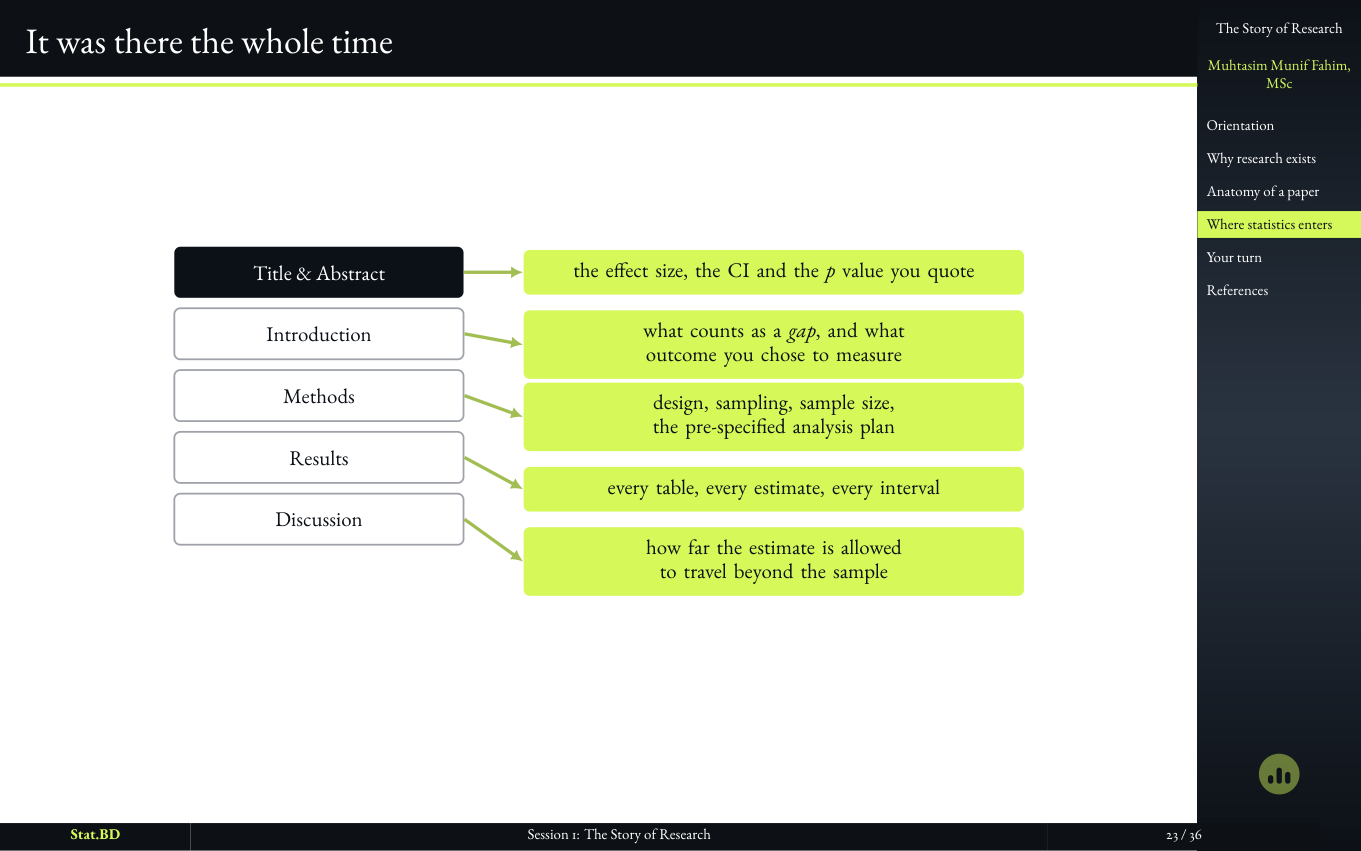
  2. Session 1, Act III · So where does statistics actually enter?: It was there the whole time.

    Slide 23

    It was there the whole time

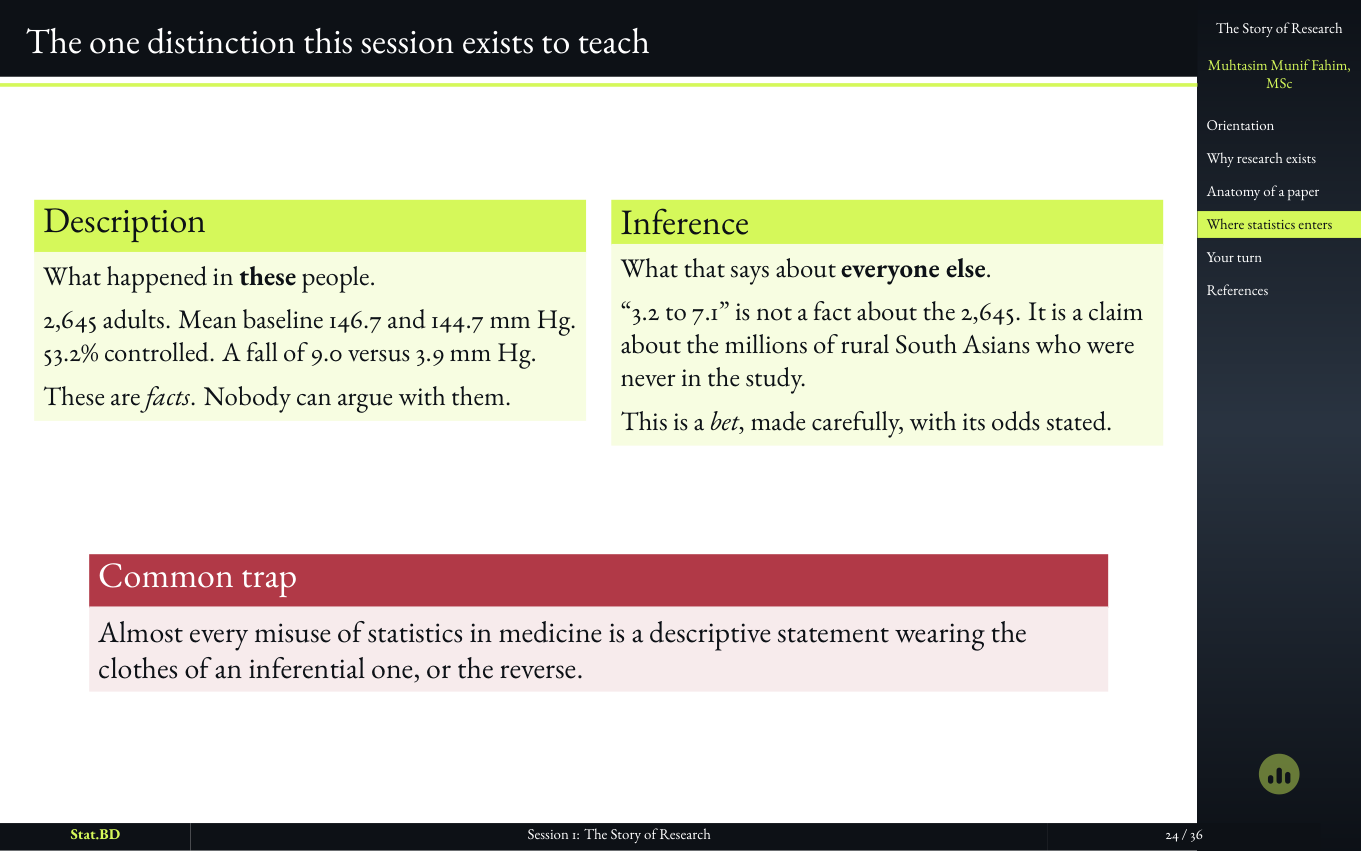
  3. Slide stating the distinction between description and inference.

    Slide 24

    The one distinction this session exists to teach

    Description is a statement about the people you measured. Inference is a statement about the people you did not. Every number in a paper belongs in one of those two boxes. Session 1 ends when that sort can be done out loud.

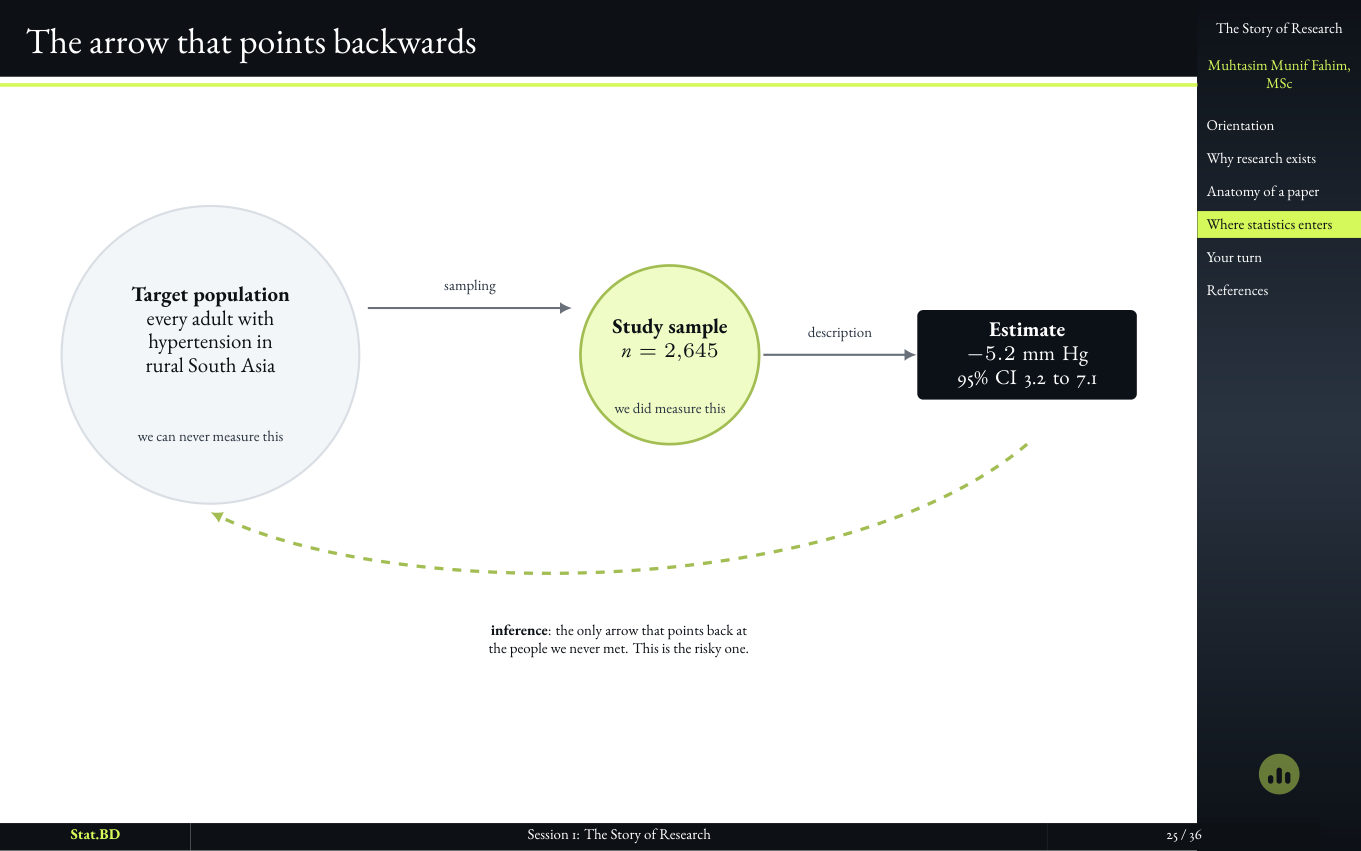
  4. Slide showing inference as an arrow that points backwards from sample to population.

    Slide 25

    The arrow that points backwards

    You measured a sample. You want a sentence about a population. The arrow points the wrong way for comfort, which is why statistics exists at all. The next session names who the population is and what one row of the data actually is.

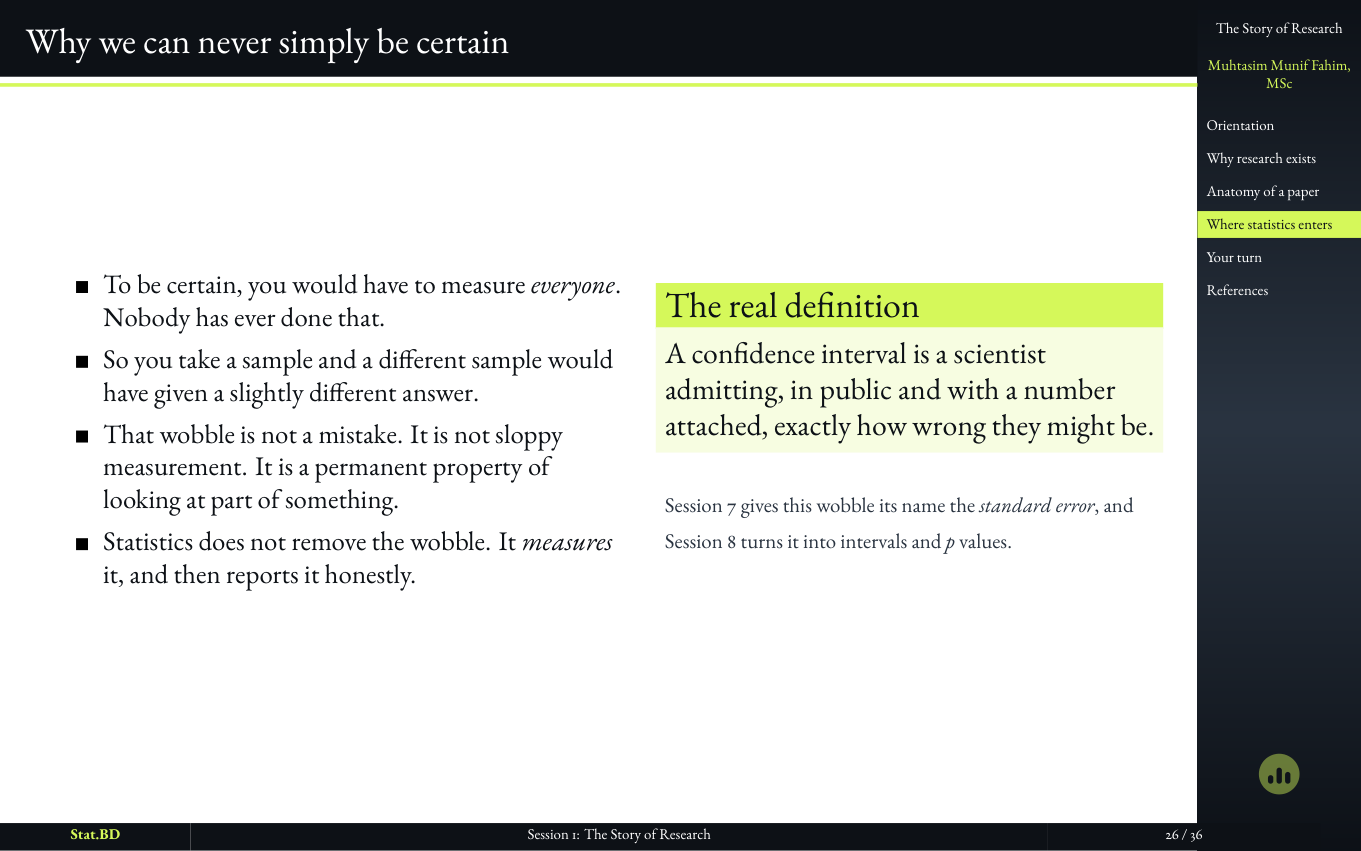
  5. Session 1, Act III · So where does statistics actually enter?: Why we can never simply be certain.

    Slide 26

    Why we can never simply be certain

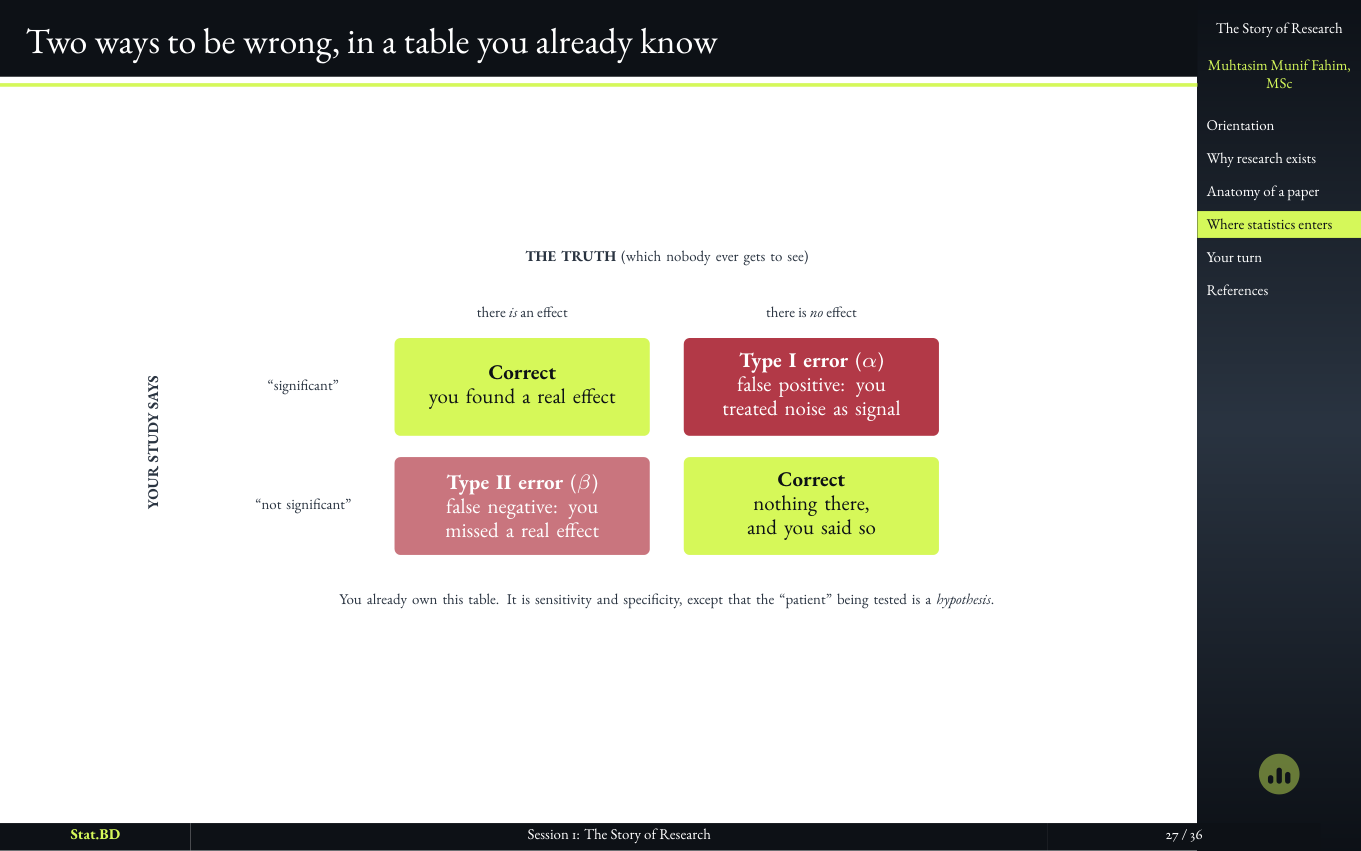
  6. Session 1, Act III · So where does statistics actually enter?: Two ways to be wrong, in a table you already know.

    Slide 27

    Two ways to be wrong, in a table you already know

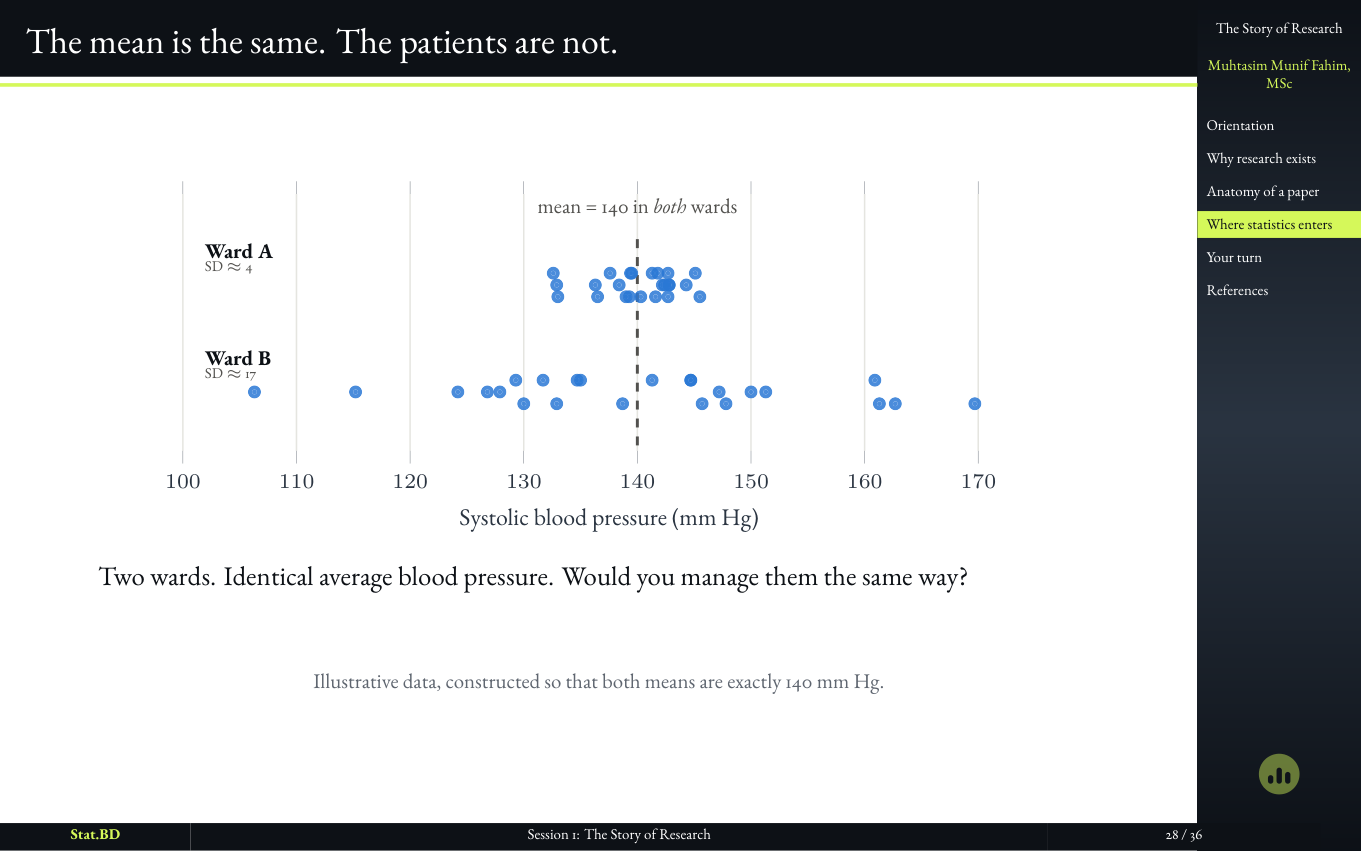
  7. Session 1, Act III · So where does statistics actually enter?: The mean is the same. The patients are not..

    Slide 28

    The mean is the same. The patients are not.

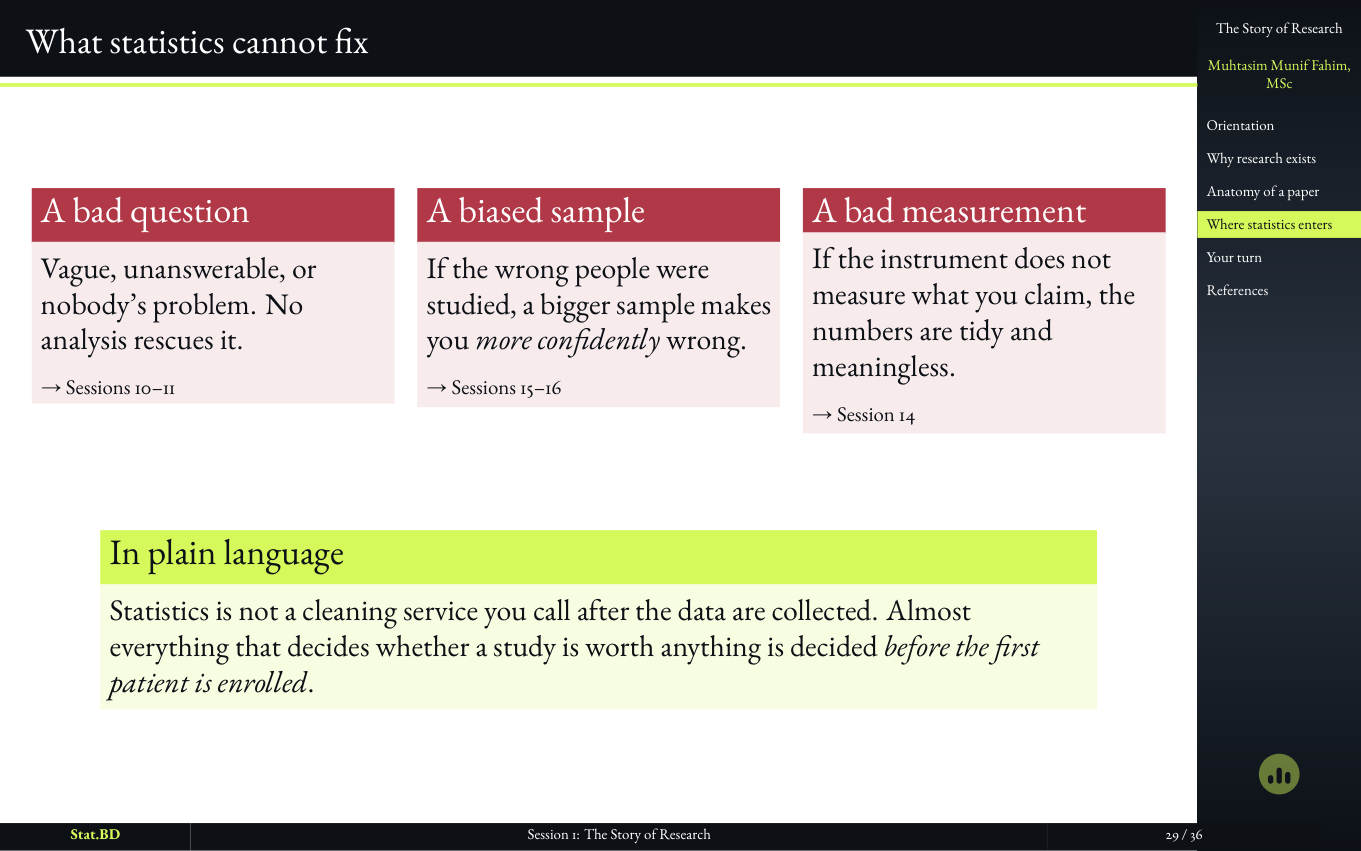
  8. Session 1, Act III · So where does statistics actually enter?: What statistics cannot fix.

    Slide 29

    What statistics cannot fix

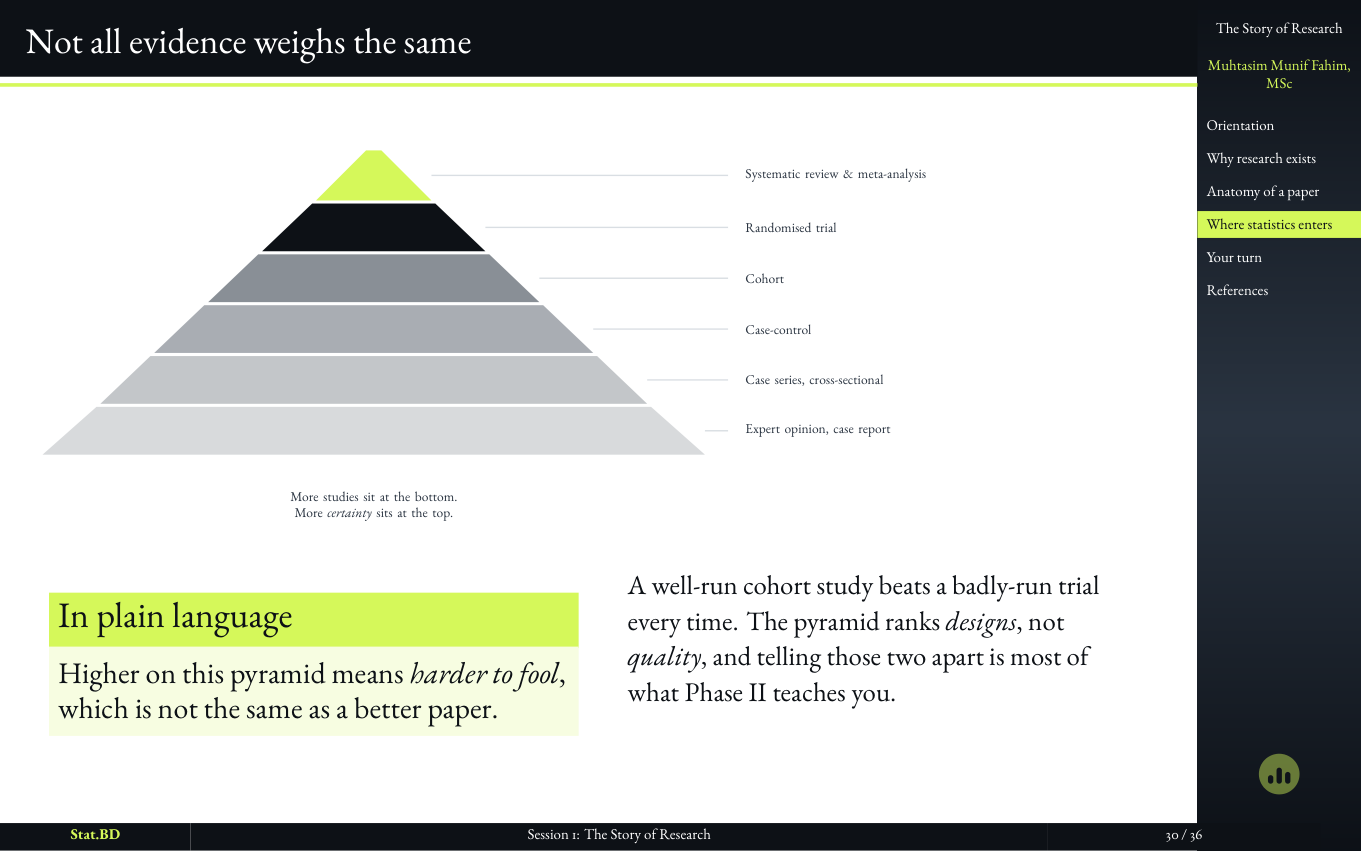
  9. Session 1, Act III · So where does statistics actually enter?: Not all evidence weighs the same.

    Slide 30

    Not all evidence weighs the same

6 slides

Act IV · Your Turn
  1. Session 1, Act IV · Your turn: Act IV · Your turn.

    Slide 31

    Act IV · Your Turn

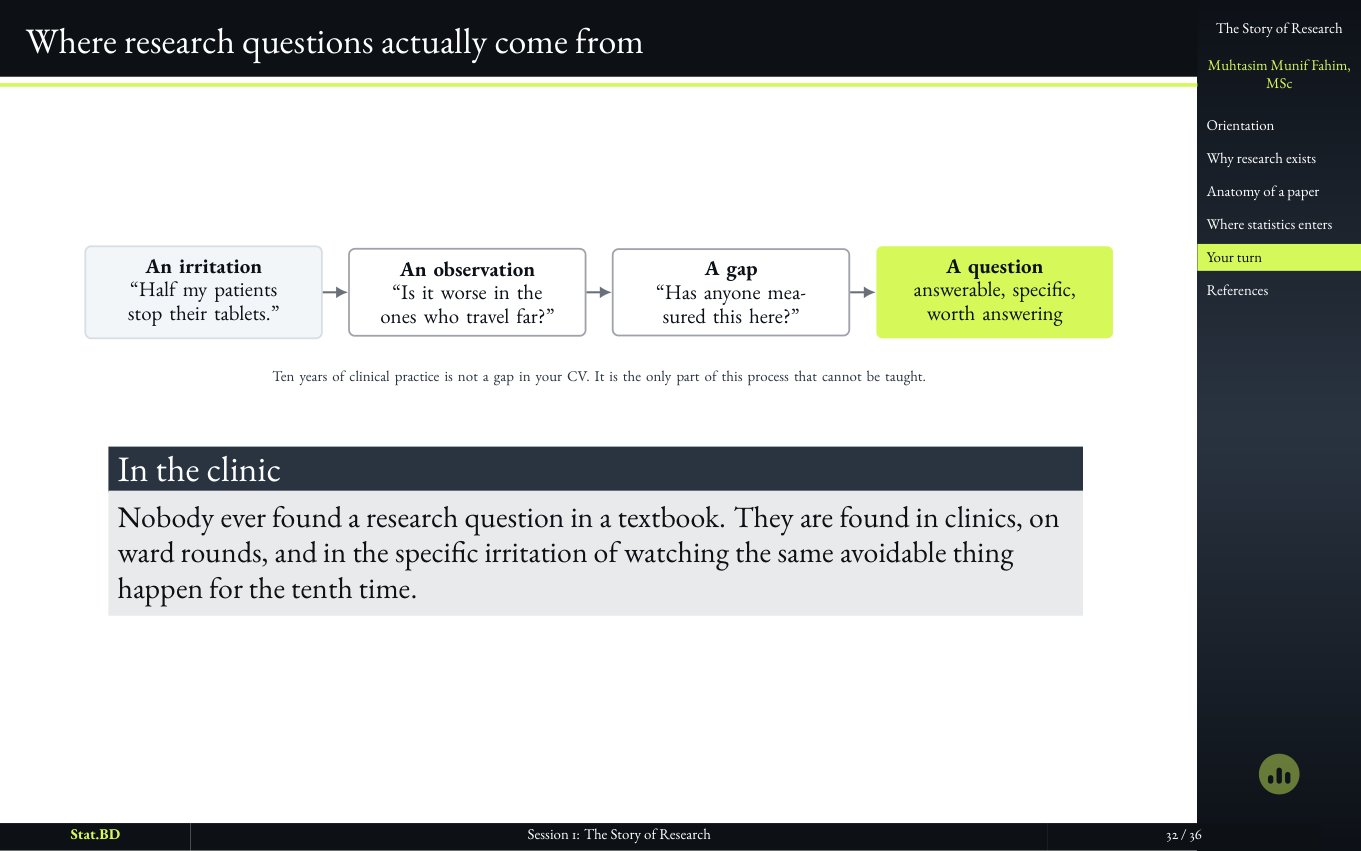
  2. Session 1, Act IV · Your turn: Where research questions actually come from.

    Slide 32

    Where research questions actually come from

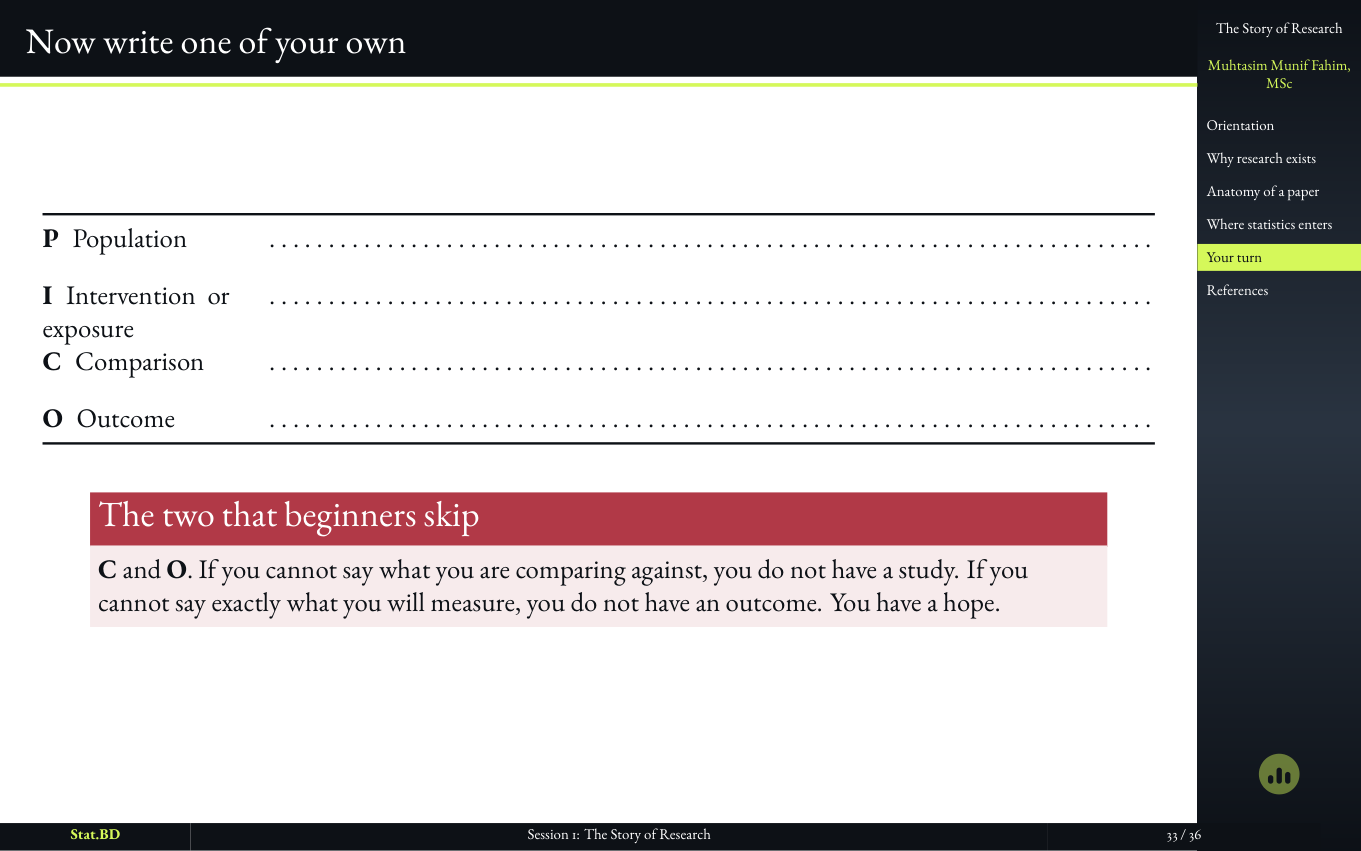
  3. Session 1, Act IV · Your turn: Now write one of your own.

    Slide 33

    Now write one of your own

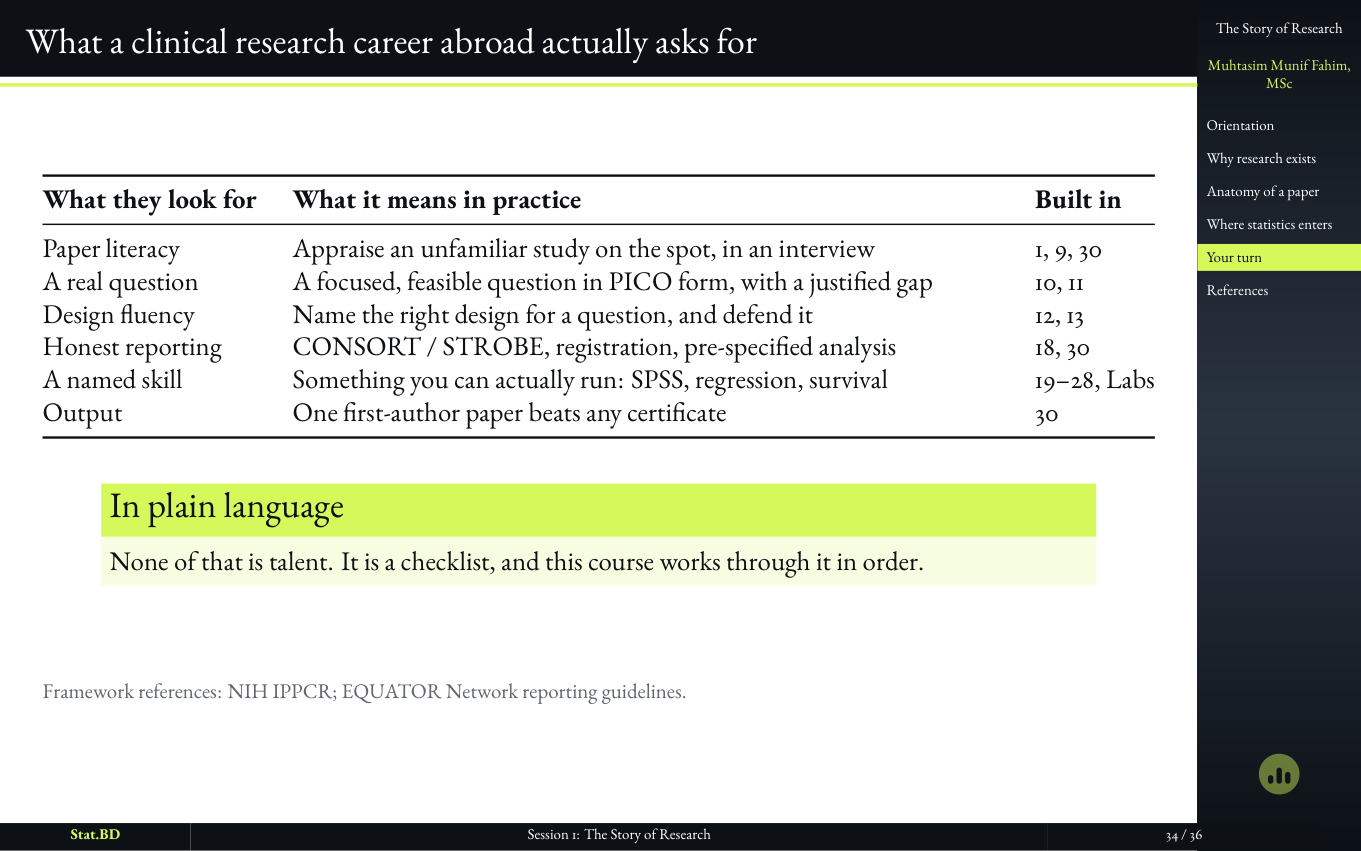
  4. Session 1, Act IV · Your turn: What a clinical research career abroad actually asks for.

    Slide 34

    What a clinical research career abroad actually asks for

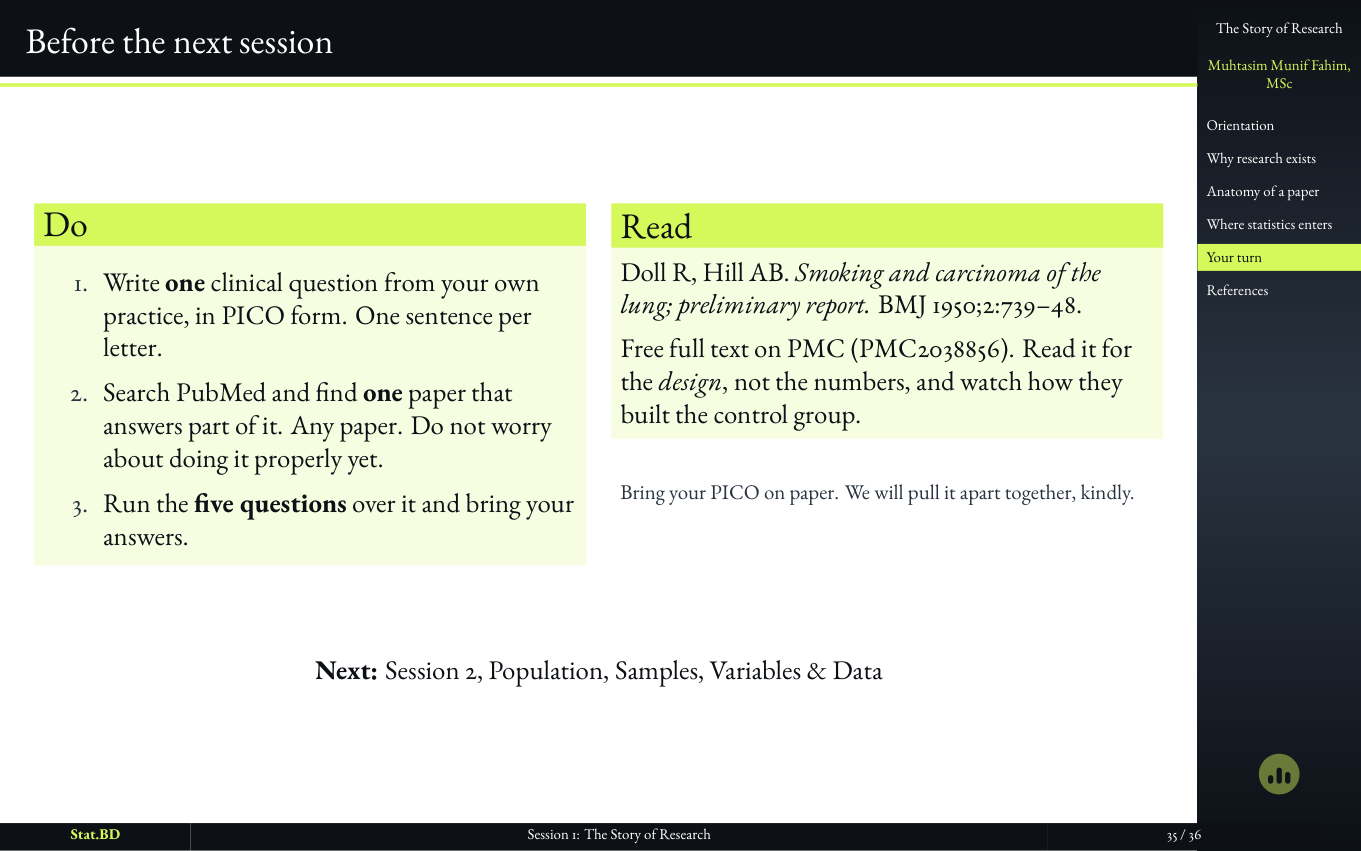
  5. Session 1, Act IV · Your turn: Before the next session.

    Slide 35

    Before the next session

  6. Session 1, Act IV · Your turn: Where we started.

    Slide 36

    Where we started

Named and stopped

What We Deliberately Did Not Teach Yet.

  • How a paper is appraised in full (Session 9).
  • How large a sample needs to be (Session 17).
  • The construction of a p value (Session 8).

Next session

Session 2: Population, Samples, Variables & Data

The next class is already up. Or request a plan built around your own question.