12
Classes a Month
Live and one-to-one, each at a time agreed with you.
1:1 Research Mentorship
Want to learn research from the beginning, at your own pace? Is your analysis stuck on one step, or has a reviewer asked for a method you never learned? Or do you need R, Stata, or a new method for work, without sitting through a whole course? In 1:1 Mentorship, one mentor teaches only you, on your curriculum, at your times.
Register with a short request. We write your plan and agree it with you before the first class.
Who It Is For
1:1 Mentorship is mainly for professionals and researchers, in Bangladesh or abroad, whose needs do not fit a shared course. You can start from the fundamentals or from the step where your work stopped.
You have no project yet, or no research training, and want to learn it step by step: the research question, study design, sampling, data analysis, and writing up results.
Your data is collected or your analysis has started, and one step is holding the work up.
A comment asks for a method or a check you cannot yet explain, and you want to answer it yourself.
A report or project needs one method or one software package, such as R or Stata, not a whole course.
A thesis submission, a revision, or a report date sets the pace, and a shared course will not move that fast.
How It Works
One mentor teaches only you. Before the first class we learn your question, your deadline, and where you are starting, and write your plan around them. There is no fixed syllabus to keep up with.
What is set for you:
Curriculum: the topics and their order follow your question.
Time: class days and times are set around your schedule.
Pace: we go back over a step you missed, and move on when you are ready.
Software: SPSS, R, Stata, Python, or Excel, whichever your work uses.
You do not need a tidy question. Tell us where the work stopped, and the first classes are built around getting it moving again.
Say a reviewer writes:
Justify the use of logistic regression and report how well the model fits.
Your first classes might cover:
Why your outcome calls for logistic regression
Checking the model’s assumptions on your own data
Reading odds ratios and their confidence intervals
Which measures of fit to report, and what they show
Writing the answer to the reviewer yourself
You leave able to answer this comment yourself, and the next one too.
We teach the method and work through it with you. We do not write your response, thesis, or paper for you.
Sample Classes
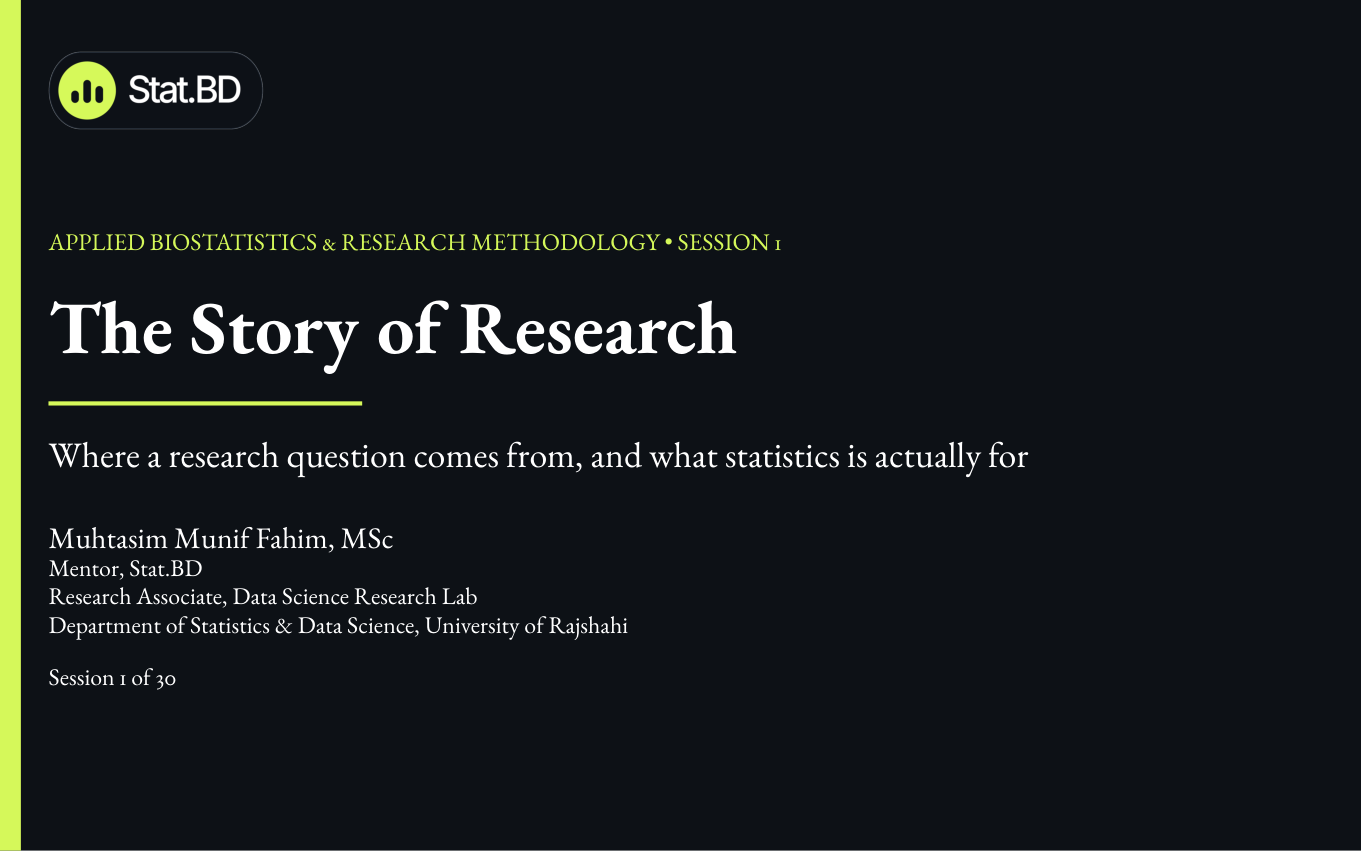
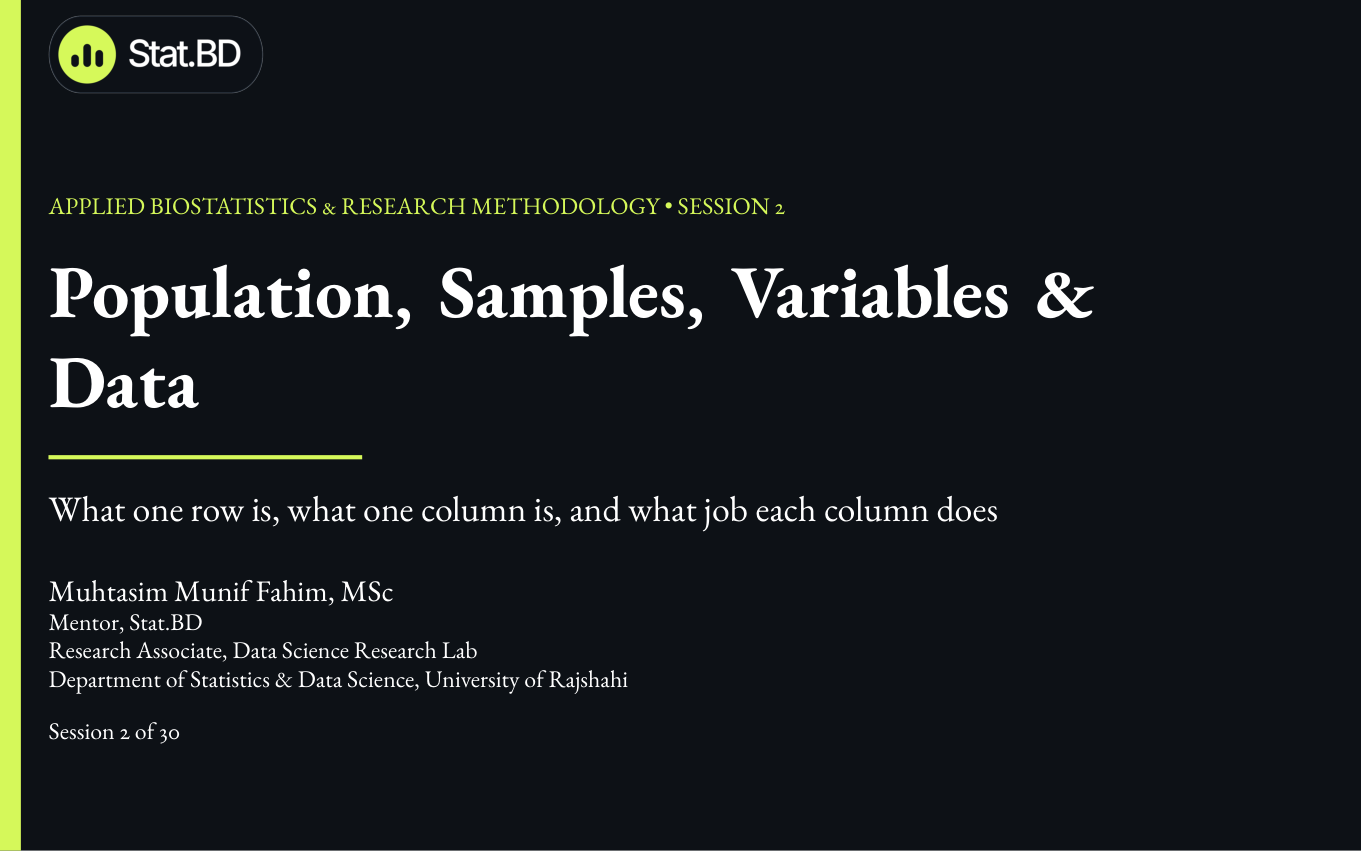
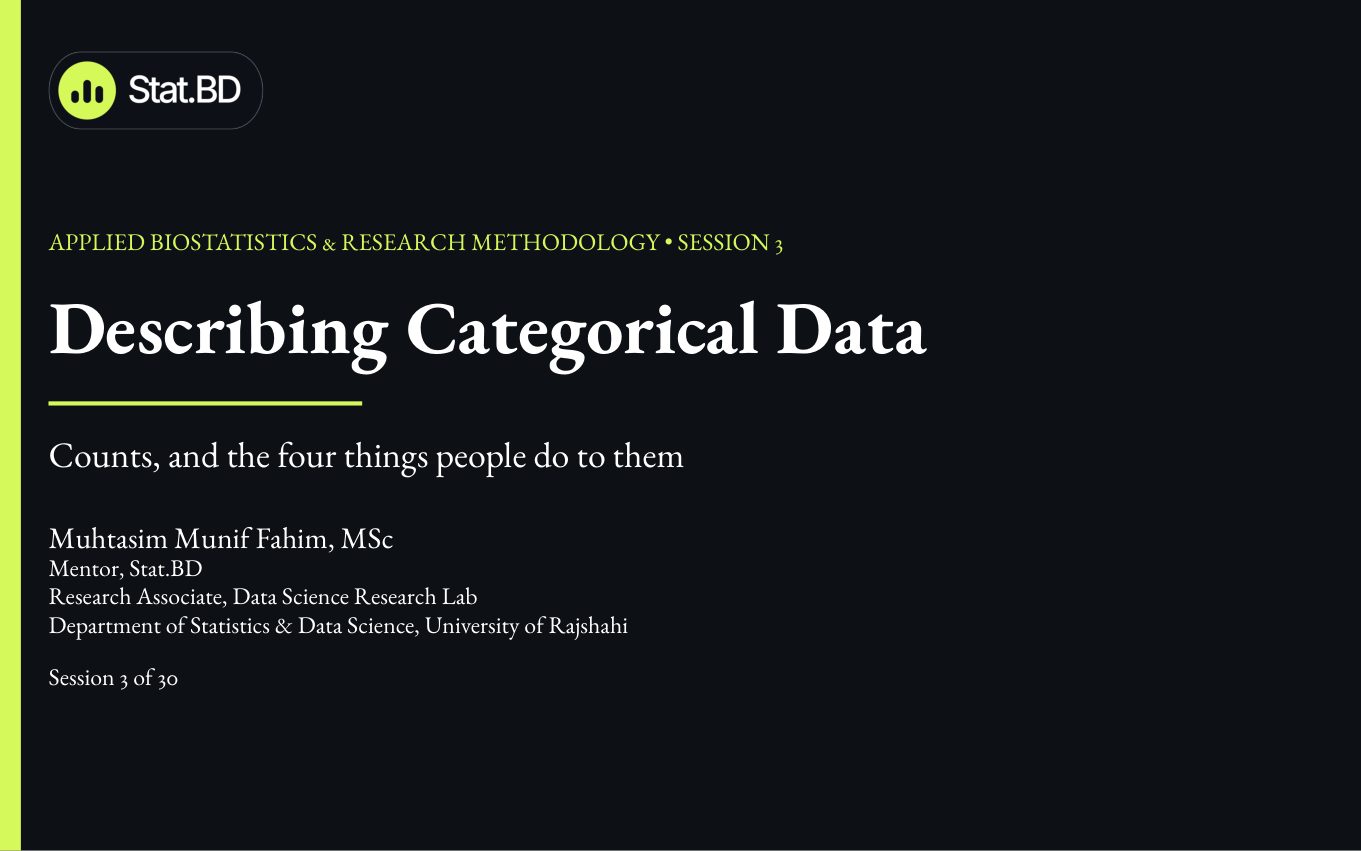
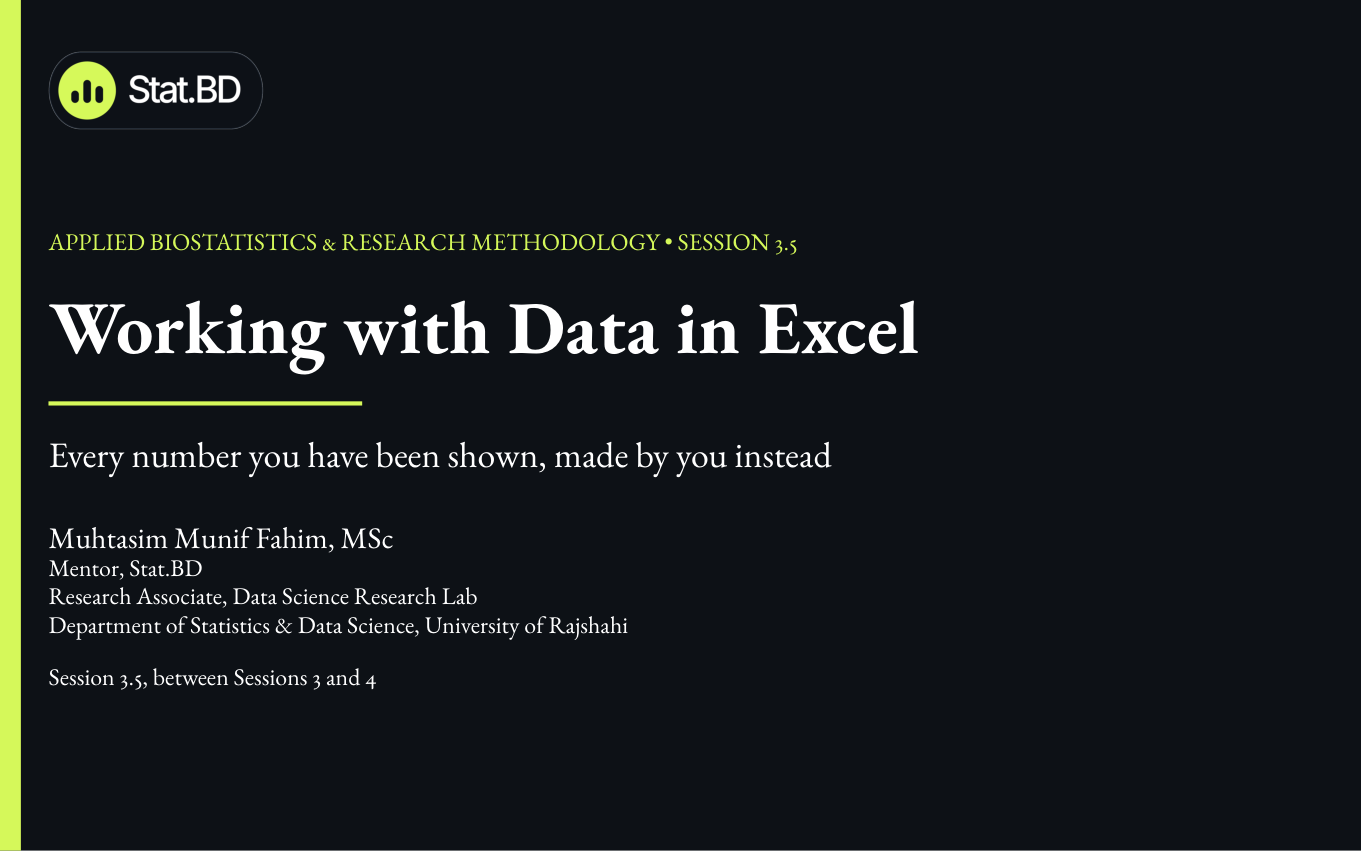
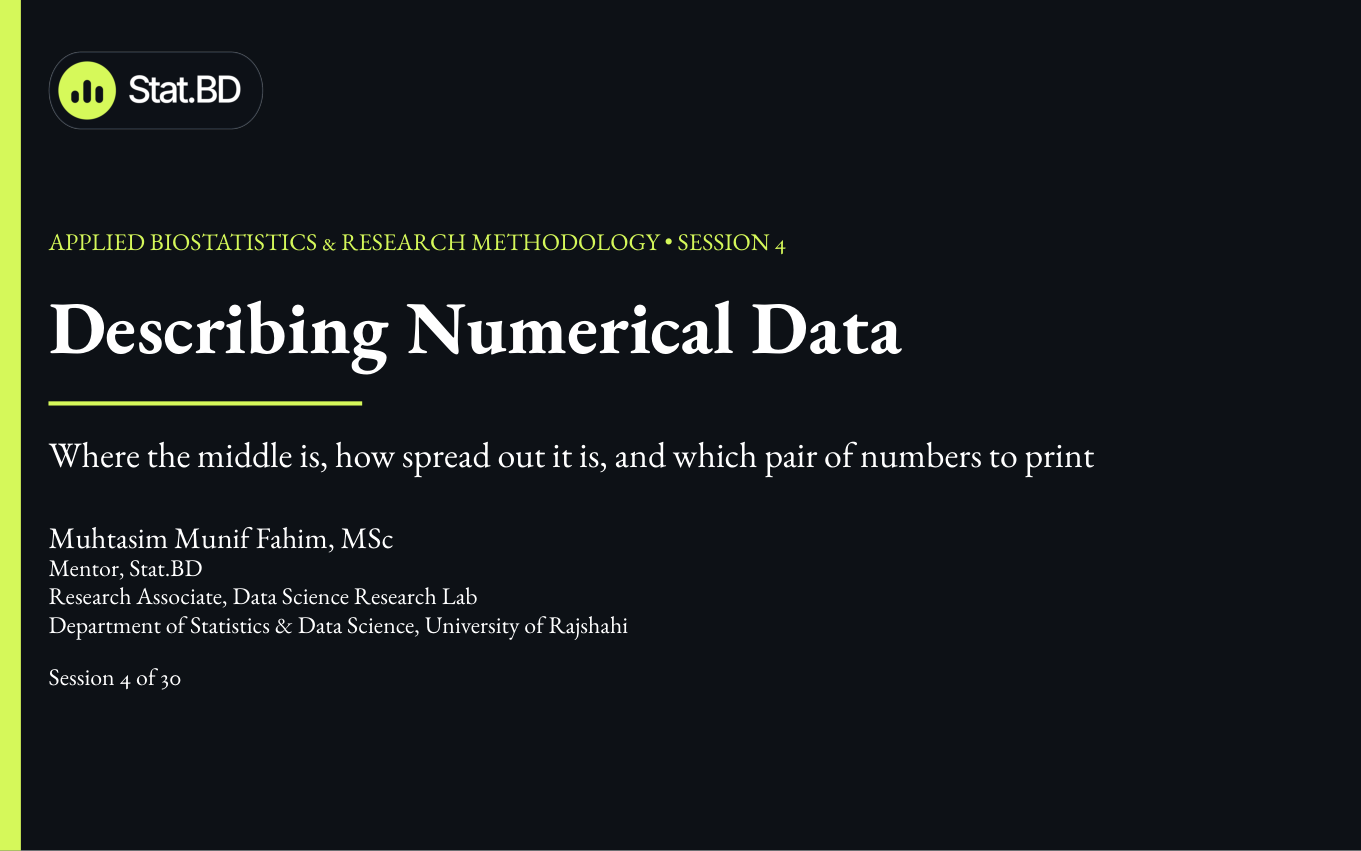
These slides are from a one-to-one class, planned around that student’s needs. Click a slide to open the session: the live slides and the notes the student keeps. We prepare the same way for other questions and other fields.
A method that makes sense in class can stall on your own data. So your mentor stays with your work between classes as well.
12
Live and one-to-one, each at a time agreed with you.
Each class gets its own slides, made for you and that session.
Written class notes, typically thirty to forty pages, drawing on textbooks, papers, and the mentor’s own research.
Get stuck between classes and you can ask. A person answers, not a recording.
Who Teaches
Stat.BD was started by a few young researchers connected to the Department of Statistics and Data Science at the University of Rajshahi. Our team members work in research methodology, statistical analysis, survey research, machine learning, and many kinds of applied research.
When we teach, we focus on the problems we run into in our own research. Beyond what a textbook says about a method, we discuss why it is used in real studies and where mistakes are likely.
We choose your mentor to match your field and your question. Some students work with more than one mentor, always one-to-one.
About Our TeamStat.BD is an independent research and mentorship initiative. This is not an official course or degree program of the University of Rajshahi.
Student Reviews
In their own words, including what they think we should do better.
My main issue with online courses has always been that I finish watching everything and then forget half of it when I actually need to use it. Had a similar problem in the beginning here too. I think the course could benefit from more follow-up assignments and feedback. But I did learn how to approach a research question and plan the analysis instead of randomly trying different tests. Still not an expert obviously, but definitely more confident than before.
থিসিসের ডেটা কালেকশনের পর প্রায় একমাস কিছু করতে পারি নাই। কোথা থেকে শুরু করব সেটাই বুঝতাম না। Stat.BD থেকে শেখার পর অন্তত নিজের অ্যানালাইসিসটা শুরু করতে পেরেছি। আগে সুপারভাইজার মেথড নিয়ে কিছু জিজ্ঞেস করলে ভয় লাগত। এখন সব না পারলেও নিজের কাজটা মোটামুটি বুঝিয়ে বলতে পারি। আমার জন্য এটাই অনেক।
Stat.BD এর teaching approach ভালো লেগেছে। But I think assignment গুলা আরেকটু challenging হওয়া উচিত। কারণ practice dataset এ সবকিছু মোটামুটি clean থাকে, নিজের research data তো এত clean না ভাই 🙂 প্রথমবার নিজের dataset নিয়ে বেশ ঝামেলায় পড়ছিলাম। যদিও এখন অনেক কিছু নিজে solve করতে পারি। Overall fundamentals clear করার জন্য ভালো, but advanced level এ যেতে আরো practice লাগবে।
Good course overall, but I wish there were more exercises with messy real-world datasets. The examples during class made sense, but when I tried my own data it wasn't that straightforward lol. That being said, the explanations of statistical tests and assumptions were genuinely helpful. I now understand a lot of things that I used to just memorize for exams.
আমার কাছে কোর্সের সবচেয়ে ভালো দিক ছিল যে শুধু SPSS শেখানোর মধ্যে সীমাবদ্ধ ছিল না। রিসার্চের প্রশ্ন থেকে শুরু করে অ্যানালাইসিস পর্যন্ত একটা ধারনা পেয়েছি। তবে একটা বিষয় বলব, কিছু টপিকের পরে আরও বেশি প্র্যাকটিস করানো দরকার। কারণ ক্লাসে বুঝলেও বাসায় এসে একা করতে গেলে আবার আটকে গেছি কয়েকবার। তারপরও আগের তুলনায় অনেক ভালো অবস্থায় আছি।
I joined mainly for my thesis, and I was expecting more of a software training course. The first few sessions were a bit too theoretical for me tbh. But later I realised why those basics were important. I had previously watched tons of tutorials, still couldn't decide which test to use on my own data. I wouldn't say I can do everything independently now, but I can at least figure out what I'm supposed to do and why. That's a pretty big improvement for me.
ভালোই ছিল কোর্সটা। তবে যারা একদমই স্ট্যাটিস্টিকস জানে না তাদের শুরুতে একটু সমস্যা হতে পারে। আমারও প্রথম কয়েকটা ক্লাস বুঝতে কষ্ট হইছে। পরে রেকর্ডিং আর প্র্যাকটিস করে বুঝছি। আসলে শুধু ক্লাস করলে হবে না নিজে ডেটা নিয়ে বসতে হবে। এই জিনিসটা আগে বুঝলে আরো ভালো হতো।
I liked the course but honestly সবকিছু যে একবারেই বুঝেছি এমন না। Especially regression part টা আমার কাছে একটু difficult ছিল। আর কিছু জায়গায় আরো examples দিলে ভালো হতো। But the good thing is, এখন অন্তত জানি analysis করার আগে কি কি চিন্তা করতে হয়। আগে শুধু YouTube দেখে SPSS এ click করতাম, output আসতো কিন্তু বুঝতাম না 😭 এখন নিজের thesis এর জন্য কাজ করতে পারছি আলহামদুলিল্লাহ।
একটা জিনিস বলি, আগে ভাবতাম research মানেই অনেক complex কিছু, আমার দ্বারা হবে না। Stat.BD করার পর এই ভয়টা কিছুটা কমছে। এখন paper পড়ার সময় methodology section skip করি না আগের মতো 😂
তবে class এর বাইরে individual feedback আরেকটু বেশি পেলে ভালো হতো। কিছু জায়গায় নিজে try করতে গিয়ে আটকে গেছি। But overall experience positive ছিল।
সত্যি বলতে আমি আগে SPSS এর অনেক টিউটোরিয়াল দেখছি, কিন্তু নিজের থিসিসের কাজ করতে গিয়ে বুঝলাম আসলে কিছুই ঠিকমতো শিখি নাই 😅 Stat.BD এর ক্লাসগুলো করে বেসিক জিনিসগুলো অনেকটা ক্লিয়ার হইছে। বিশেষ করে কোন টেস্ট কেন করব এটা আগে বুঝতাম না। এখন নিজের ডেটা নিয়ে কাজ করতে পারছি। তবে কিছু ক্লাস একটু ফাস্ট মনে হইছে, নতুনদের জন্য আরেকটু স্লো হলে ভালো হতো।
How to Start
Sign in and tell us what you want to learn, where you are starting, any deadline, and when you are free. It takes a few minutes.
We read your answers and contact you by email or phone to talk through the plan and the class times.
Once you approve the plan, we assign your mentor and the classes begin at the times you chose.
BDT 1,500 per class. A month is 12 classes, so BDT 18,000 a month. That covers the live class, the slides and written chapter made for it, and questions between classes.
We talk first: the goal, the deadline, the software, and where you are starting. Then we write a curriculum for you and send it. Classes start when you approve it, not before. The sample classes on this site come from one live program; they are not the plan you would receive.
At times agreed with you. On the registration form you tell us which days and times suit you, and we set the classes around them. Each class is 60–120 minutes, online.
The slides from that class, and a written chapter, typically thirty to forty pages. The five public sample classes show both: the live slides and the PDF the student keeps.
No. We teach the method and work through it with you, step by step. We do not complete graded assignments, theses, or reviewer responses for you, and we do not promise marks or acceptance.
Yes. Tell us that on the form, and your plan starts from the fundamentals: how to frame a research question, choose a study design and sample, analyze the data, and write up the results. We move to the next step only when you are ready.
Usually the Research Cohort is a better fit: three to five students learn research methodology, statistics, and software with one mentor over three months, and each completes a study of their own. If you are not sure, email hello@stat.bd with what you need and we will suggest one.
Tell us where your work stands and what you want to learn. We write a plan for you alone, set the classes around your time, and teach you to do the work yourself.
Stat.BD · Learn Research by Doing Research.