3 slides

Orientation

  1. Session 2 title slide: Population, Samples, Variables & Data.

    Slide 1

    Population, Samples, Variables & Data

  2. Session 2, Orientation: Where we left it.

    Slide 2

    Where we left it

  3. Session 2, Orientation: What you will be able to do at the end of today.

    Slide 3

    What you will be able to do at the end of today

7 slides

Act I · Your Question, Turned Into Rows and Columns
  1. Session 2, Act I · Your question, turned into rows and columns: Act I · Your question, turned into rows and columns.

    Slide 4

    Act I · Your Question, Turned Into Rows and Columns
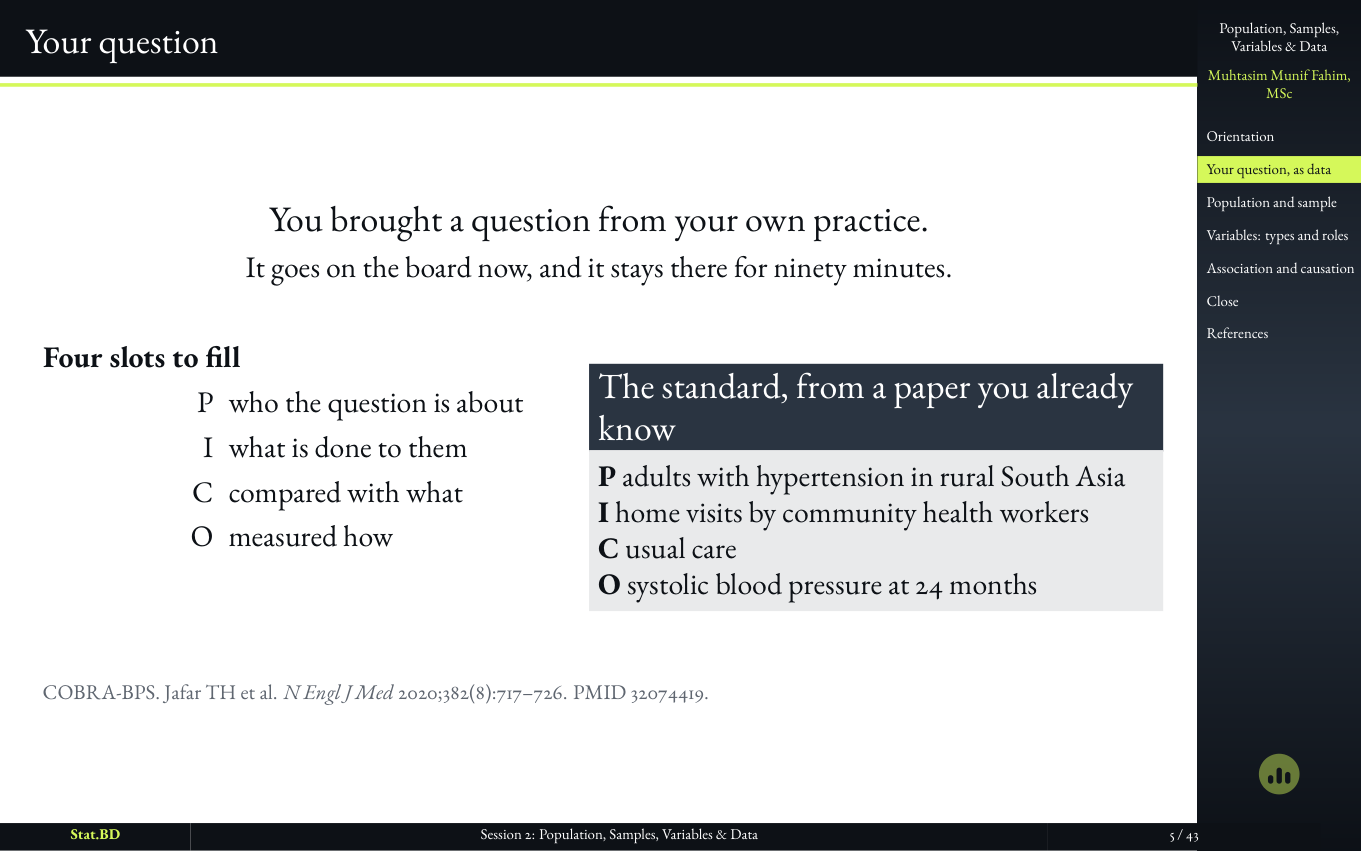
  2. Session 2, Act I · Your question, turned into rows and columns: Your question.

    Slide 5

    Your question

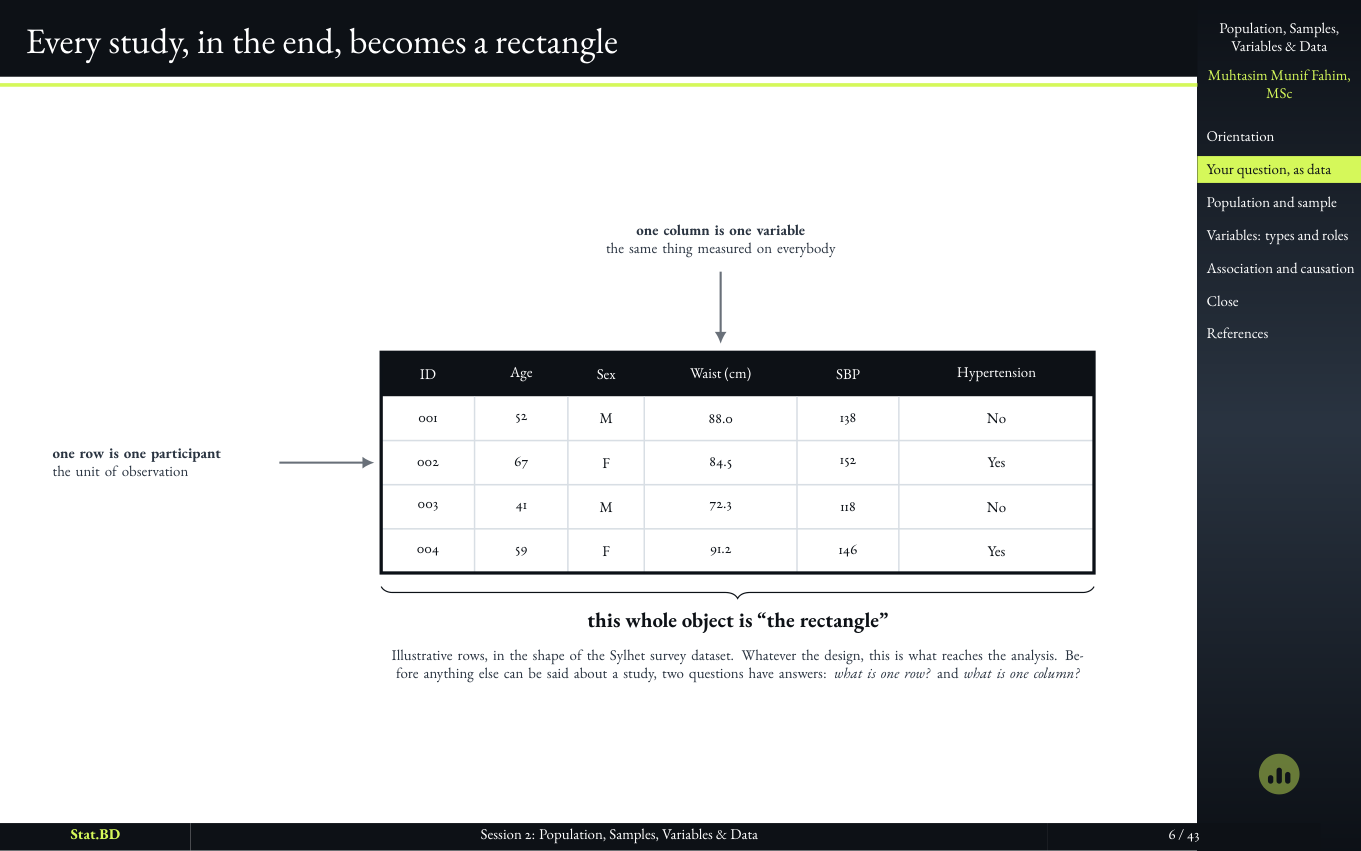
  3. Slide introducing a study as a rectangle of rows and columns.

    Slide 6

    Every study becomes a rectangle

    Before any test, the data have a shape. Rows are the units you measured. Columns are the things you measured on them. The rest of the session lives inside that picture.

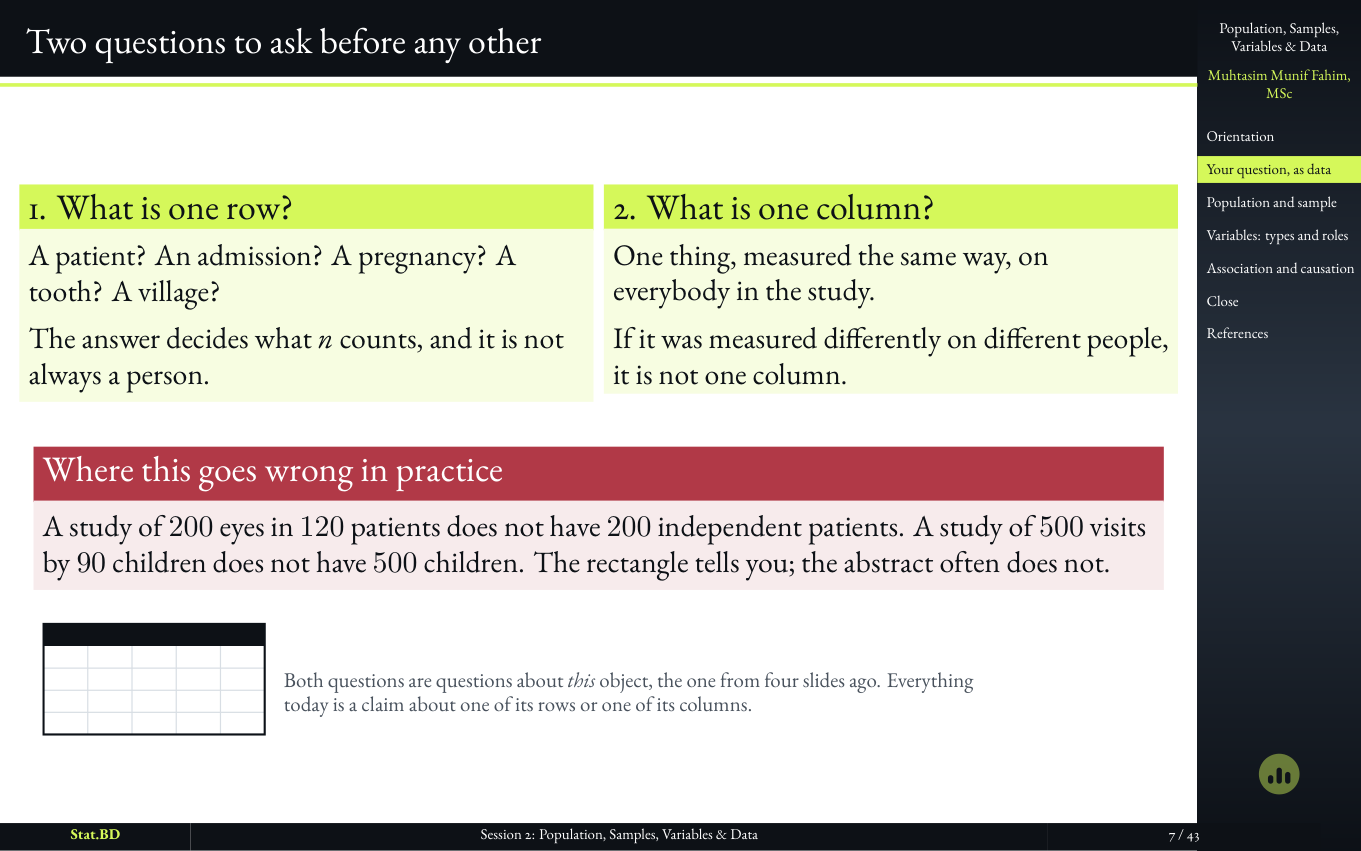
  4. Session 2, Act I · Your question, turned into rows and columns: Two questions to ask before any other.

    Slide 7

    Two questions to ask before any other

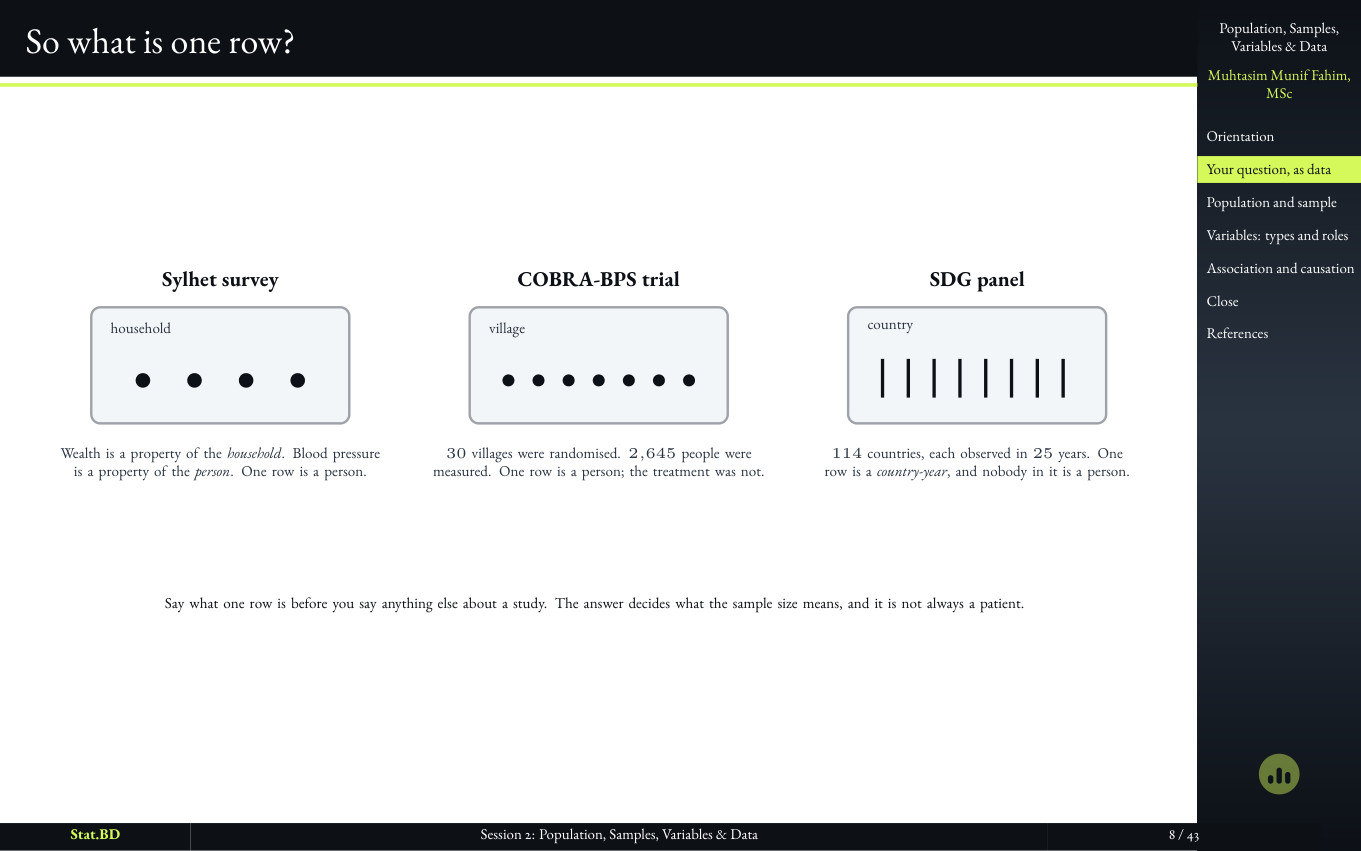
  5. Slide asking what one row of a dataset represents.

    Slide 8

    So what is one row?

    A row is not automatically a person. It is the unit the researcher decided to measure. Eyes, visits, households, and patients are different rows, and mixing them is how a paper quietly changes what it is about.

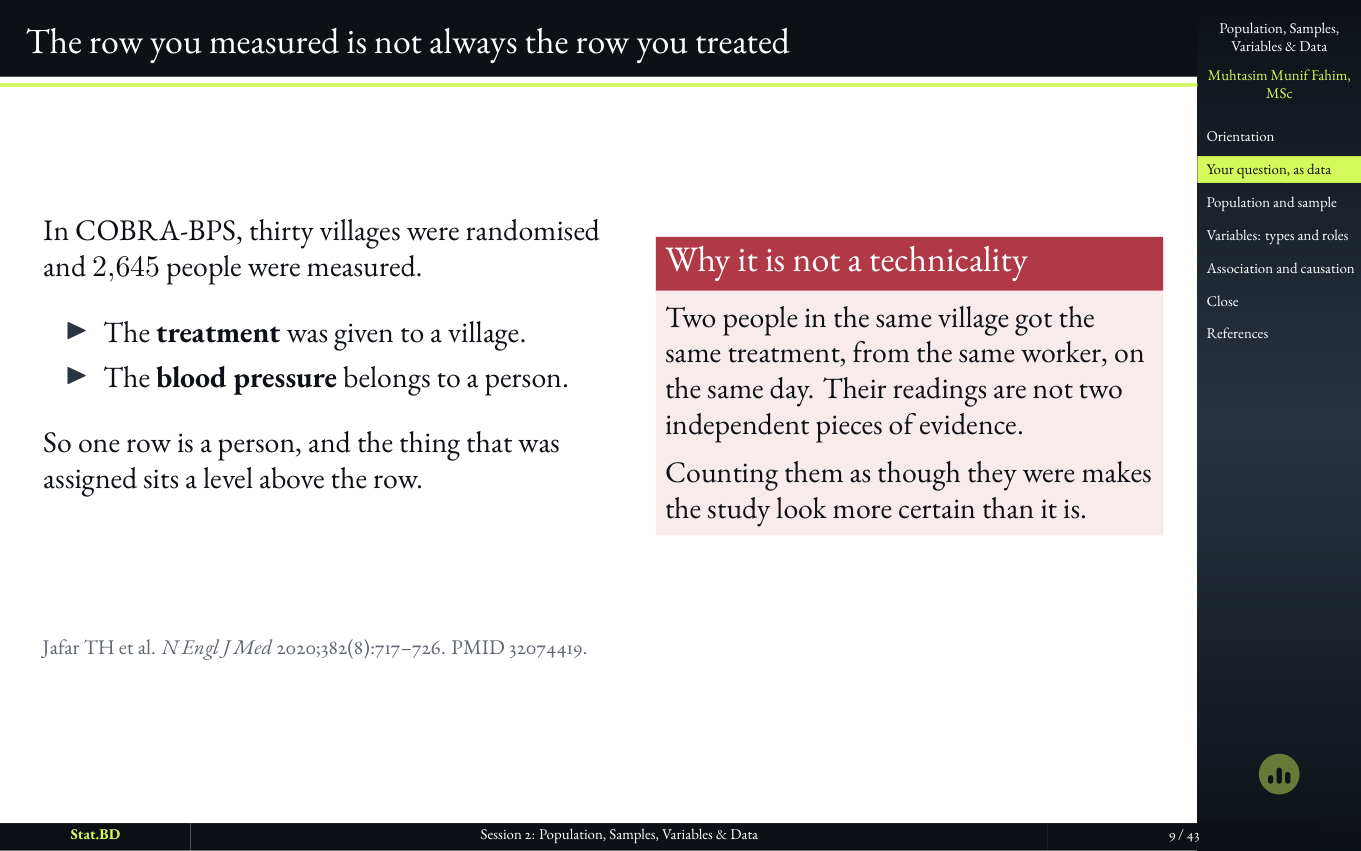
  6. Session 2, Act I · Your question, turned into rows and columns: The row you measured is not always the row you treated.

    Slide 9

    The row you measured is not always the row you treated

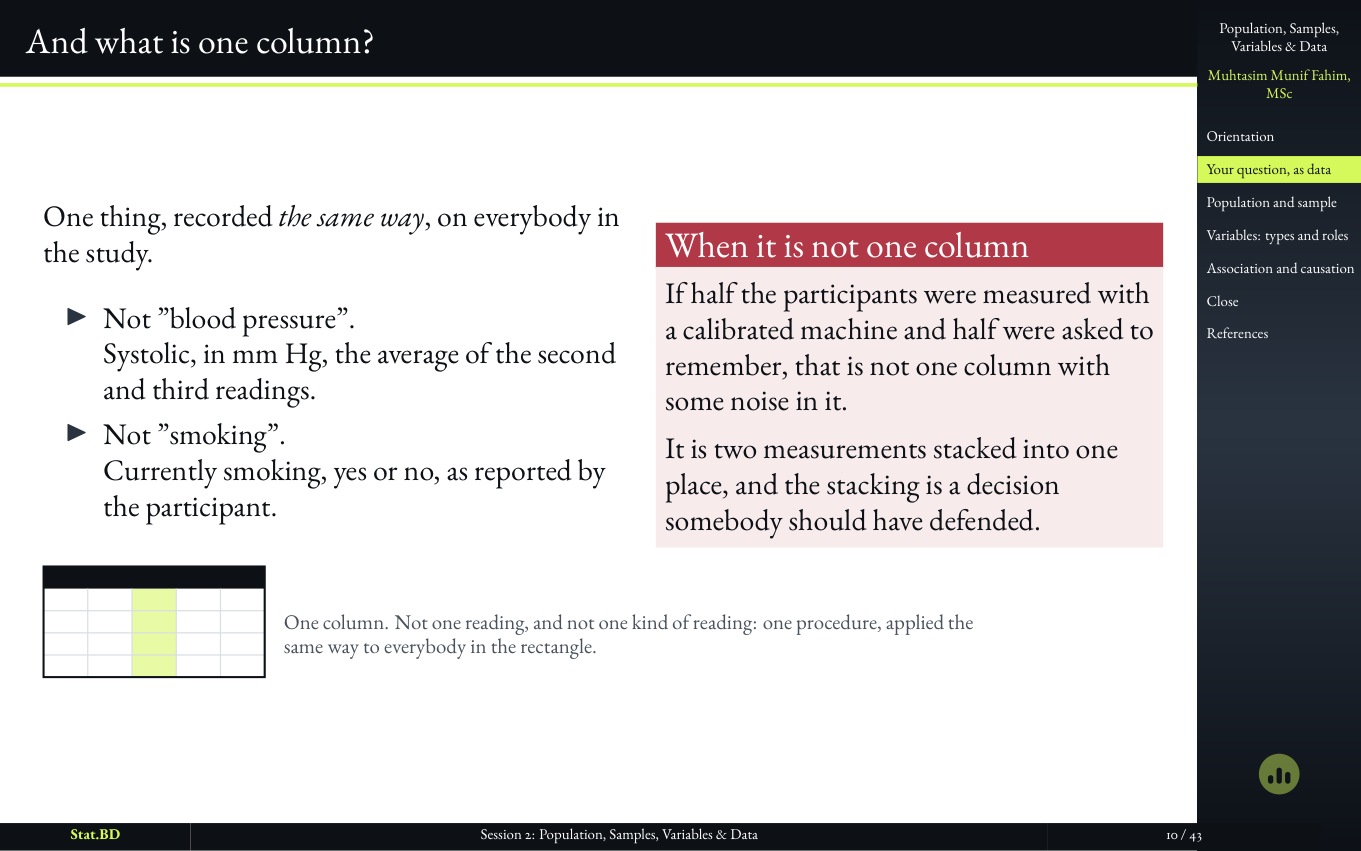
  7. Slide asking what one column of a dataset represents.

    Slide 10

    And what is one column?

    A column is one measured thing, with a type and a job. Until those two are named, a later table is just a pile of numbers with headings.

12 slides

Act II · Who the Study Is Actually About
  1. Session 2, Act II · Who the study is actually about: Act II · Who the study is actually about.

    Slide 11

    Act II · Who the Study Is Actually About
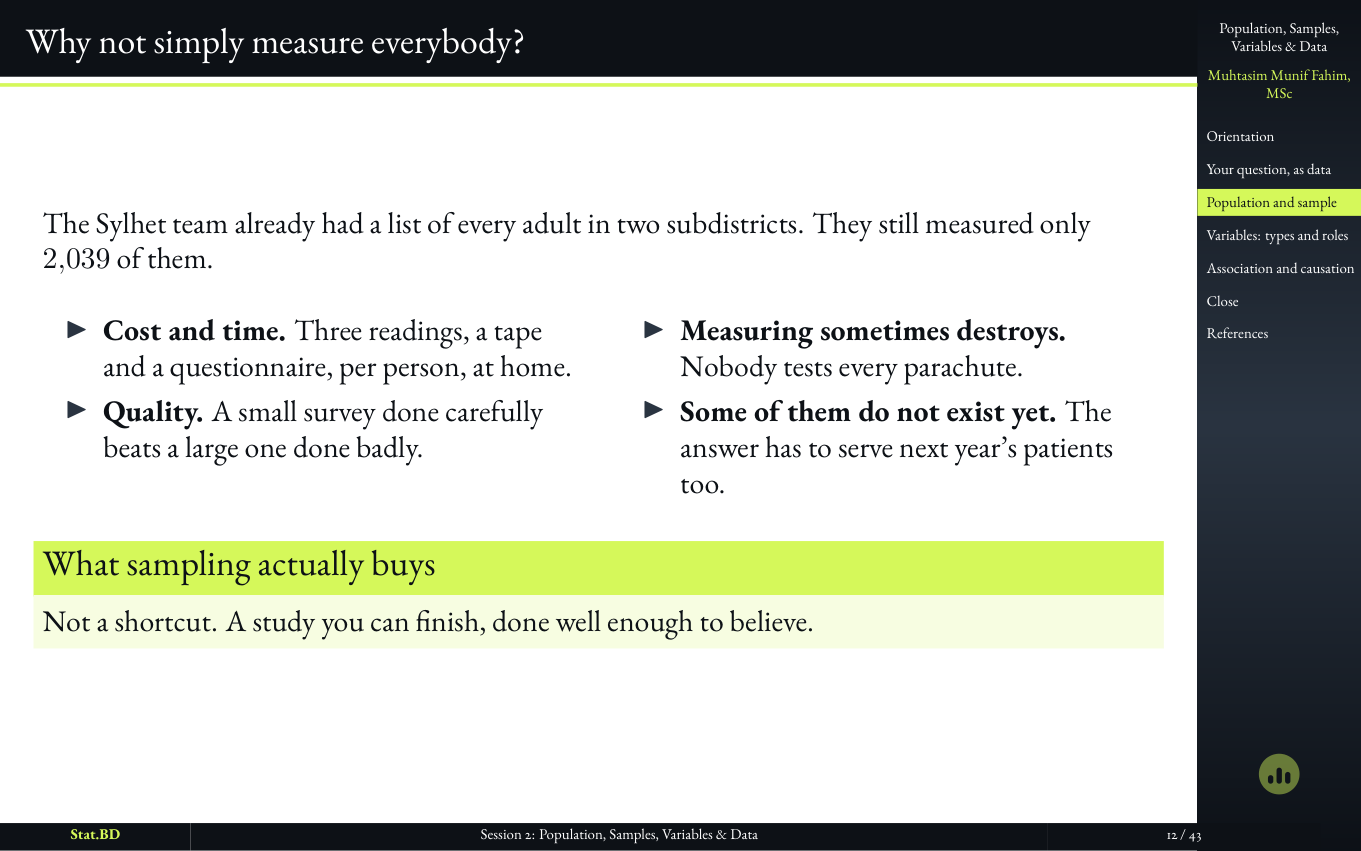
  2. Session 2, Act II · Who the study is actually about: Why not simply measure everybody?.

    Slide 12

    Why not simply measure everybody?

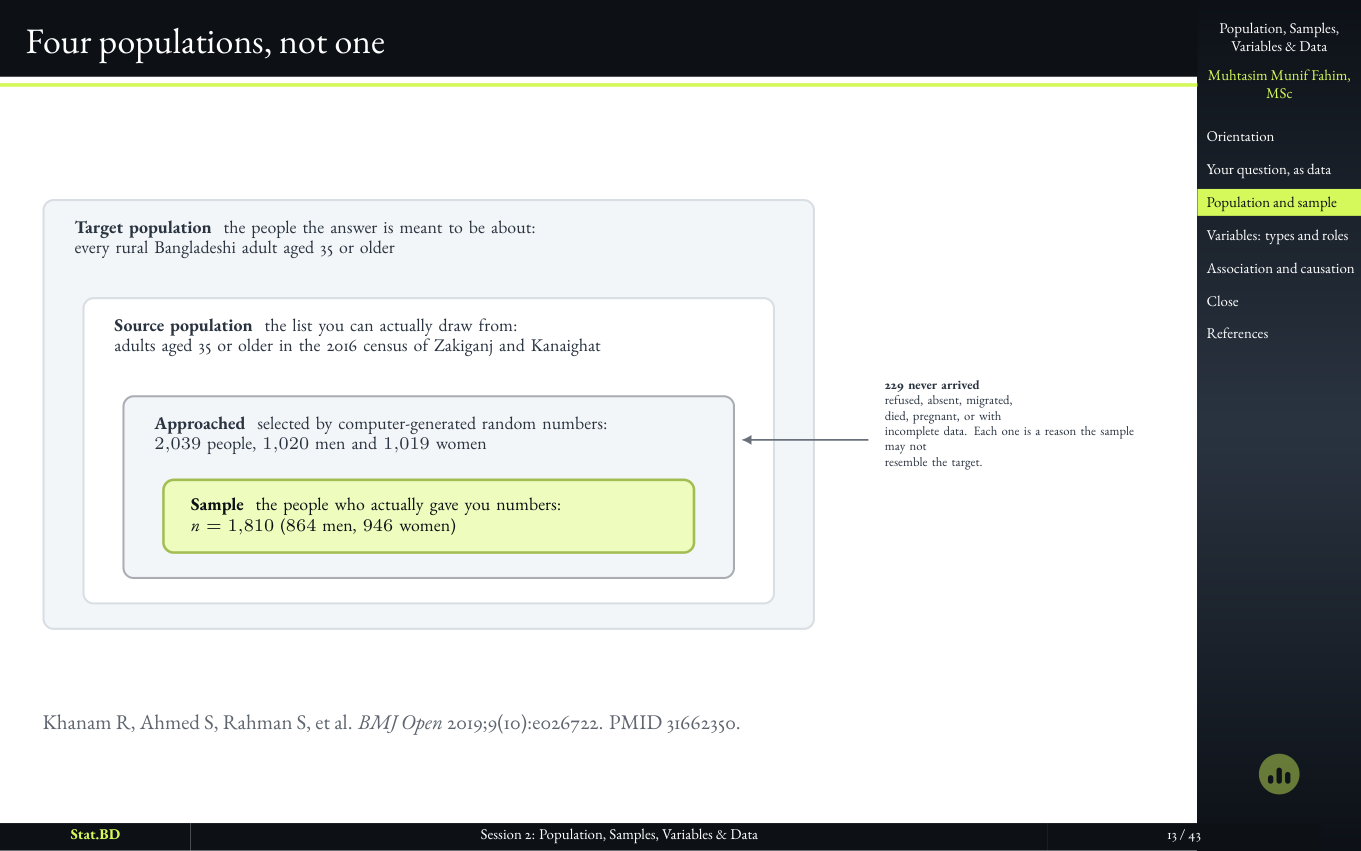
  3. Slide distinguishing four populations in a study.

    Slide 13

    Four populations, not one

    Target, source, sampled, and analyzed are not synonyms. Papers collapse them into one word. The session pulls them apart so a later claim about ‘the population’ has to say which one.

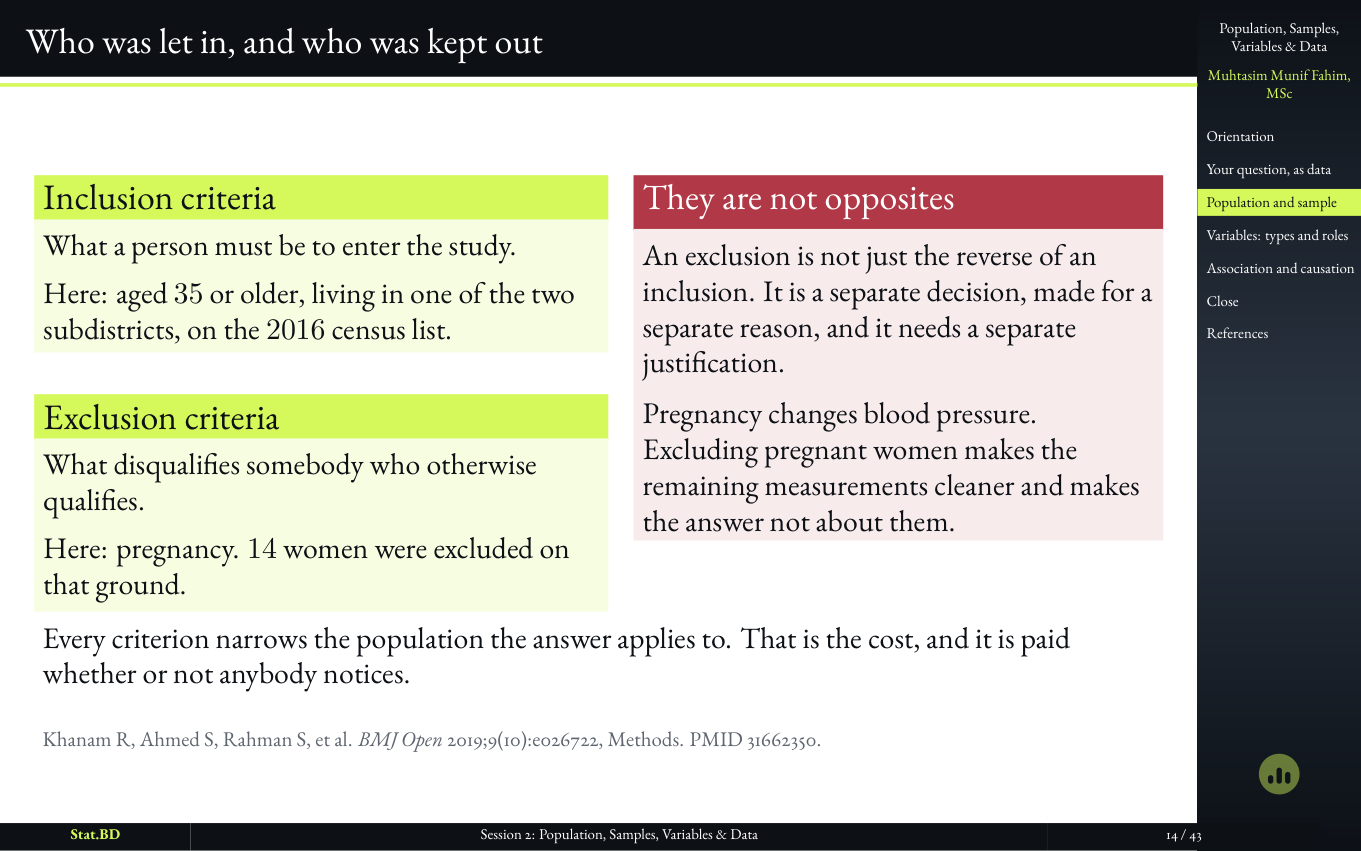
  4. Session 2, Act II · Who the study is actually about: Who was let in, and who was kept out.

    Slide 14

    Who was let in, and who was kept out

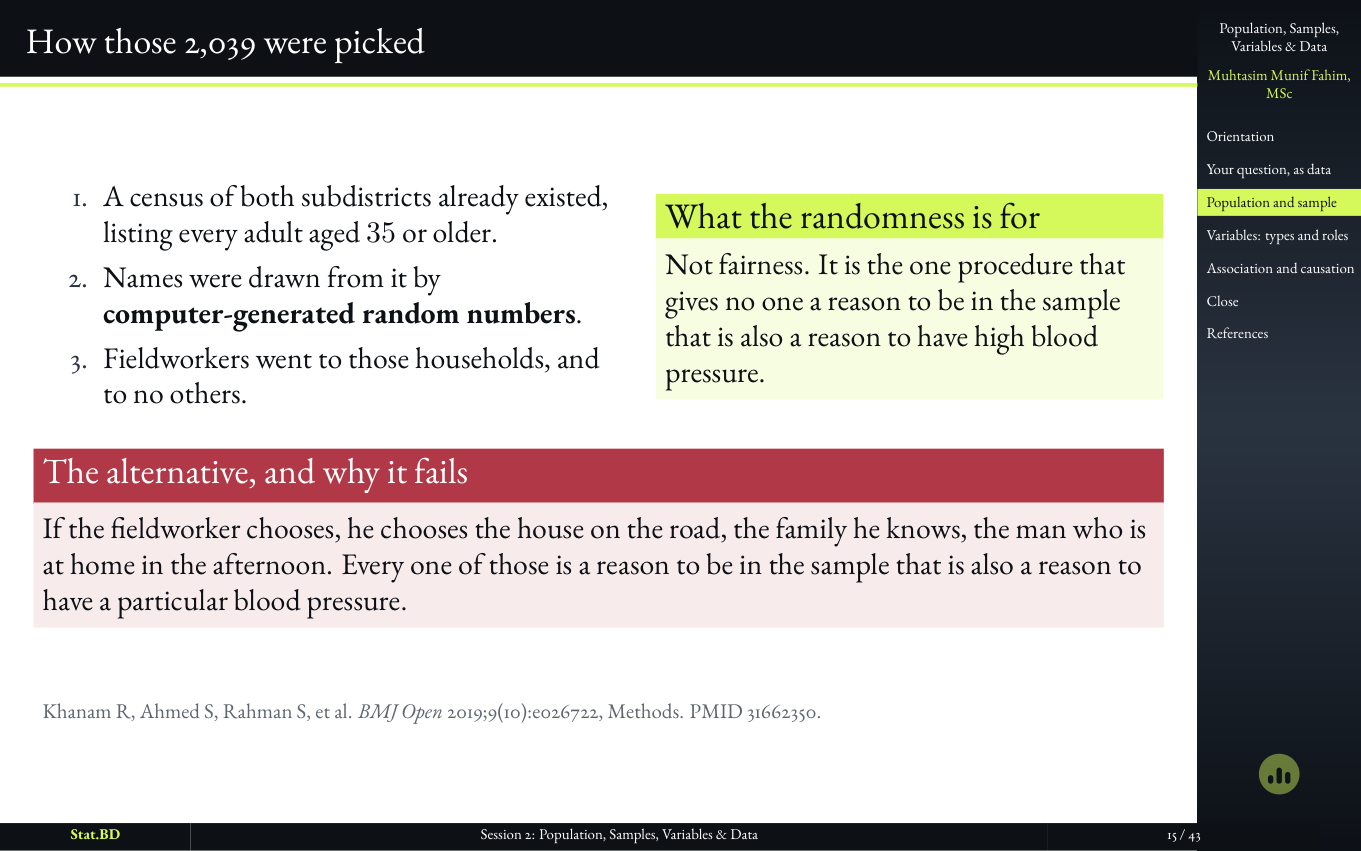
  5. Session 2, Act II · Who the study is actually about: How those 2,039 were picked.

    Slide 15

    How those 2,039 were picked

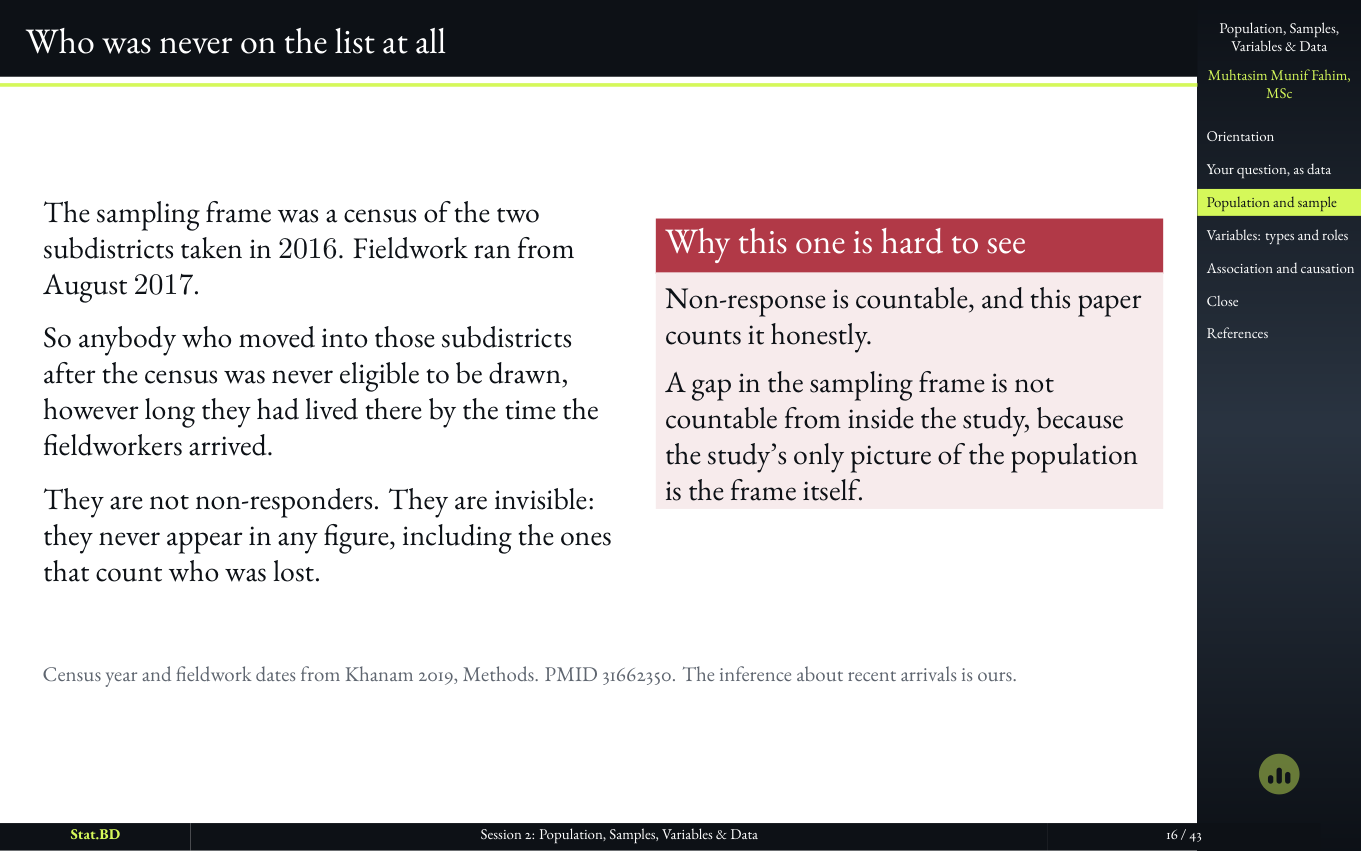
  6. Session 2, Act II · Who the study is actually about: Who was never on the list at all.

    Slide 16

    Who was never on the list at all

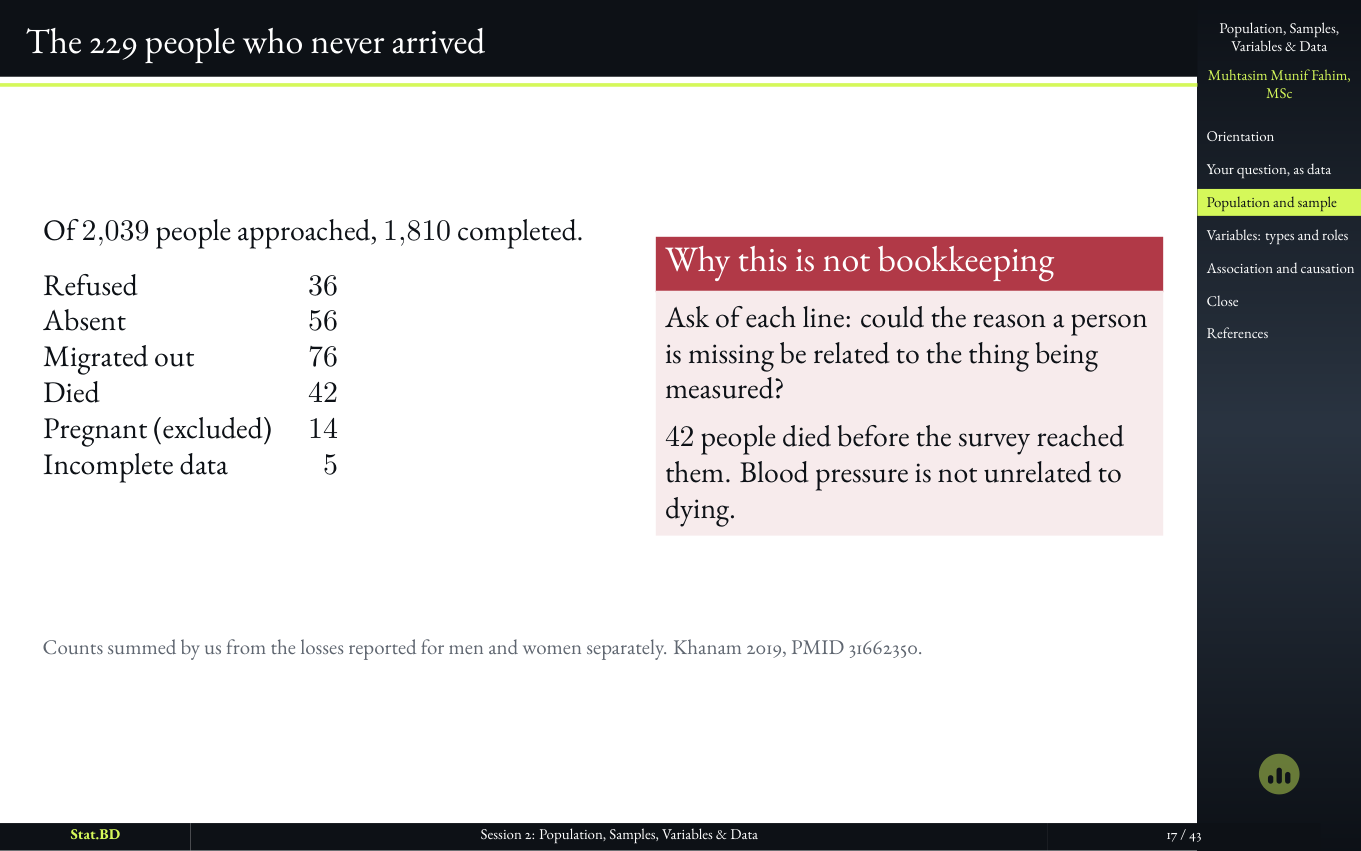
  7. Session 2, Act II · Who the study is actually about: The 229 people who never arrived.

    Slide 17

    The 229 people who never arrived

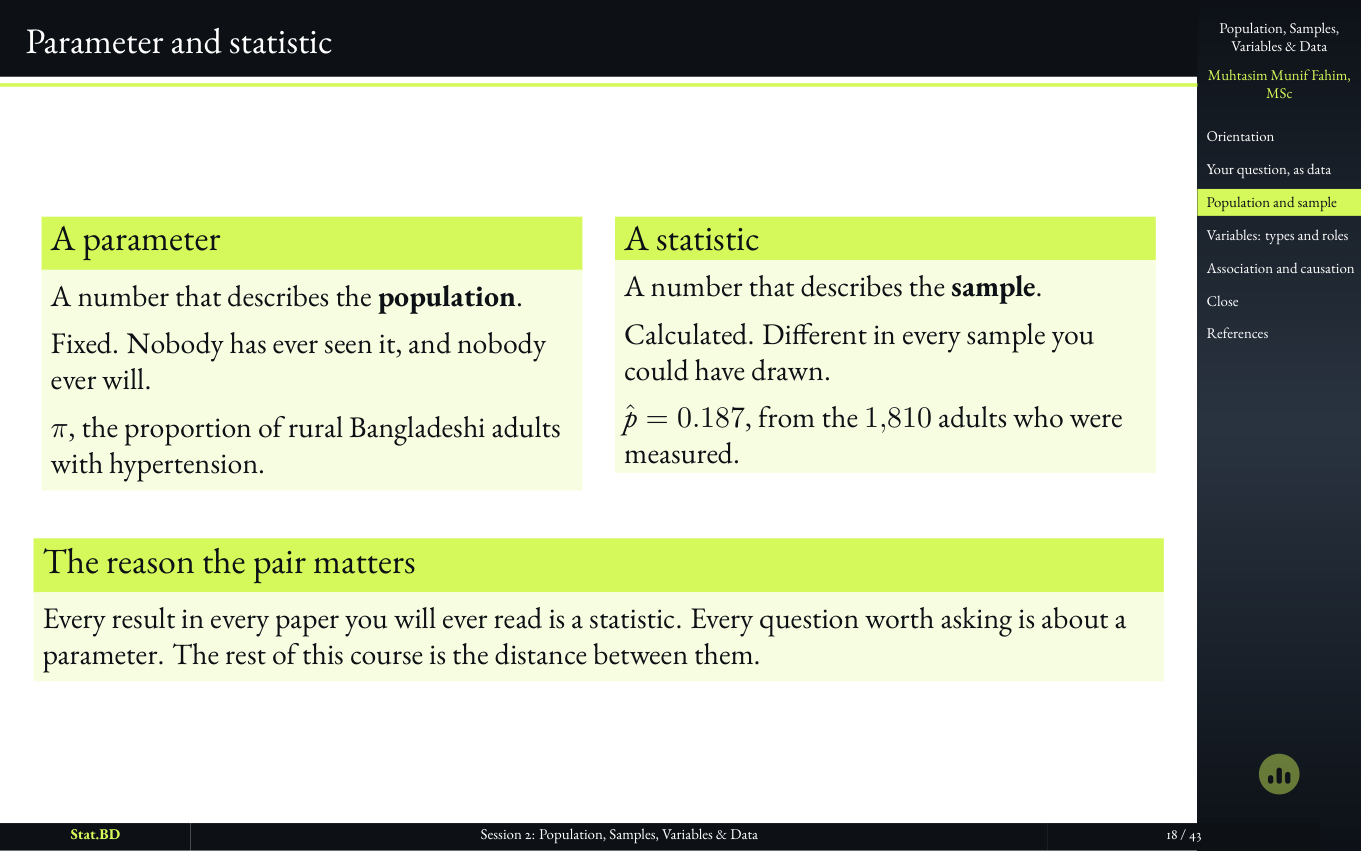
  8. Slide distinguishing a parameter from a statistic.

    Slide 18

    Parameter and statistic

    The parameter lives in the population you did not measure. The statistic lives in the sample you did. Session 1’s backwards arrow now has names on both ends.

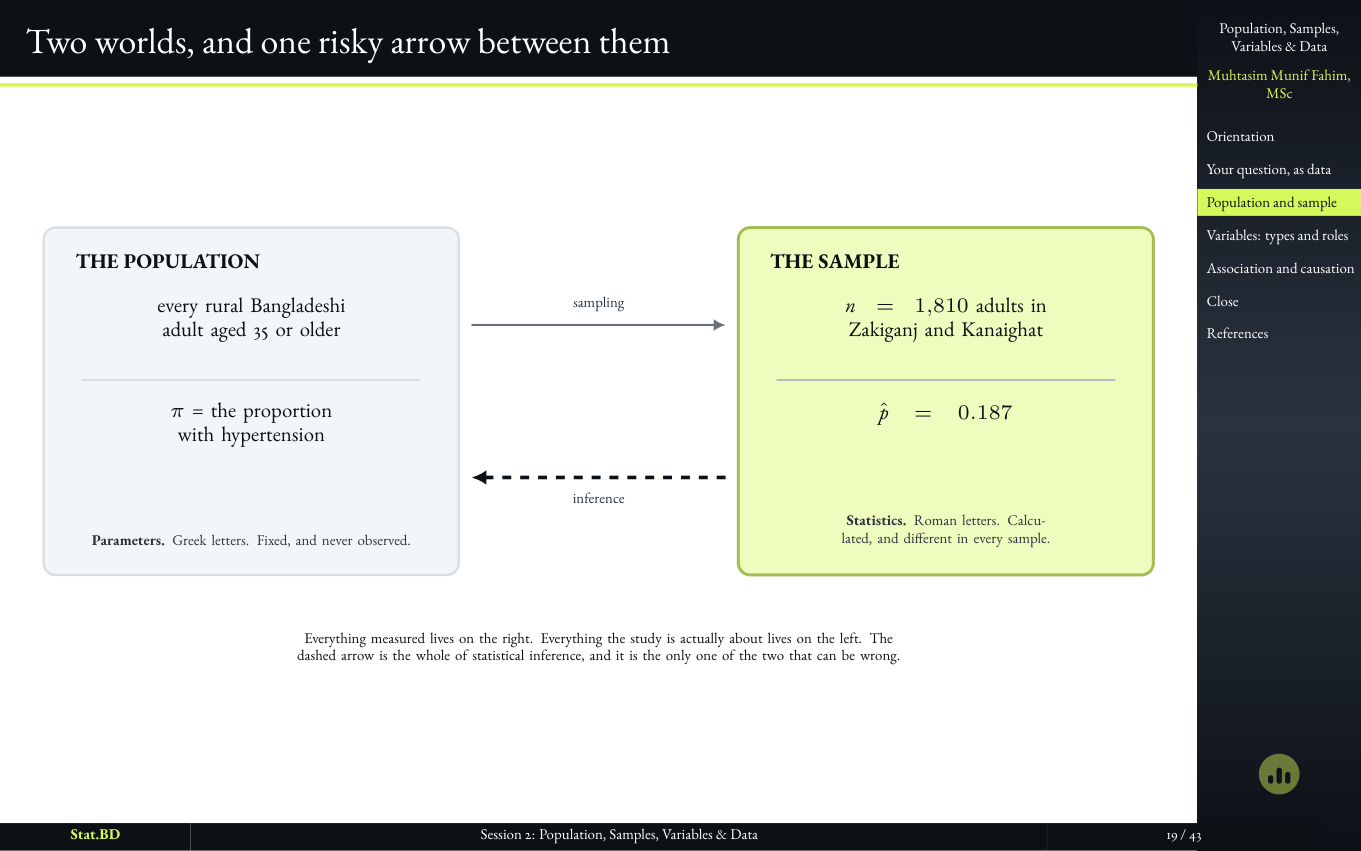
  9. Slide showing the risky arrow from sample statistic to population parameter.

    Slide 19

    Two worlds, and one risky arrow

    Everything later (standard error, confidence intervals, p values) is an attempt to say how much risk that arrow carries. Those tools are named and left. Today only names the two worlds.

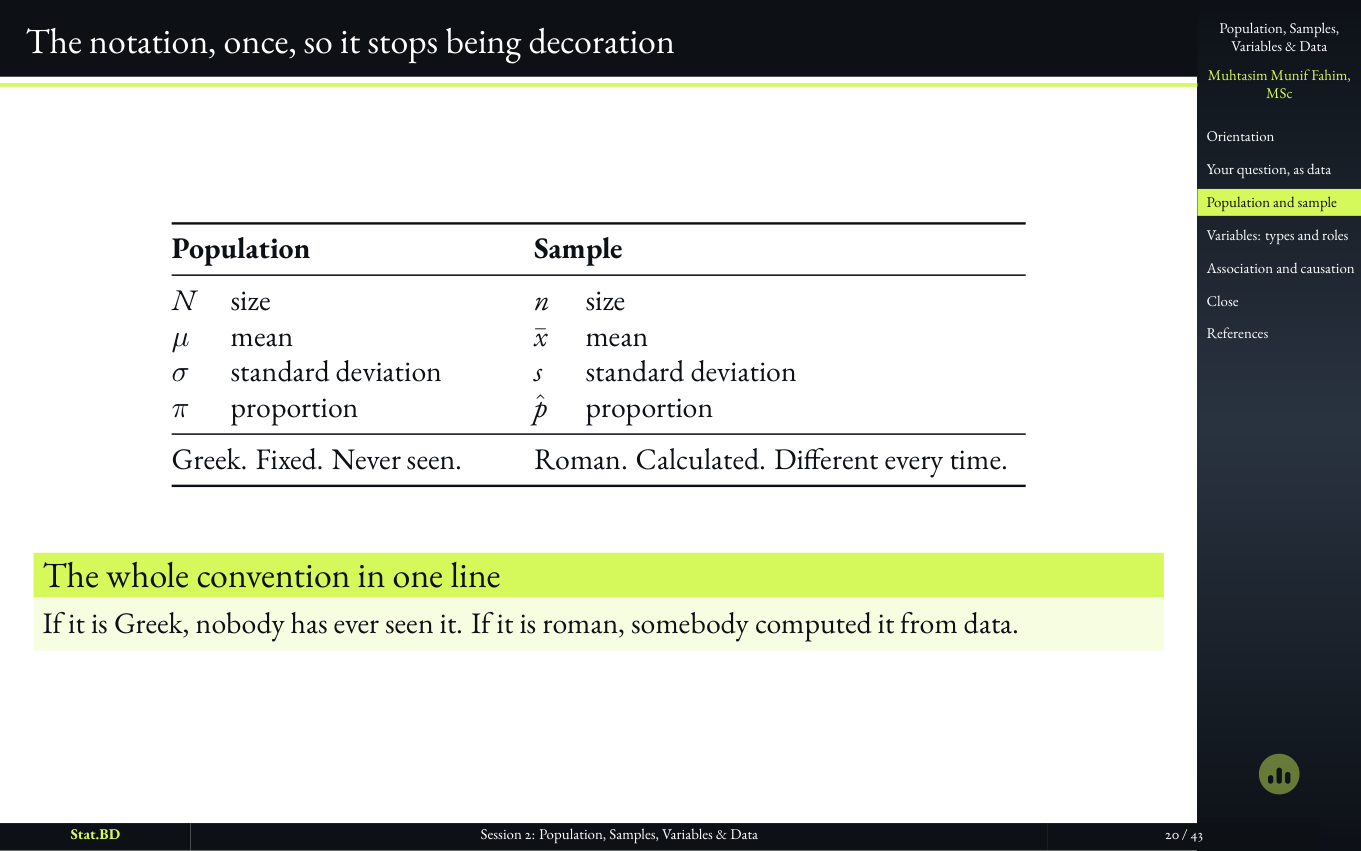
  10. Session 2, Act II · Who the study is actually about: The notation, once, so it stops being decoration.

    Slide 20

    The notation, once, so it stops being decoration

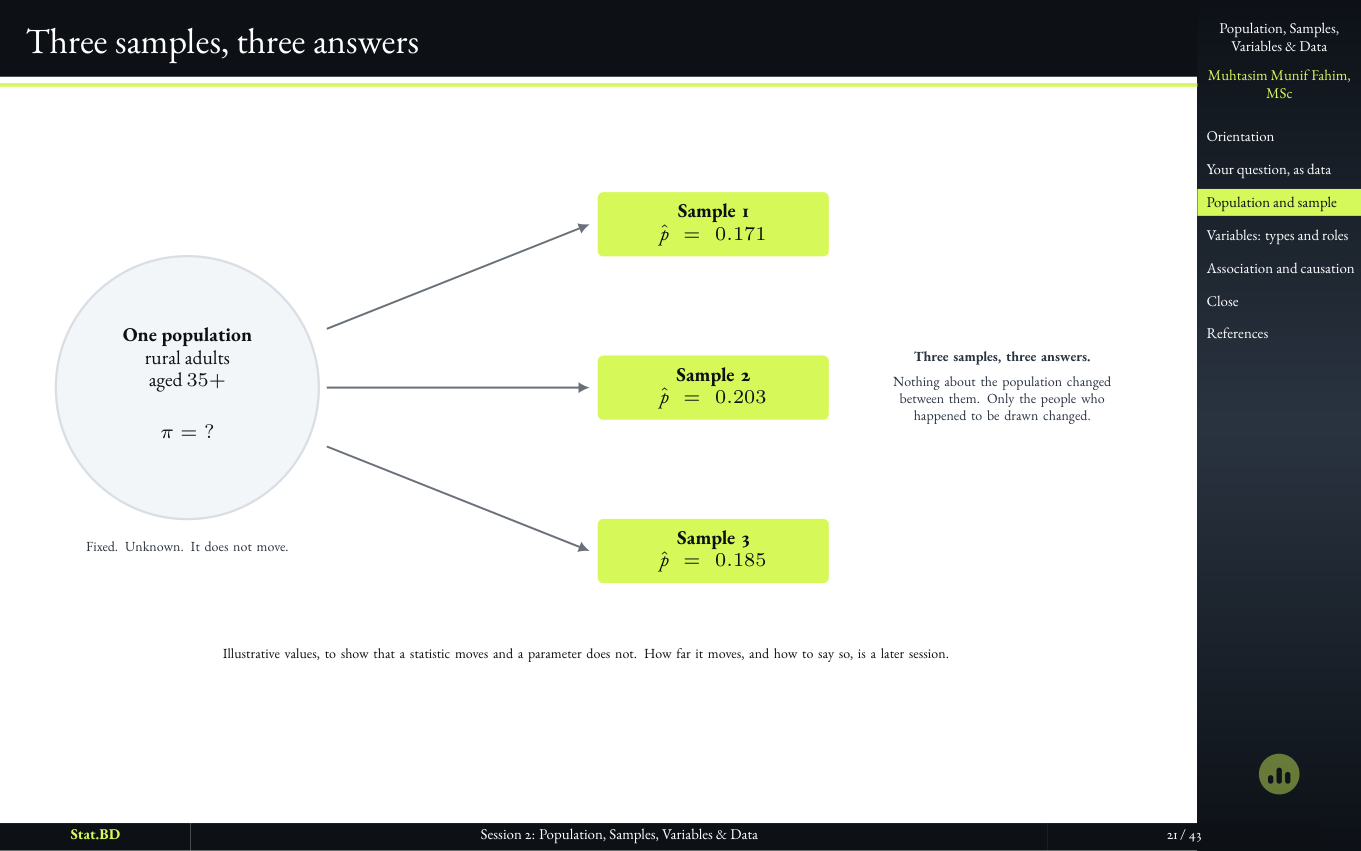
  11. Session 2, Act II · Who the study is actually about: Three samples, three answers.

    Slide 21

    Three samples, three answers

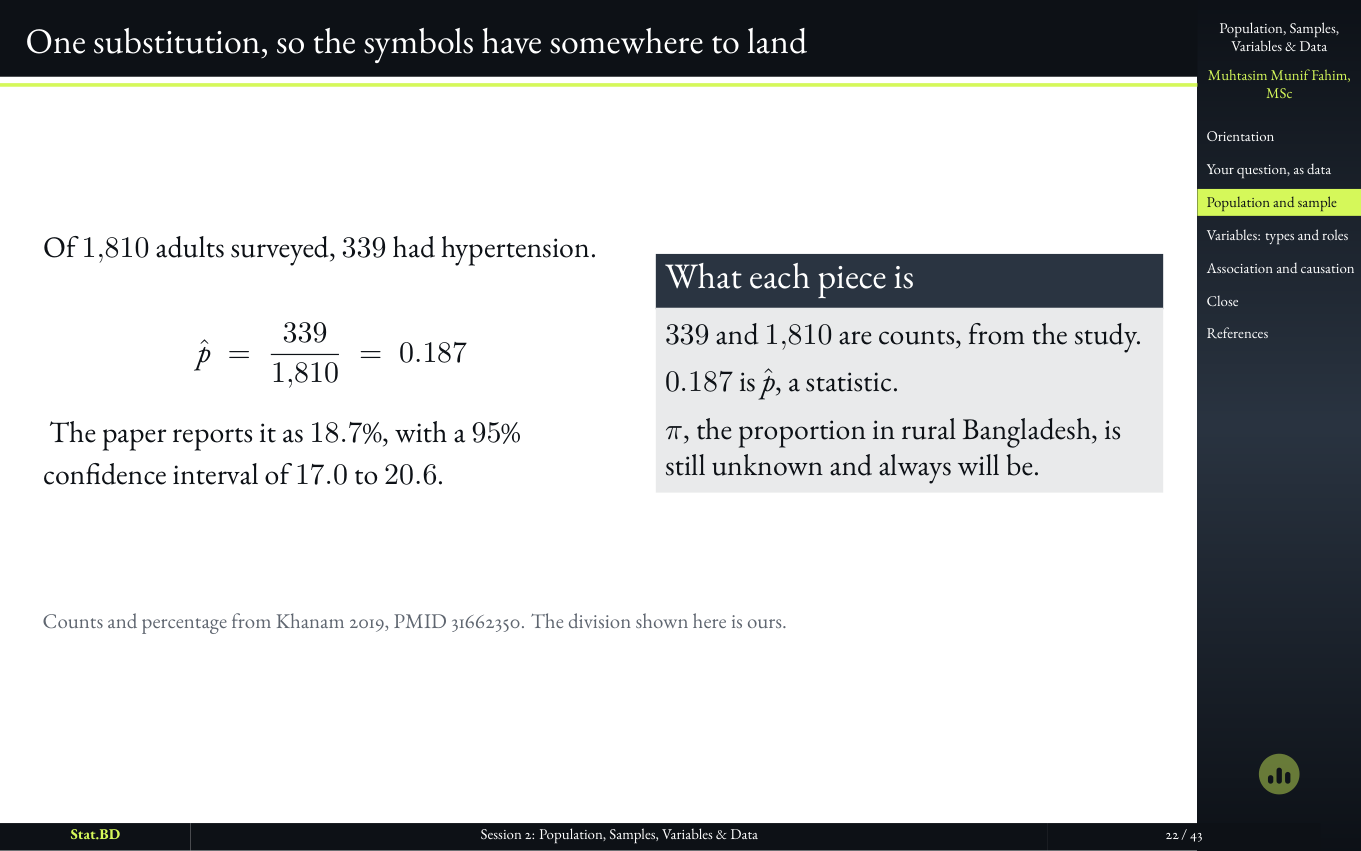
  12. Session 2, Act II · Who the study is actually about: One substitution, so the symbols have somewhere to land.

    Slide 22

    One substitution, so the symbols have somewhere to land

12 slides

Act III · What Kind of Thing Is This Column, and What Job Does It Do?
  1. Session 2, Act III · What kind of thing is this column, and what job does it do?: Act III · What kind of thing is this column, and what job does it do?.

    Slide 23

    Act III · What Kind of Thing Is This Column, and What Job Does It Do?
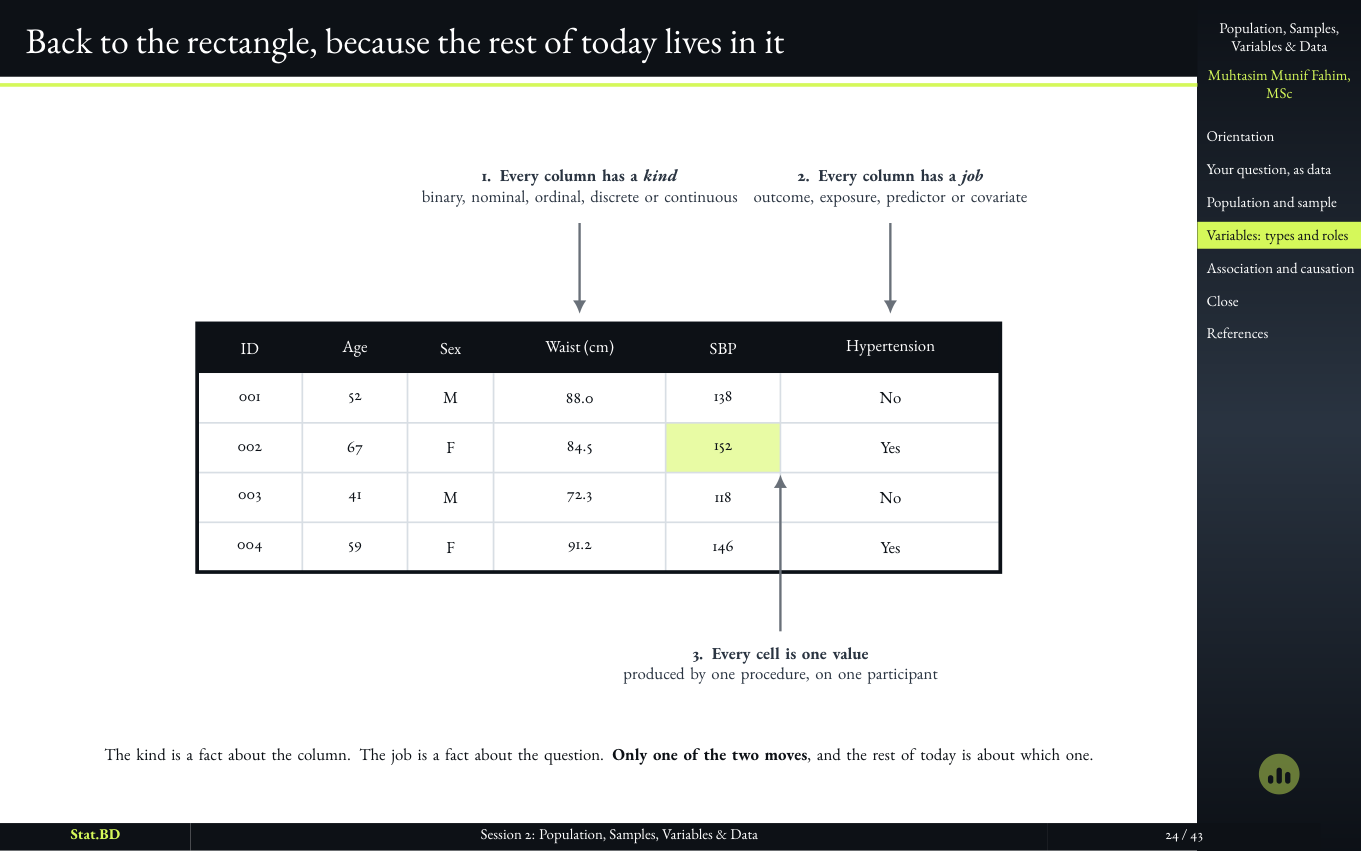
  2. Session 2, Act III · What kind of thing is this column, and what job does it do?: Back to the rectangle, because the rest of today lives in it.

    Slide 24

    Back to the rectangle, because the rest of today lives in it

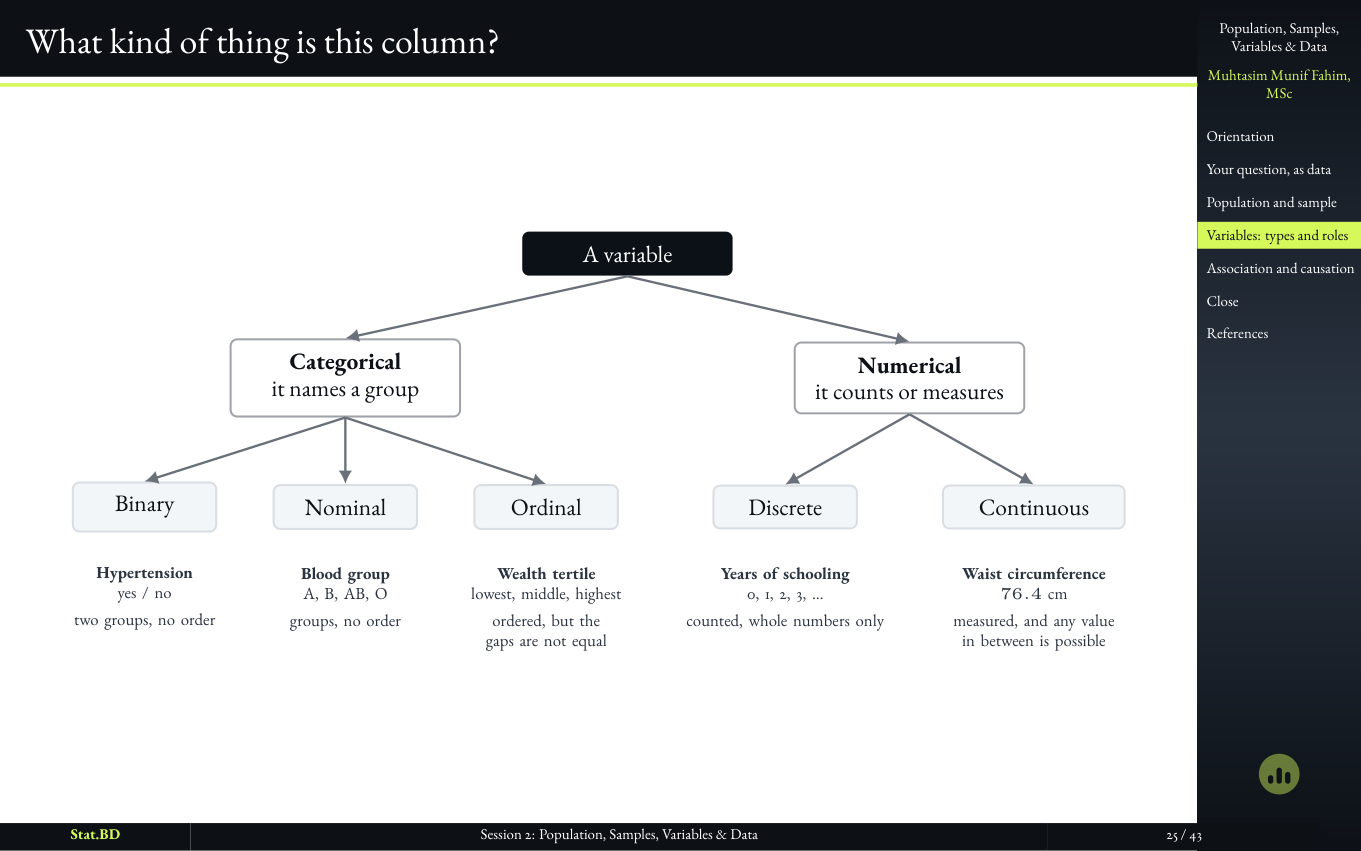
  3. Session 2, Act III · What kind of thing is this column, and what job does it do?: What kind of thing is this column?.

    Slide 25

    What kind of thing is this column?

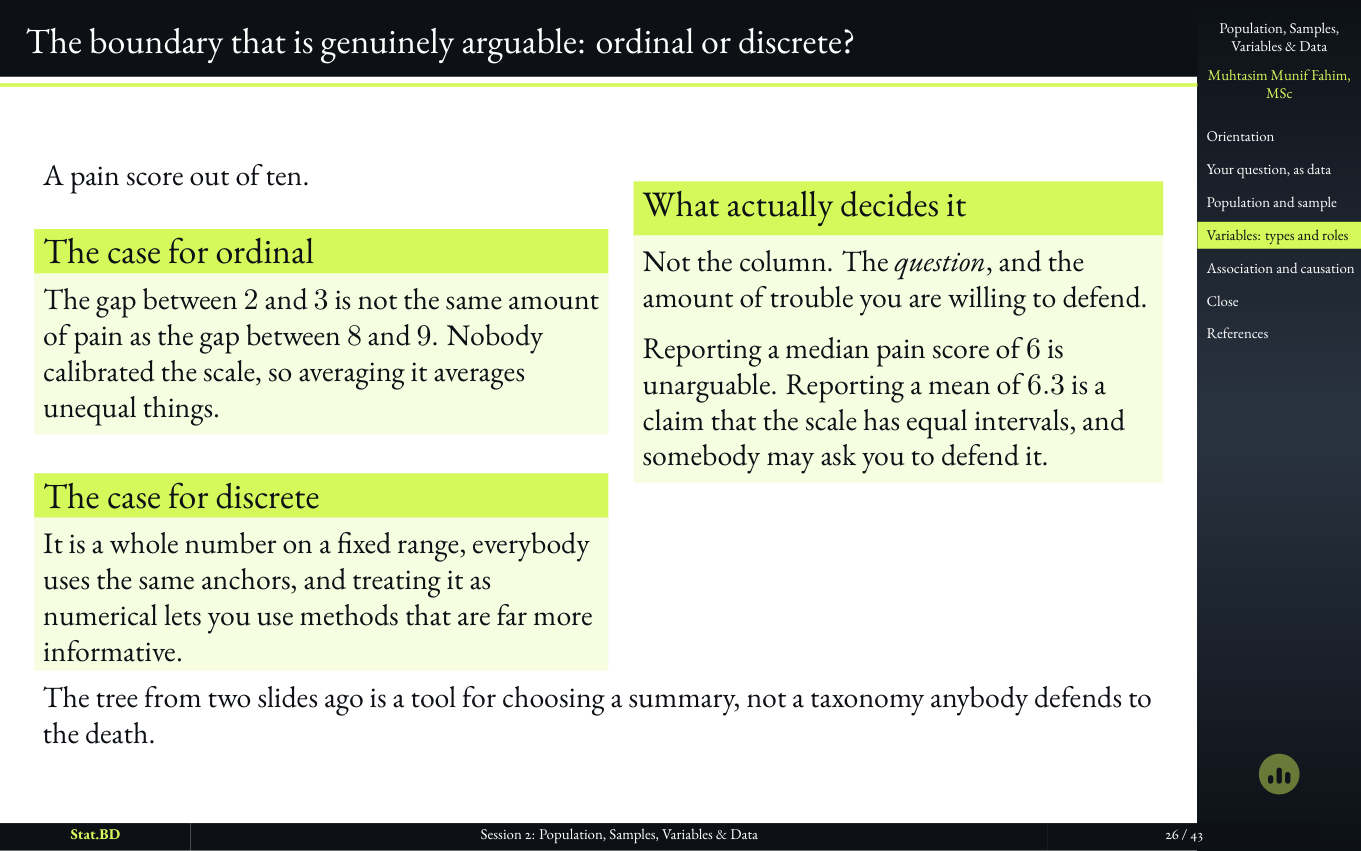
  4. Session 2, Act III · What kind of thing is this column, and what job does it do?: The boundary that is genuinely arguable: ordinal or discrete?.

    Slide 26

    The boundary that is genuinely arguable: ordinal or discrete?

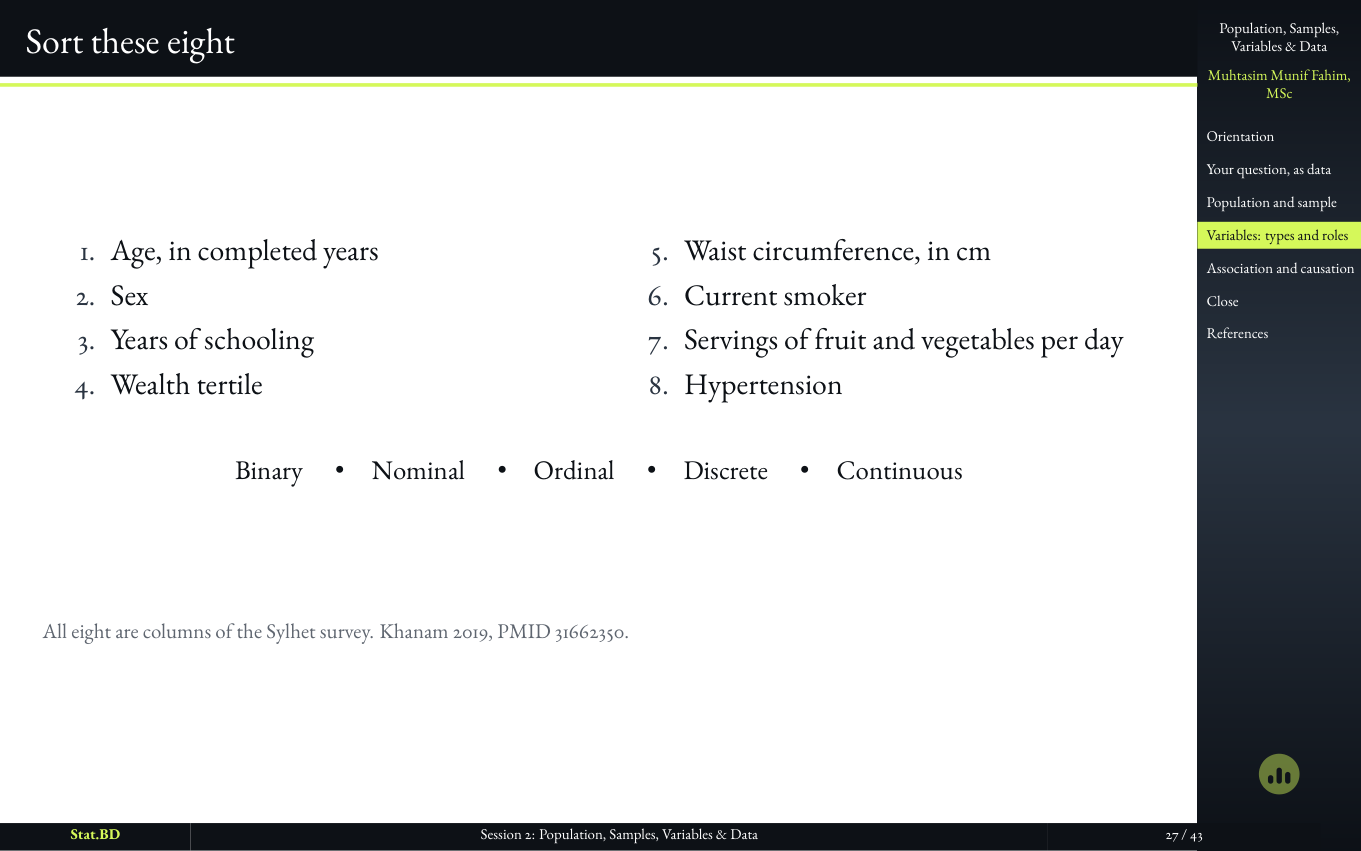
  5. Session 2, Act III · What kind of thing is this column, and what job does it do?: Sort these eight.

    Slide 27

    Sort these eight

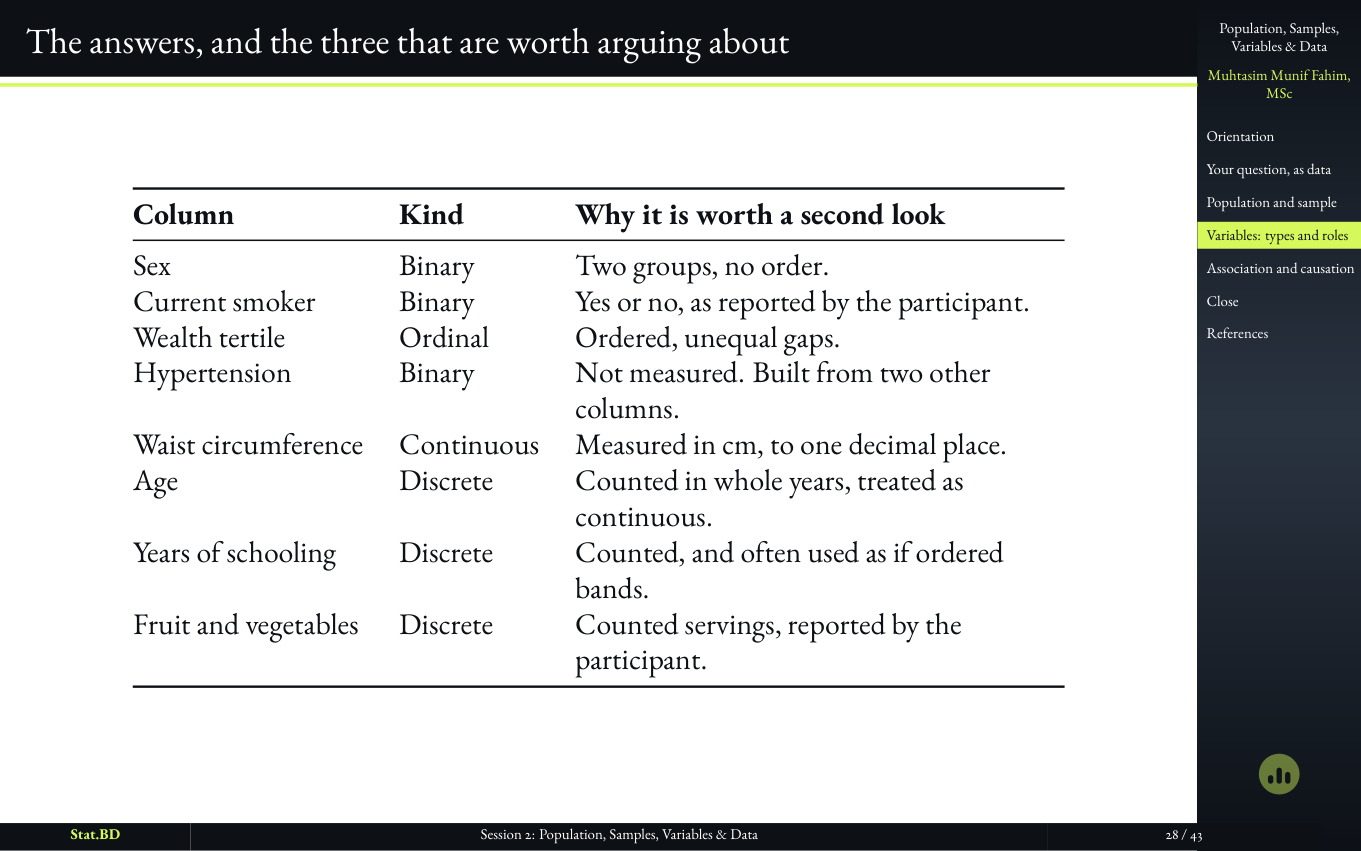
  6. Session 2, Act III · What kind of thing is this column, and what job does it do?: The answers, and the three that are worth arguing about.

    Slide 28

    The answers, and the three that are worth arguing about

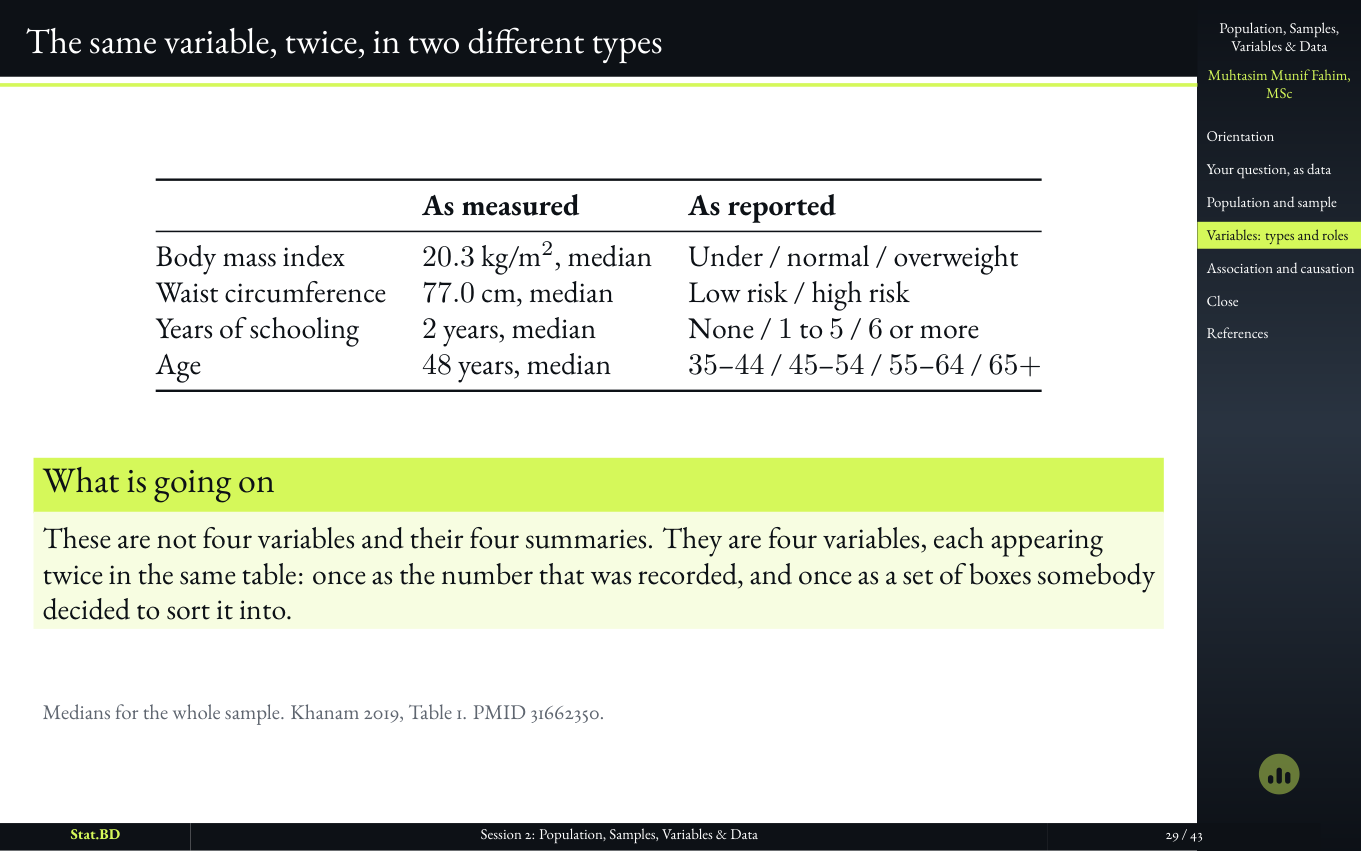
  7. Session 2, Act III · What kind of thing is this column, and what job does it do?: The same variable, twice, in two different types.

    Slide 29

    The same variable, twice, in two different types

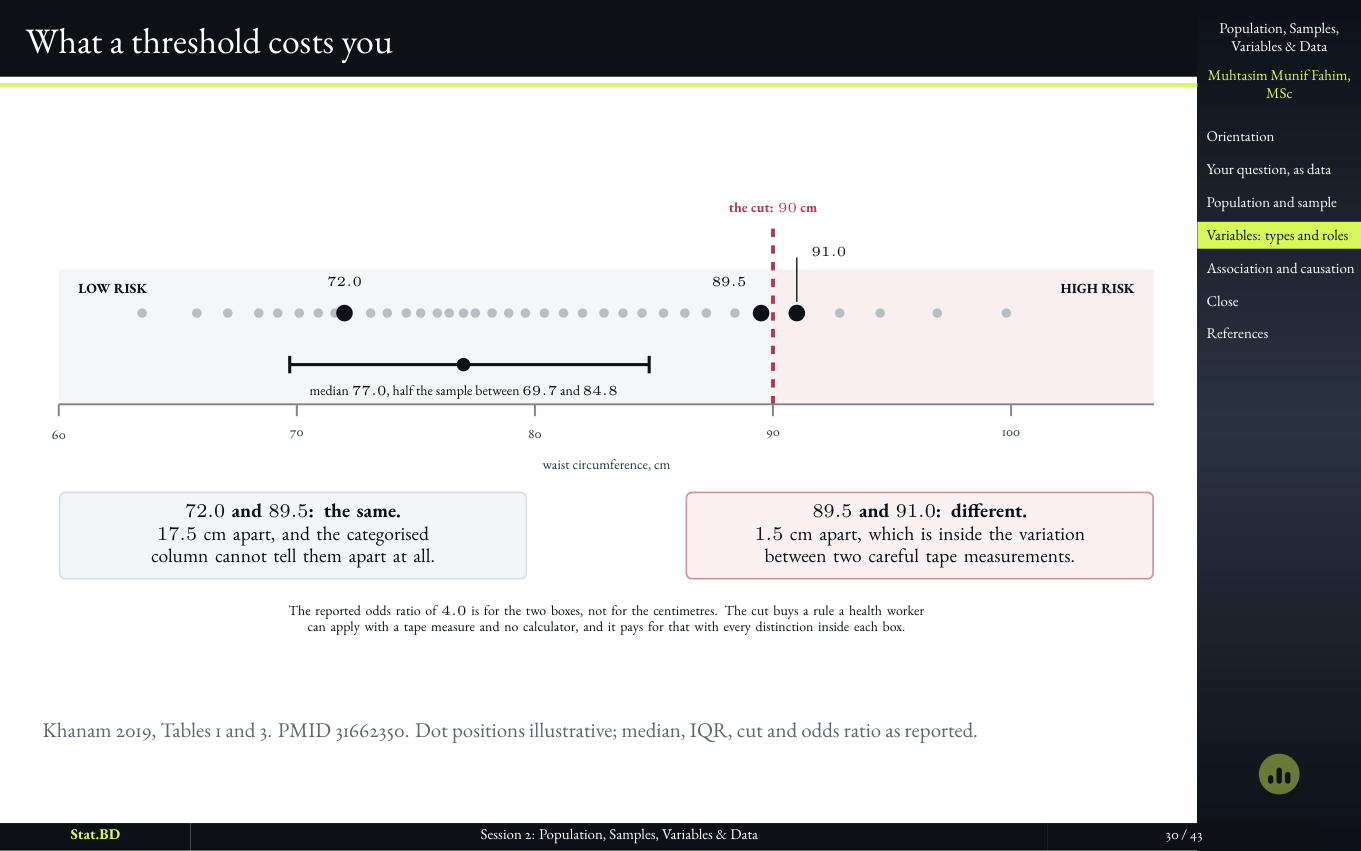
  8. Session 2, Act III · What kind of thing is this column, and what job does it do?: What a threshold costs you.

    Slide 30

    What a threshold costs you

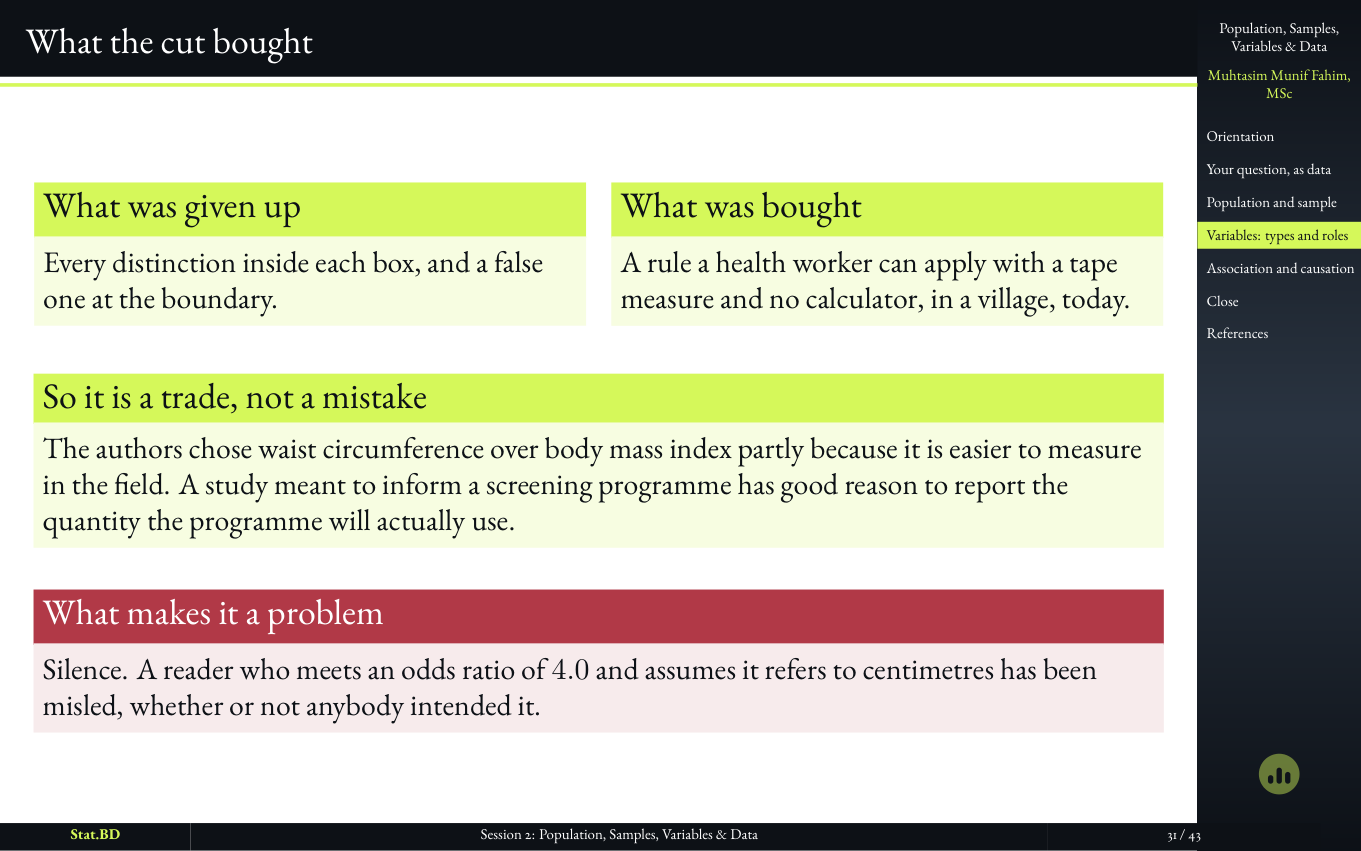
  9. Session 2, Act III · What kind of thing is this column, and what job does it do?: What the cut bought.

    Slide 31

    What the cut bought

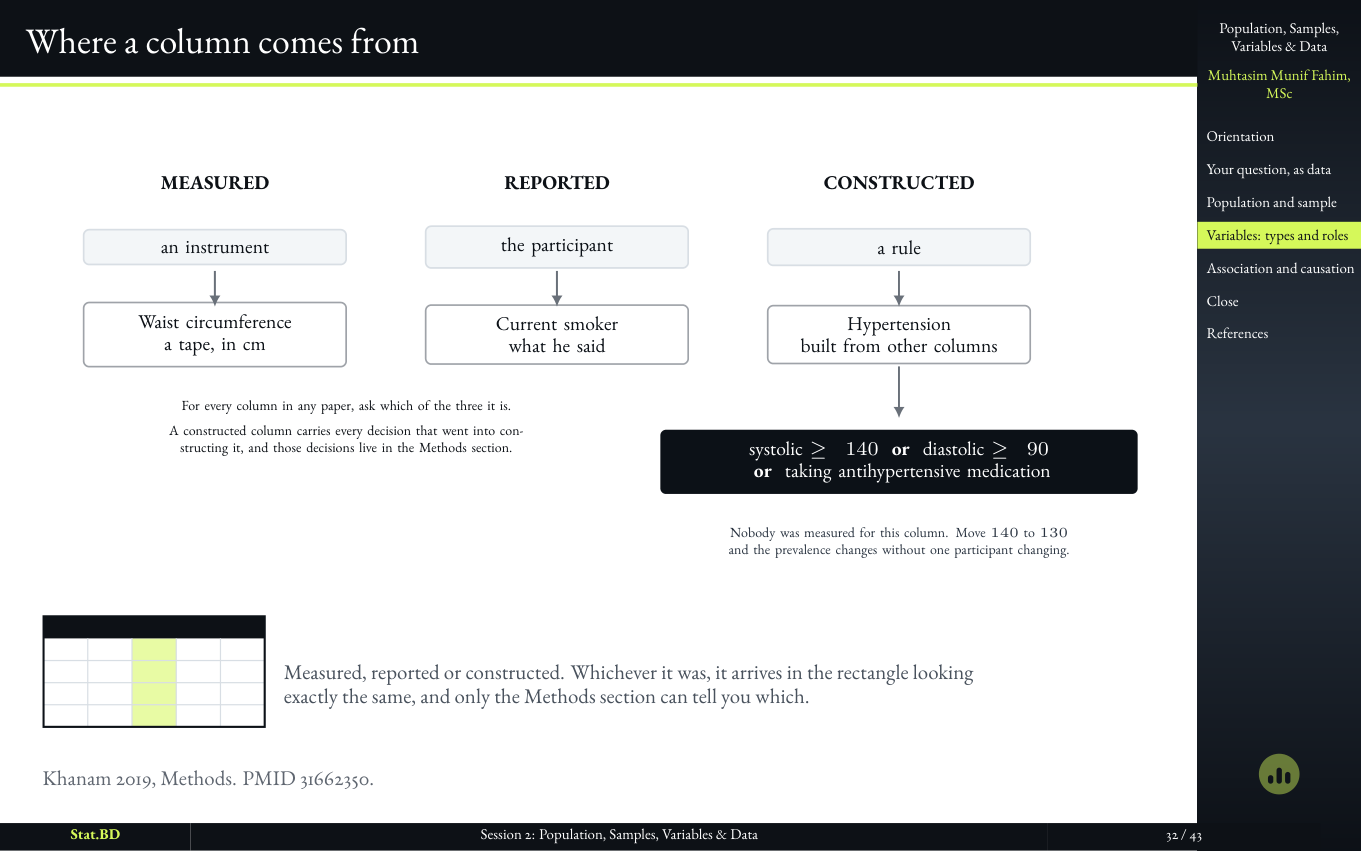
  10. Session 2, Act III · What kind of thing is this column, and what job does it do?: Where a column comes from.

    Slide 32

    Where a column comes from

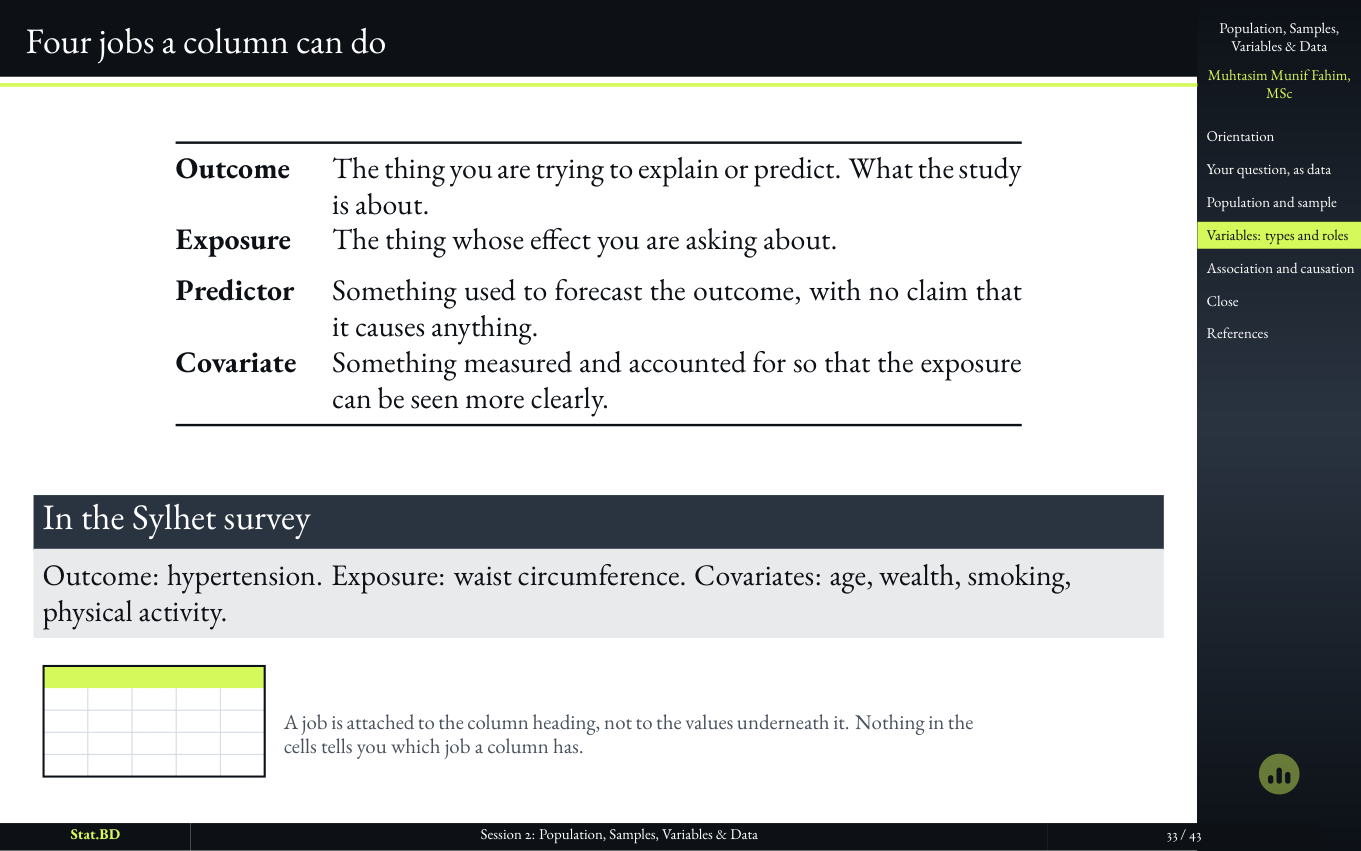
  11. Slide listing four jobs a column can do in a study.

    Slide 33

    Four jobs a column can do

    Outcome, exposure or predictor, confounder, and descriptor. The same blood-pressure column can do more than one job in two different papers. The job is a decision, not a property of the variable.

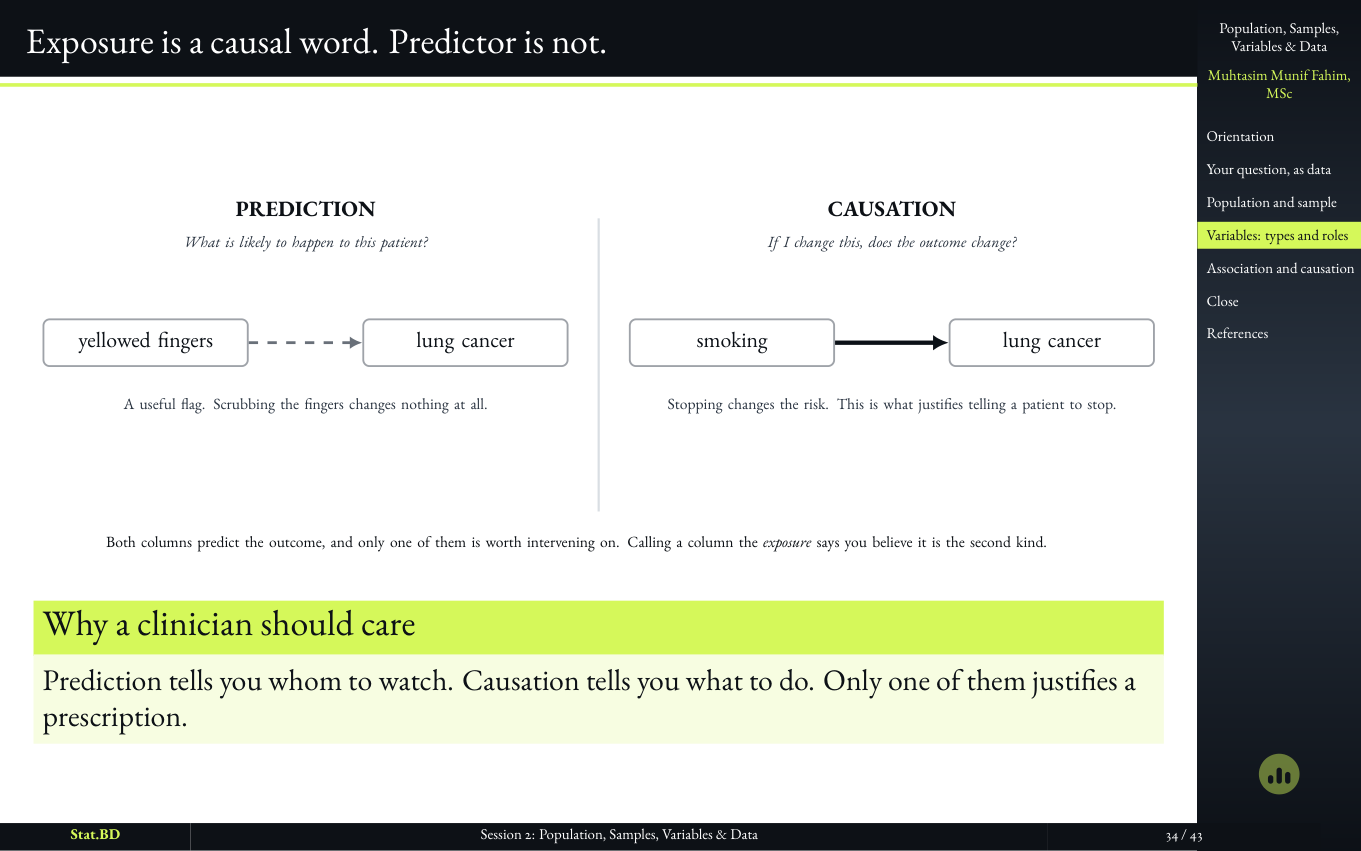
  12. Slide stating that exposure is a causal word and predictor is not.

    Slide 34

    Exposure is a causal word. Predictor is not.

    Calling a column an exposure is already a claim about the world. Calling it a predictor is not. The session makes that distinction early so later regression language cannot hide it.

5 slides

Act IV · The Role Is Not in the Column. It Is in the Question.
  1. Session 2, Act IV · The role is not in the column. It is in the question.: Act IV · The role is not in the column. It is in the question..

    Slide 35

    Act IV · The Role Is Not in the Column. It Is in the Question.
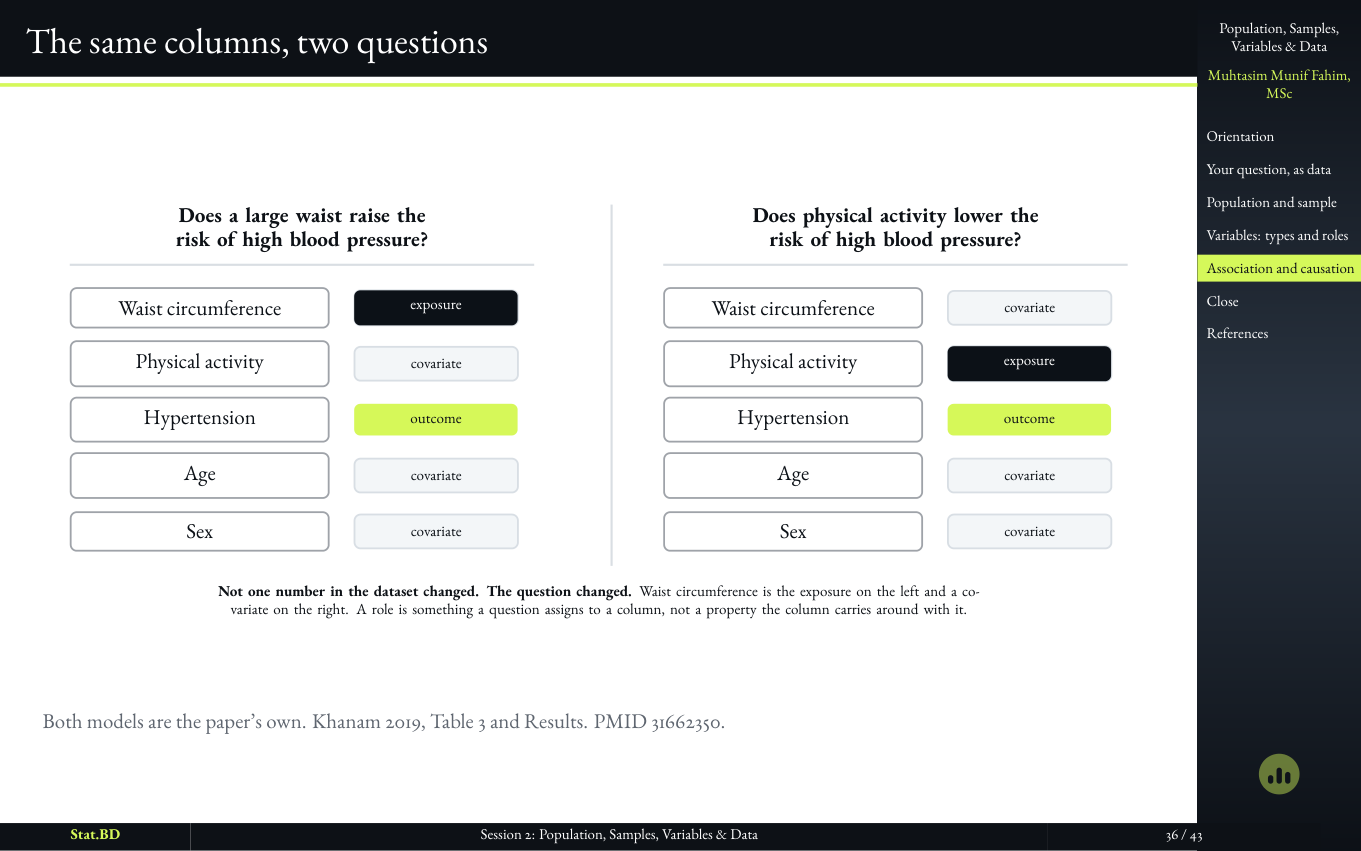
  2. Session 2, Act IV · The role is not in the column. It is in the question.: The same columns, two questions.

    Slide 36

    The same columns, two questions

  3. Session 2, Act IV · The role is not in the column. It is in the question.: Association, and what it is not.

    Slide 37

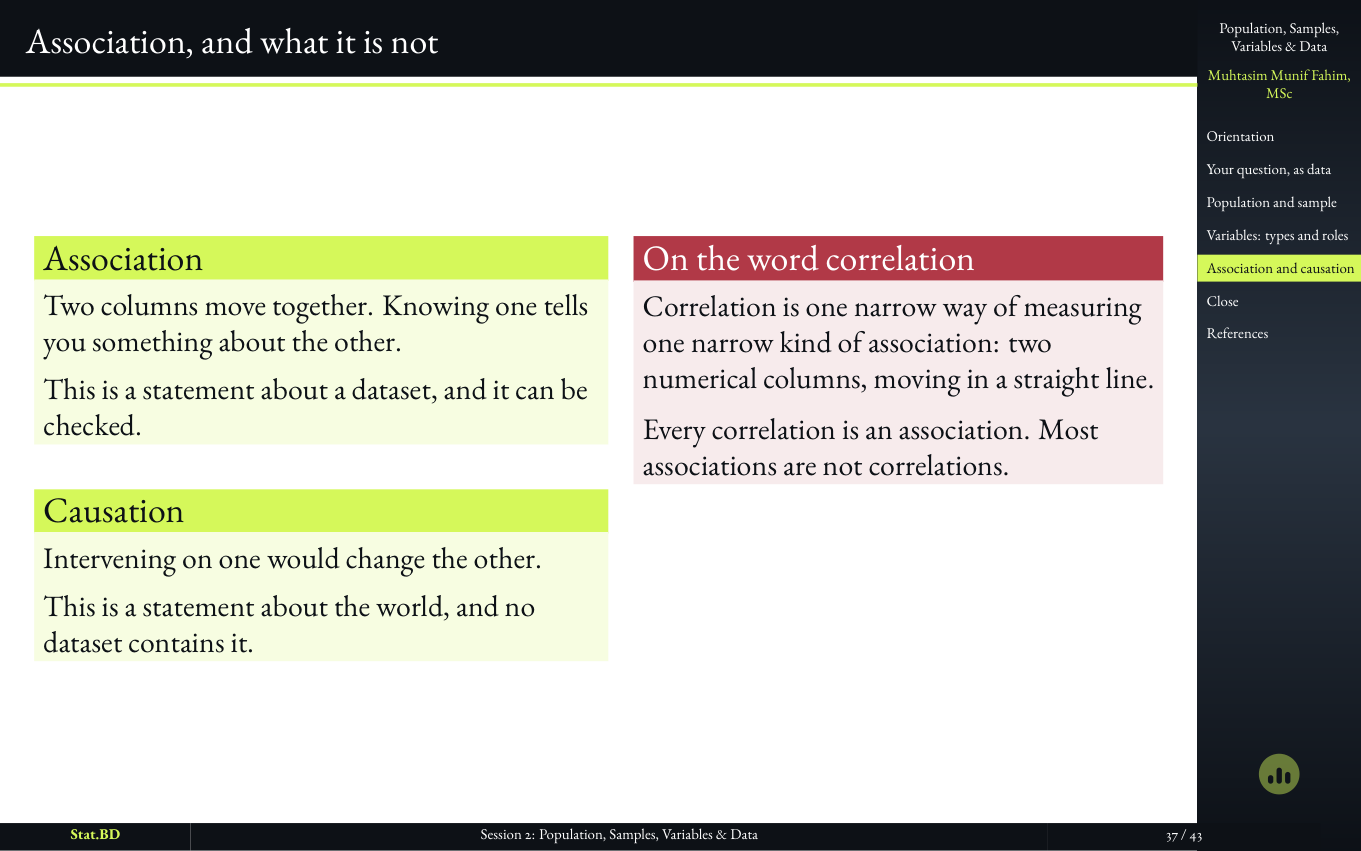
    Association, and what it is not

  4. Session 2, Act IV · The role is not in the column. It is in the question.: Four reasons two columns move together.

    Slide 38

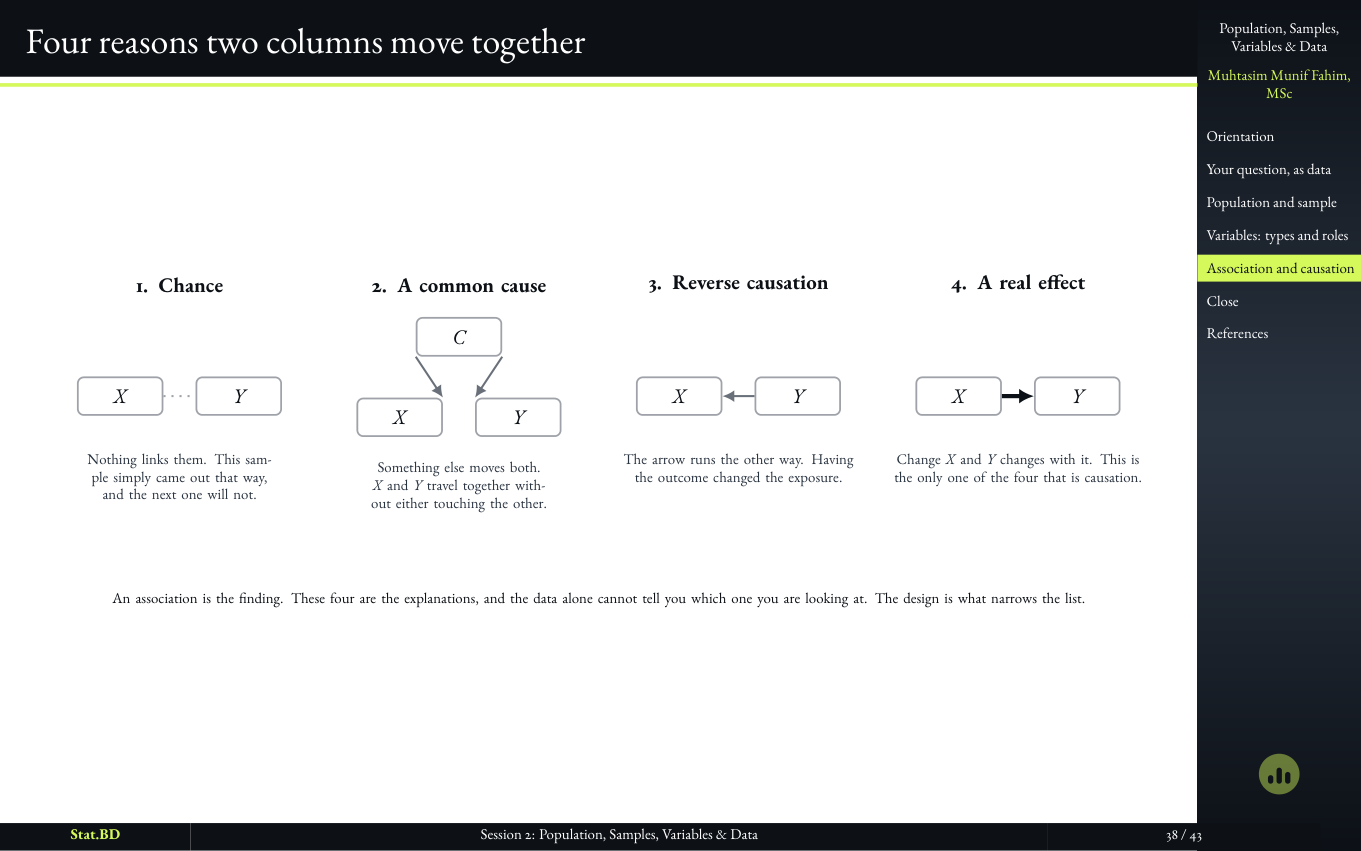
    Four reasons two columns move together

  5. Slide showing an association in which smoking appears protective for hypertension.

    Slide 39

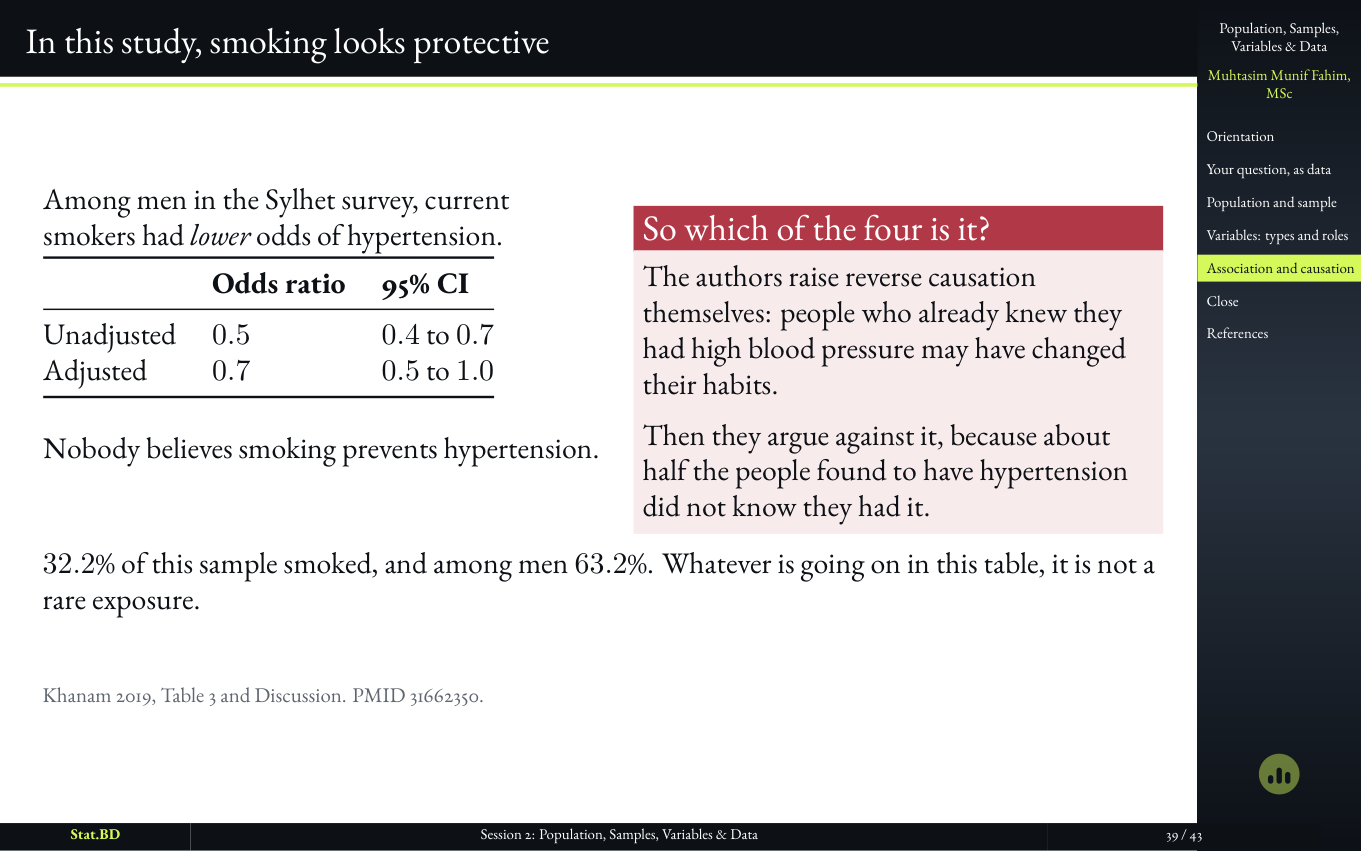
    In this study, smoking looks protective

    Among men in the Sylhet survey, current smokers had lower odds of hypertension. Nobody in the room believes smoking prevents high blood pressure. The point is the habit: an association is not a cause, and a paper that looks surprising is where the four reasons two columns move together become useful.

4 slides

Close

  1. Session 2, Close: Close.

    Slide 40

    Close

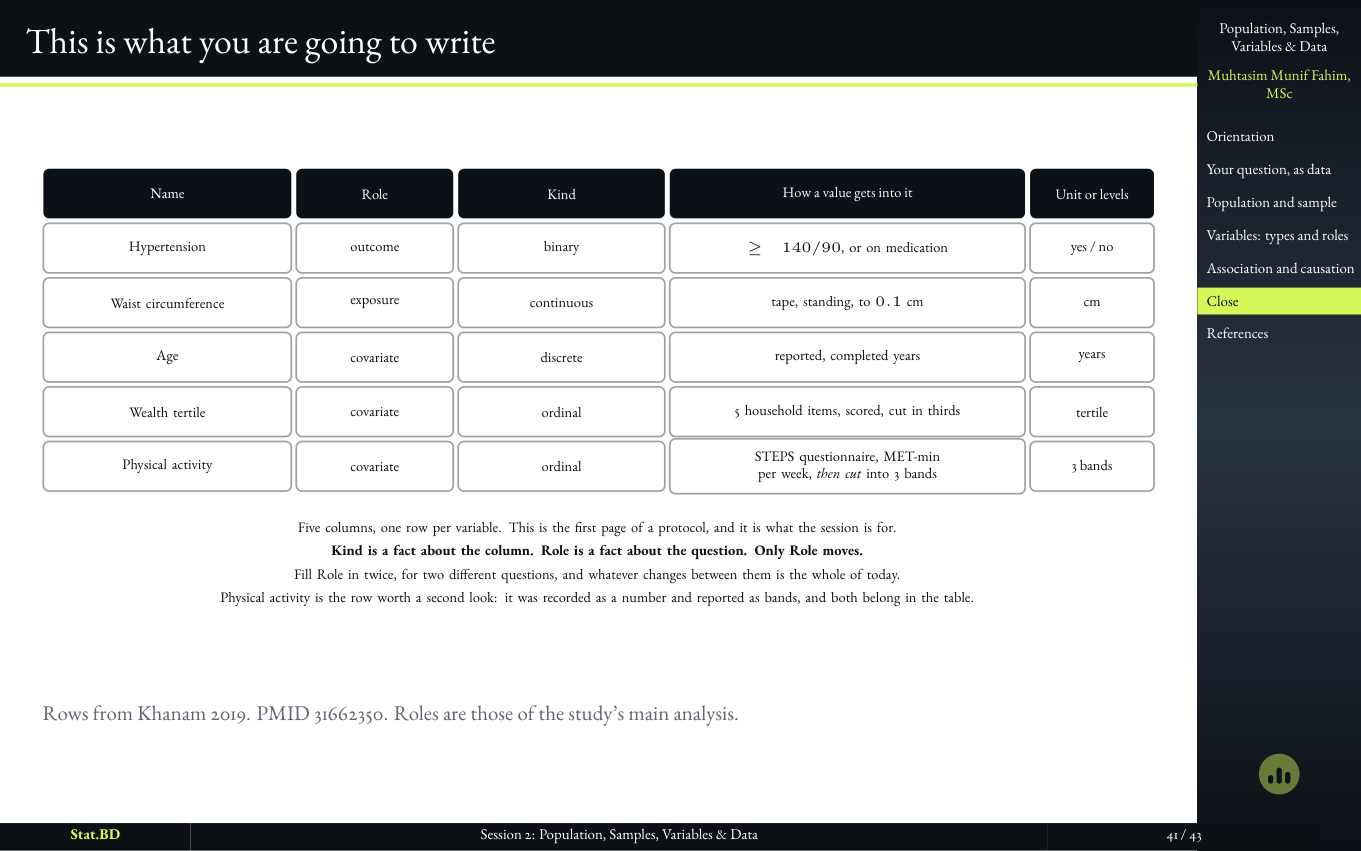
  2. Session 2, Close: This is what you are going to write.

    Slide 41

    This is what you are going to write

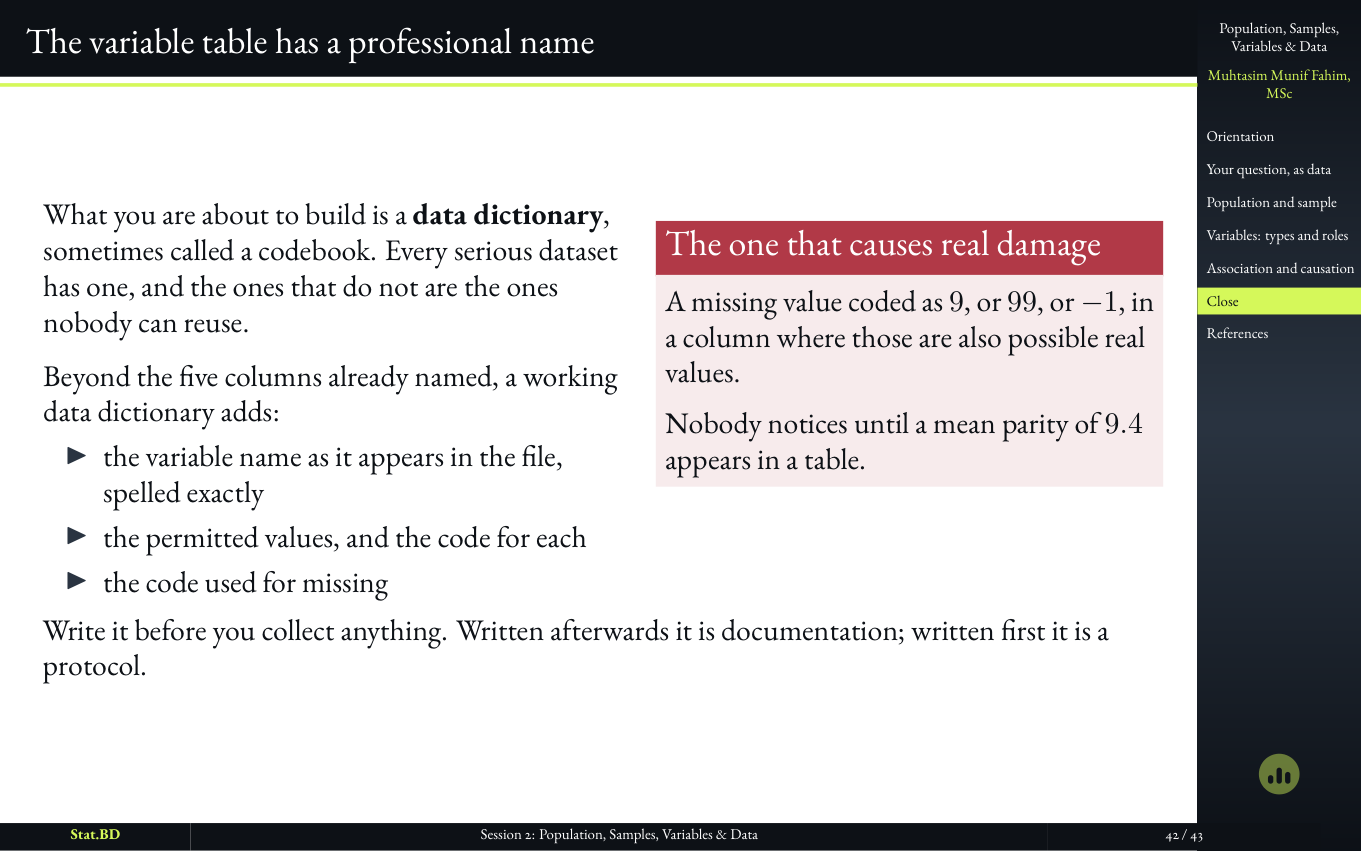
  3. Session 2, Close: The variable table has a professional name.

    Slide 42

    The variable table has a professional name

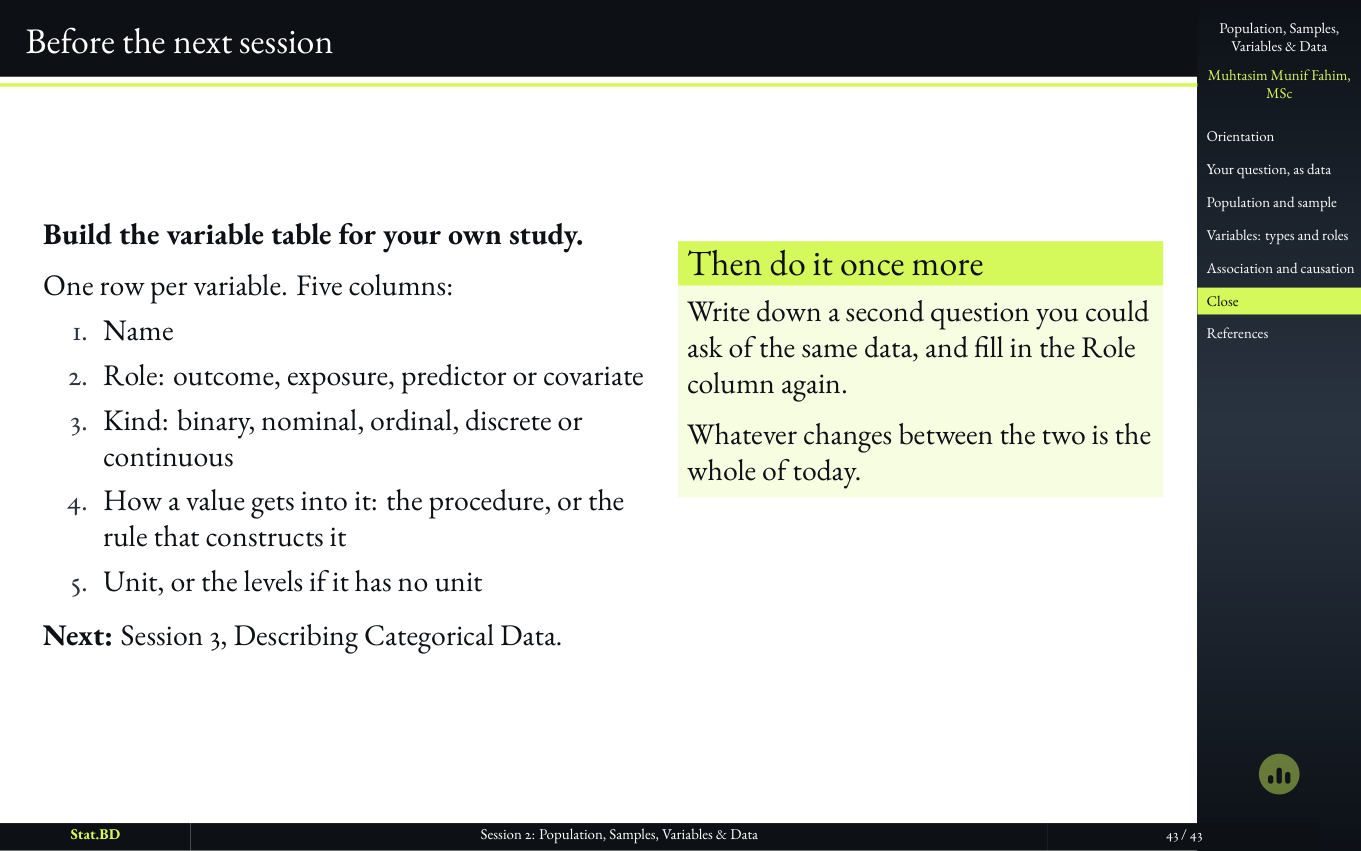
  4. Session 2, Close: Before the next session.

    Slide 43

    Before the next session

Named and stopped

What We Deliberately Did Not Teach Yet.

  • How large a sample needs to be (Session 17).
  • Selection bias and sampling frames (Sessions 15 and 16).
  • Correlation and regression (Session 24).

Next session

Session 3: Describing Categorical Data

The next class is already up. Or request a plan built around your own question.